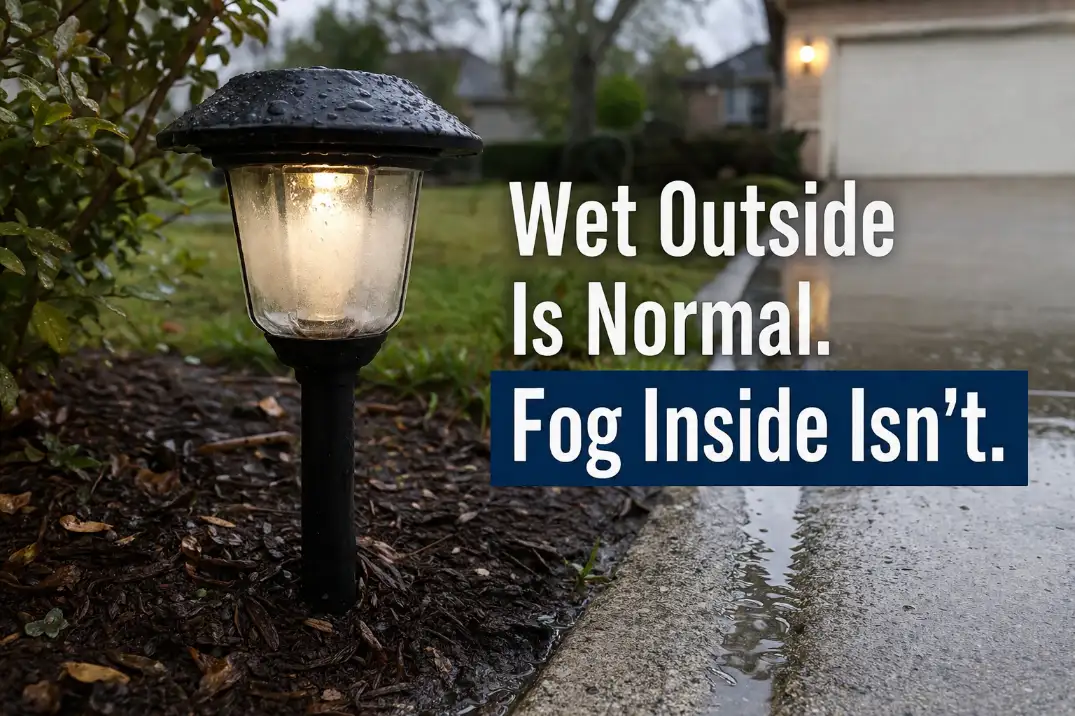
Moisture exposure in driveway lighting usually becomes a problem at one of three places: the fixture seal, the buried splice, or the low point where driveway runoff collects. Start with the pattern, not the bulb.
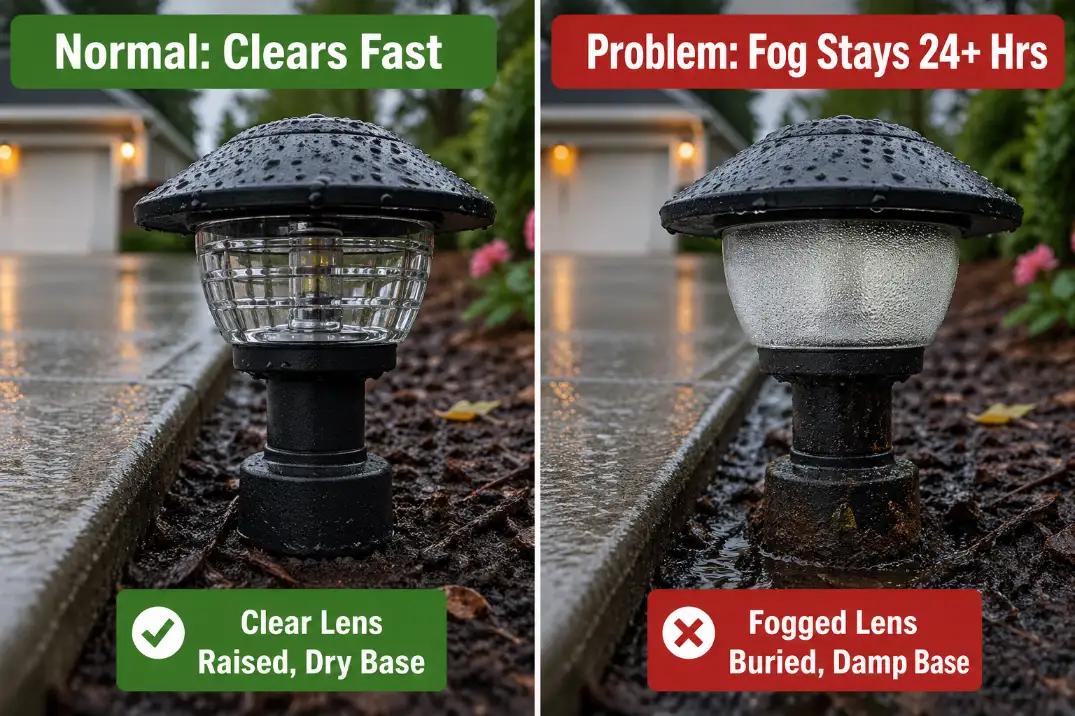
If light fog clears from the lens within 30–90 minutes, it may be normal condensation. If droplets, streaking, corrosion, or cloudy glass remain more than 24 hours after dry weather returns, water is being trapped where it should not be.
Before replacing a fixture, check whether one light, one run, or the whole system failed. One bad light often points to a local splice or seal. A whole system outage points more toward the transformer, GFCI, breaker, timer, or photocell.
Replacing lamps may help once, but repeated failure at the same driveway edge usually means moisture is reaching the electrical path.
Quick Diagnostic Checklist
- Lens fog remains longer than 24–48 hours after rain.
- Droplets or streaks appear inside the lens, not just outside it.
- One fixture fails after irrigation, storms, or snowmelt.
- A GFCI trips only during wet weather.
- Mulch, gravel, or soil sits above the fixture’s drain or wire entry.
- The same light fails every 6–18 months while nearby lights keep working.
What People Usually Misread First
A wet fixture is not automatically a failed fixture
Outdoor lights are supposed to get wet. Rain on the housing, dew on the lens, and brief fogging after a cold night are not enough to condemn the fixture. The useful distinction is trapped moisture. Standing droplets, internal streaking, or corrosion around the socket are much more decision-useful than a wet exterior.
Driveway lights also live in a harsher zone than garden path lights. A fixture beside concrete may receive rainfall, tire spray, snow slush, irrigation overspray, and pressure-washer mist. Even a modest 1–2% driveway slope can send runoff toward the same low fixture over and over.
The bulb is usually the wrong suspect
A burned-out lamp is the symptom. The mechanism is often moisture entering through a failed gasket, a buried splice, or a base that stays wet too long. If one driveway light keeps failing while others on the same run stay reliable, the fixture location matters more than the lamp brand.
That is why a driveway light that fails after storms should be compared with broader rain-triggered failures, such as Why Outdoor Lights Fail After Rain, before assuming the lamp itself was defective.
Before You Replace the Fixture
Check the system from broad to narrow
If the entire lighting system is off, do not start by digging around one fixture. Check the GFCI, breaker, transformer, timer, photocell, and any obvious loose plug connection first. A tripped GFCI after rain is a warning that moisture may be reaching the electrical path.
If only one section is out, look at the first failed light on that run. If only one fixture is unreliable, inspect that fixture, its nearby splice, and the ground immediately around it.
If your wall-mounted outdoor light keeps collecting moisture, condensation inside porch light fixtures may be the reason behind the cloudy glass.
Separate low-voltage work from line-voltage risk
Low-voltage landscape lighting is more homeowner-serviceable, especially when the task is clearing mulch, replacing a lamp, or using manufacturer-approved waterproof connectors. Hardwired line-voltage driveway fixtures are different. Repeated GFCI trips, damaged junction boxes, exposed conductors, or water inside a hardwired housing should be handled by a licensed electrician.
Do not keep resetting a GFCI that trips immediately after wet weather. If the same outlet trips only after rain, Outdoor Lights Tripping GFCI Outlets is a better diagnostic direction than repeatedly resetting it and hoping the problem dries out.
Why Driveway Lighting Gets Hit Harder
Wet-rated matters, but it is not a cure-all
Exposed driveway lighting should be rated for wet locations, not merely damp locations. Damp-rated fixtures belong in protected areas, such as covered porches where direct rain and spray are limited. Along a driveway edge, wet-rated is the baseline.
IP ratings can help, too. IP65 or IP66 fixtures may resist dust and water spray better than weaker products. But this is the rating myth: a better rating does not make a fixture immune to standing water, blocked drains, buried bases, or bad splices. Product rating reduces risk; it does not override a poor installation site.
Splash-back beats rainfall
Rain mostly comes from above. Driveway moisture often attacks from the side. Tire spray can throw dirty water several feet, and irrigation heads can push water directly into lens seams or wire exits. Fixtures mounted lower than 12 inches from grade are especially exposed to splash-back.
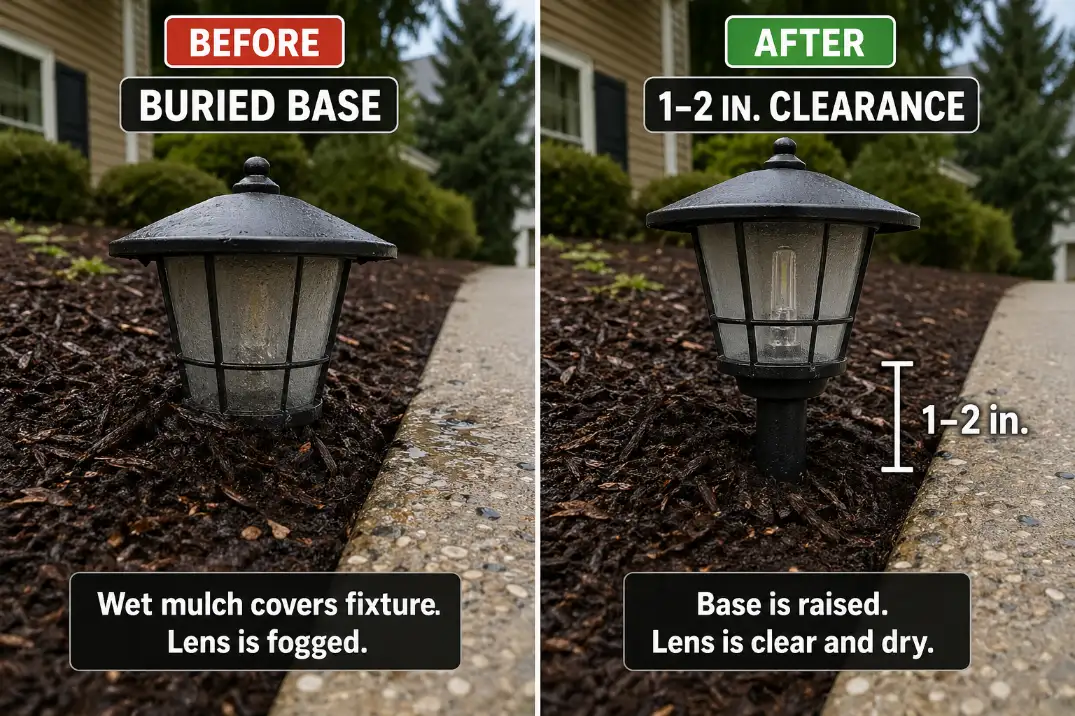
Pro Tip: Keep mulch or gravel at least 1–2 inches below the fixture’s lowest seam or drain point. Raising a light slightly is often more effective than resealing it again.
The Fixes That Actually Change the Outcome
Find the wettest point first
Watch the area during irrigation or after a storm. If water pools around a light for more than 30–60 minutes, the fixture is being asked to survive in standing moisture, not ordinary outdoor exposure. In clay-heavy soil, the base may stay damp for 48 hours after the driveway looks dry.
For lights near sprinklers, the trigger may not be rainfall at all. Sideways spray can hit lens seams and cable exits repeatedly, which is why the failure pattern often overlaps with Sprinkler Spray Damages Outdoor Lights.
Upgrade weak splices before blaming the fixture
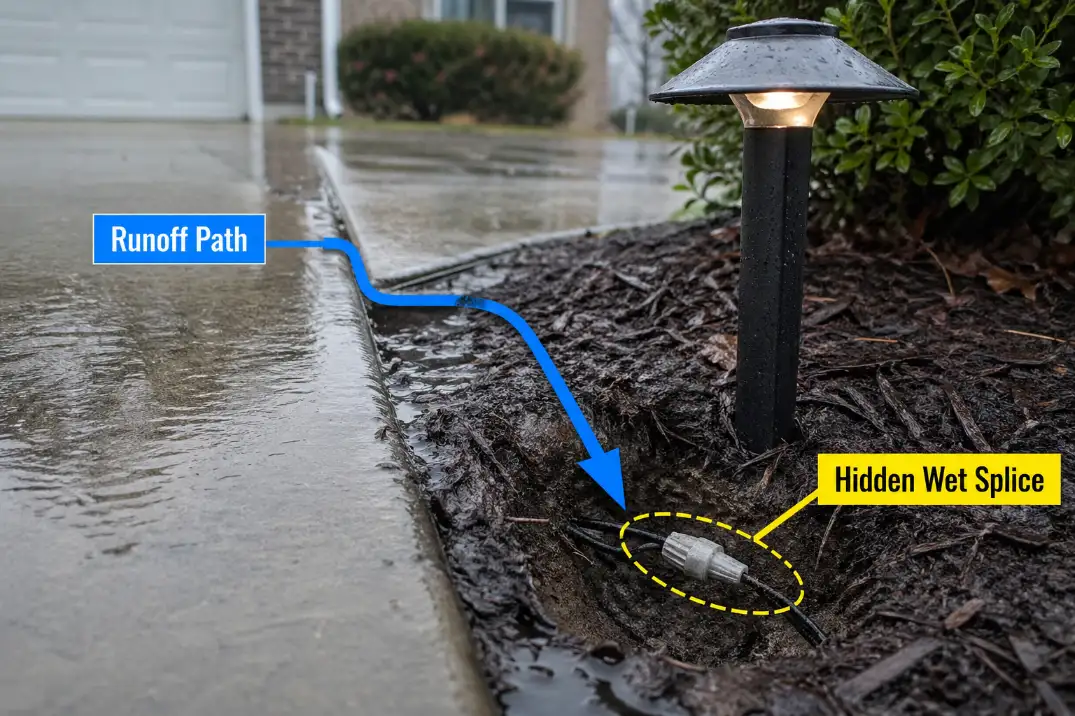
For low-voltage systems, the splice often fails before the fixture head. Tape-wrapped twist connectors are a common weak point outdoors. Replace them with waterproof direct-burial connectors or manufacturer-approved gel-filled splice kits.
| Failure area | Typical clue | What to do first |
|---|---|---|
| Fixture seal | Fogged lens, droplets, internal streaks | Inspect gasket, cap, drain path |
| Buried splice | One light or one run fails after rain | Replace with direct-burial connector |
| Transformer or GFCI | Whole system goes out | Check reset, power, timer, breaker |
| Site runoff | Same low fixture fails repeatedly | Raise, relocate, or improve drainage |
| Rating mismatch | Damp-rated fixture exposed to rain or spray | Replace with wet-rated fixture |
| Blocked base | Corrosion near stem or mounting point | Clear mulch and expose drain area |
When Cleaning and Resealing Stop Making Sense
Caulk can make the problem worse
Caulking every seam feels practical, but it can trap moisture inside and block designed drainage. Outdoor fixtures need to shed and dry, not become sealed containers for damp air. Clean the gasket, tighten the cap, and clear weep points first.
If the socket is corroded, the LED board is stained, or the housing is warped, resealing is mostly delay. A fixture that needs attention twice in one wet season has moved beyond routine maintenance.
Higher-rated fixtures help only after the site is corrected
Buying a better fixture can be worthwhile, but not if the new light goes into the same wet pocket with the same weak splice. The better order is: correct runoff exposure, fix the connector, raise the base, then upgrade the fixture if needed.
When corrosion is already visible at the connection, the repair should focus on the electrical joint, not just the fixture housing. Corroded Wire Splices Outdoors goes deeper into why those small connection points often fail before the light itself does.
What Changes Under Different Conditions
Humid and coastal climates corrode faster
In humid Florida or coastal California, the issue may be constant condensation rather than dramatic flooding. Salt air and high humidity can accelerate corrosion even when the fixture never sits in a puddle. Stainless hardware, sealed connectors, and better air-drying around the base matter more in these settings.
Northern winters stress small leaks
In northern states, freeze-thaw cycles can turn a small leak into a wider gap. Moisture inside the housing expands when it freezes, stressing lens seals and caps. A light that survived summer rain may start failing after winter because the seal has been physically pushed apart.
Driveway cable routes can hide the real fault
Some driveway lighting problems are not inside the fixture at all. If a run loses power near or beyond a driveway crossing, moisture may be reaching a cable route, splice, sleeve, or buried connection that is not visible from above. That is especially likely when multiple fixtures beyond the same point fail together.
In that case, the problem starts to resemble Outdoor Lights Losing Power Under Walkways or Driveways, where the visible outage is downstream from a hidden cable or connection issue.
Practical Repair Order
- Identify whether one fixture, one run, or the whole system failed.
- Check GFCI, breaker, transformer, timer, and photocell before digging.
- Confirm whether moisture is inside the fixture or only outside it.
- Clear mulch, gravel, or soil from the base and drain points.
- Inspect the gasket, cap, socket, housing, and visible corrosion.
- Replace weak low-voltage splices with direct-burial waterproof connectors.
- Raise or relocate fixtures that sit in recurring runoff paths.
- Upgrade damp-rated or low-rated fixtures only after the site problem is corrected.
- Call an electrician for line-voltage fixtures, damaged boxes, exposed conductors, or repeated GFCI trips.
The repair that wastes the most time is repeatedly replacing lamps in the same wet location. The repair that changes the outcome is finding why that location stays wetter than the rest.
For homeowner-friendly electrical safety context beyond lighting placement, see the CPSC guide to GFCIs.