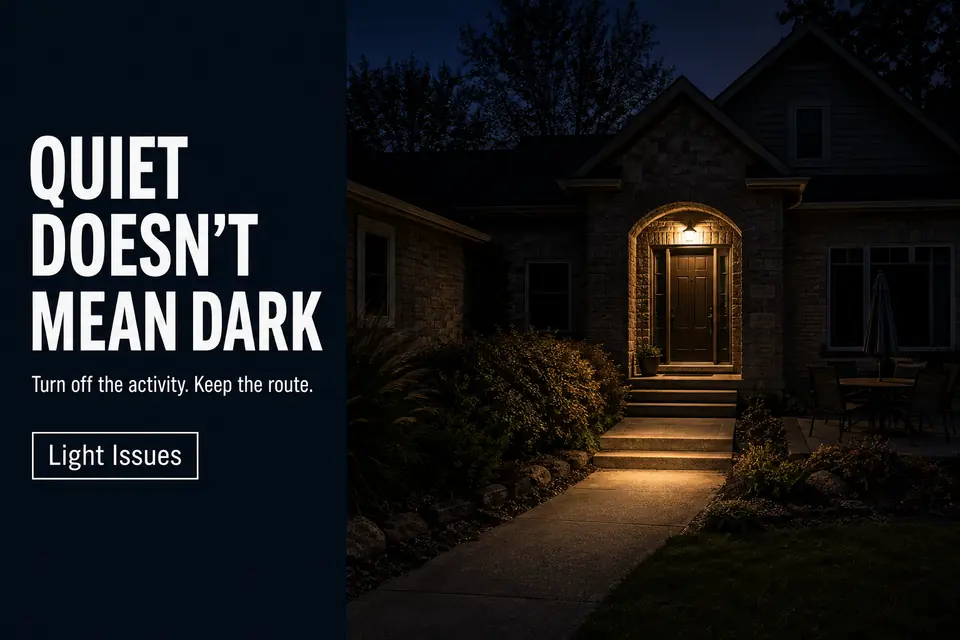
A quiet-hours rule fails when it treats the entire property as one lighting zone. Switch everything off and the yard looks quiet, but the steps, door hardware, and first part of the entry route may disappear.
Leave everything dimmed and the route remains visible, but the patio can still look occupied long after outdoor use ends.
The real decision is not whether the yard should be bright or dark. It is which lights still have a purpose after active use stops.
A practical system moves through three distinct states: active lighting while the yard is in use, a restrained baseline during quiet hours, and a temporary response when movement requires more visibility.
The decisive setting is the one homeowners often overlook: where the lights return after that temporary response ends.
Quiet Hours Purpose
Quiet hours should remove the visual signs of outdoor activity while preserving the smallest useful circulation layer. Different zones therefore need different outcomes rather than one property-wide command.
Dining lights, string lights, pergola fixtures, and decorative landscape accents can normally turn off when outdoor use ends. A door landing, step transition, or beginning of an access path may need to stay visible at a much lower level. A driveway approach or side gate may need no continuous light but can respond temporarily to motion.
The low baseline must be defined before motion overrides are added. Without it, the system has no clear state to restore. A motion timer may simply switch the entry light off, even though the intended overnight condition was a restrained entry level.
A whole-property OFF command is easy to program but can leave a late arrival waiting for a sensor before the route becomes readable. Applying one dimmed setting everywhere causes the opposite problem: recreational zones continue signaling activity despite serving no overnight purpose.
Judge each zone with one question: what does this light still need to accomplish after active use ends? The answer assigns it to one of three outcomes—OFF, low baseline, or temporary motion response.
Household use can determine when this transition occurs, but applicable municipal or HOA requirements still need to be checked separately. A comfortable household schedule does not replace local restrictions.
Low-Level Entry Light
Keep continuous overnight light only where someone needs orientation before motion activates. At an entry, this usually means the door hardware, immediate landing, step edge, and first part of the approach—not the complete yard.
What the baseline needs to reveal
A late arrival should be able to identify the landing and begin the approach without reaching for a phone flashlight. That does not require a bright façade or an uninterrupted row of path lights. It requires controlled light on the surfaces that communicate where to step and where the doorway begins.
The source should remain visually secondary to the route. If the lamp itself dominates the view, lowering its output may still leave an uncomfortable hotspot. Shielding, mounting position, surface reflectance, and fixture distribution all influence how bright the entry appears.

What it does not need to illuminate
The entry baseline does not need to reach the lawn, fence, property line, entire driveway, or patio seating. Those areas can remain dark unless movement creates a temporary reason to illuminate them.
Warm light can make an entry feel less visually active, but color temperature cannot compensate for an exposed or poorly aimed source. The guide to using restrained 2700K light after dark explains that distinction in greater depth.
Do not copy a universal dimming percentage. The same setting may look subdued inside a deep, shielded fixture and glaring through clear glass against pale siding. Set the baseline by observing the real landing and approach after full darkness.
Motion-Only Security
Use motion to borrow temporary visibility, not to replace the quiet baseline with repeated bursts of whole-yard brightness. This works best in zones where continuous output serves little purpose but a genuine approach still needs short-term illumination.
Temporary visibility
A side gate, driveway approach, detached garage door, or exposed rear entrance may fit this role. The activation should cover the route or task that triggered it rather than broadcast across the property.
The duration only needs to let someone approach, unlock the door, or cross the relevant transition without the light expiring midway. Extending it well beyond that task recreates an active-use scene every time the sensor operates.
False activation changes the character of the rule. A fixture responding to branches, passing traffic, pets, or movement beyond the useful zone may be technically motion-only while behaving like intermittent all-night lighting.
That is why motion lights that repeatedly surprise nearby homes require more than a simple timer adjustment.
The return state
The return state owns the success of the automation. If the entry was low before motion, the stronger response should restore that level when the timer expires—not switch the entry completely off.

The common programming mistake is to treat motion as a standalone ON-and-OFF event. During quiet hours, it should be a temporary override of an existing state.
Motion lighting cannot guarantee security or prevent crime. Its useful role here is narrower: it supplies brief task visibility without requiring continuous higher-output lighting.
Neighbor-Safe Settings
A night rule is not genuinely quiet if its source, reflection, or repeated activation remains obvious from the next property. Evaluate the result from likely neighboring sightlines, not only from beneath the fixture.
Check direct source visibility separately from reflected brightness. A beam may stop within the property while pale siding, pavement, or a glossy fence sends a conspicuous hotspot beyond it. Lowering a brightness slider may help, but shielding and aim usually produce a more meaningful change.
Late-night activations should also be narrower and shorter than active-evening lighting. They need enough coverage for the real approach—not enough to announce every passing animal or movement near the street.
Broader neighbor-friendly outdoor-lighting control includes source exposure, aiming, and property-line decisions beyond quiet-hours scheduling. Local ordinances or HOA rules may impose additional requirements, so a comfortable result from inside the yard is not the only test.
Patio Cutoff Time
The patio cutoff should follow the last real use of the patio, not sunset. Sunset begins the active-lighting period; it rarely marks the end of dining, conversation, or outdoor cleanup.
String lights, pergola fixtures, dining lights, and decorative perimeter layers signal continued activity more strongly than one low entry fixture. Leaving all those layers dimmed may still make the yard appear occupied. Turning them off creates a clearer transition into quiet hours.
A scheduled cutoff works for households with a regular routine. When timing varies, a manual “end patio use” scene can remove the recreational layers while preserving the circulation light needed to reach the back door.
This matters when the patio also forms part of the route into the house. The choice is not full entertaining light or complete darkness. Dining and mood layers can switch off while a controlled door landing or step light remains low.
Test the cutoff against dusk schedules, saved scenes, and manual overrides. If another command restores the patio unexpectedly—or prevents the entry baseline from returning—the issue has shifted from timing to outdoor-lighting automations that target the same zone.
Night Rule Test
Test the full transition after darkness, because an app preview cannot show whether a step remains readable, a reflection reaches a neighbor, or the intended baseline returns after motion.
Begin with the normal active-evening state. Trigger quiet hours and observe the property as a whole. Recreational zones should stop looking occupied, essential transitions should remain legible, and no unrelated fixture should stay bright merely because it shares a rule.
Then approach the home as a late arrival would. Walk the essential route without a phone flashlight, trigger the motion response, complete the approach, and wait for the timer to expire.
Use this five-point check:
- Confirm that patio, dining, and decorative zones turn off.
- Verify that the essential entry route remains readable.
- Trigger motion and complete the short route before it expires.
- Wait until the intended low baseline returns.
- Recheck direct and reflected light from neighboring sightlines.
If the sequence fails, change one rule at a time. Altering the cutoff, baseline, motion duration, and scene membership together hides which command owns the wrong result.
The National Park Service’s outdoor-lighting principles similarly recommend limiting outdoor light to the place, time, amount, and purpose for which it is needed.
A successful quiet-hours rule has three recognizable states: active use, low baseline, and temporary response. The yard should lose its signs of activity without losing its necessary route.
Judge the system after motion ends; that final state reveals whether quiet hours were actually designed or merely scheduled.