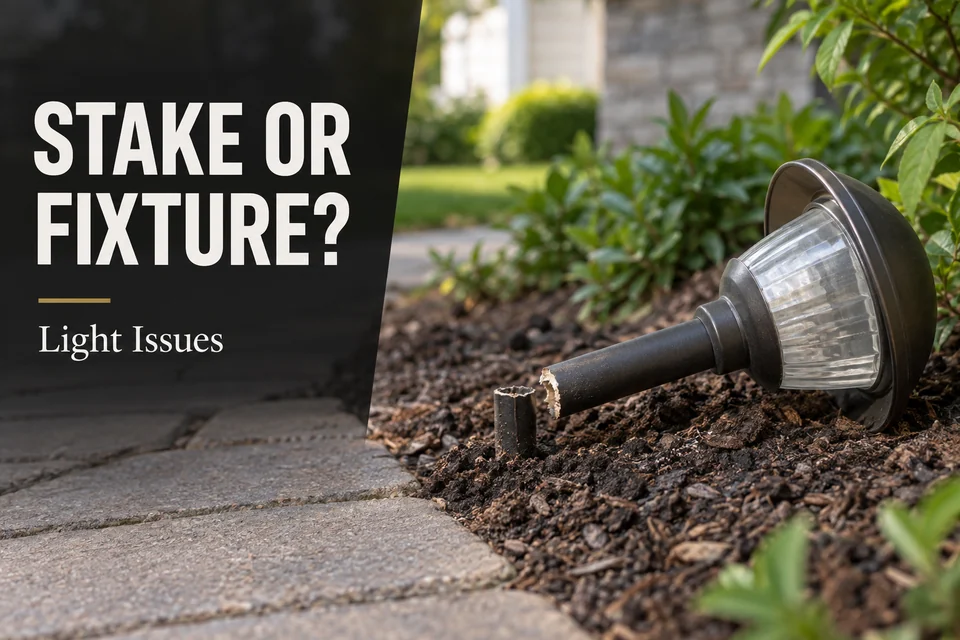
The part that remains attached to the light controls how much you need to replace. A separate broken stake can be replaced when the fixture’s mating attachment remains intact, a compatible part is available, and the fall has not damaged the wiring.
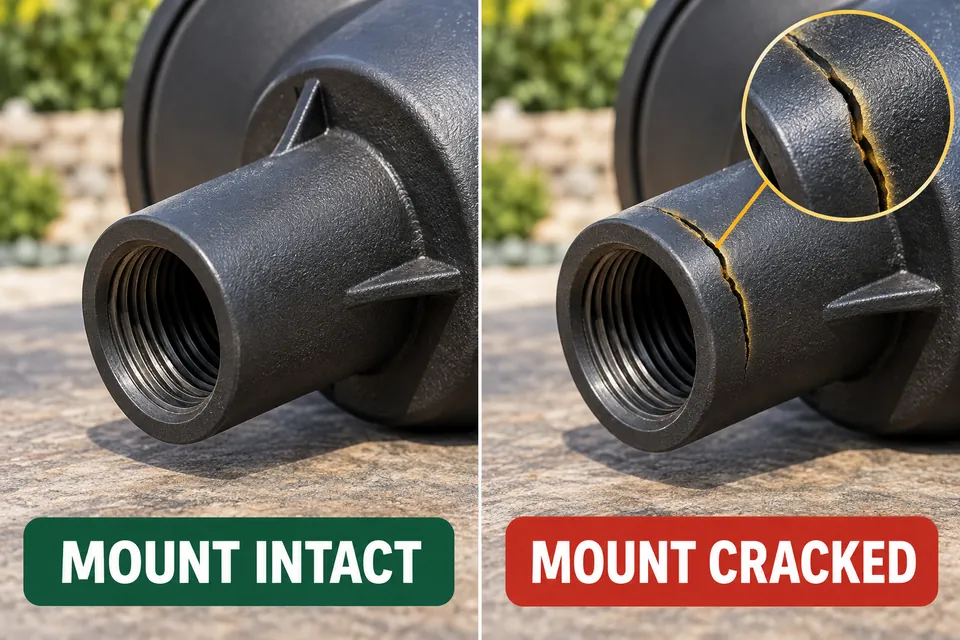
A crack extending into the fixture’s mounting socket or integral stem changes that decision. A new stake cannot restore a damaged attachment, even when the lamp still turns on.
Before handling a wired light, isolate its power supply and support the fixture without pulling its cable. The useful inspection follows the break into the surviving connection: identify what failed, what remains sound, and whether those remaining parts can hold the replacement securely.
Why Stakes Break Where Soil Meets Air
A sideways push against a path light creates leverage above the ground while the buried stake resists movement below it. Stress can concentrate near that transition, leaving the fixture on the ground and part of the stake still embedded.
Compacted soil can make this contrast more pronounced: the buried section stays restrained while a mower wheel, trimmer, foot, or sideways pull moves the fixture above it. Forcing an assembled light into hard ground can also load its support before normal use begins.
Material deterioration may contribute, but the fracture location alone does not prove corrosion, brittle plastic, or mower damage. Look for accompanying clues such as a fresh scrape, a bent stem, or a position directly in the maintenance route.
That distinction affects the replacement. An isolated broken support may need only a compatible part. A new stake installed where the mower still catches the light remains exposed to the same force, regardless of whether its material looks stronger.
Fixture Body vs Replaceable Stake
Confirm that the stake is a separate service part before trying to detach it. The model label, parts diagram, or installation instructions should identify the connection. Some lights use threads, others use a push-fit joint, and some assemblies have little or no separately serviceable support.
Any inspection requiring lifting or rotation must wait until you have checked the cable slack described in the next section.
When the Stake Alone Is Enough
Stake-only replacement fits a fixture whose receiving socket, threads, collar, or mounting boss—the reinforced attachment area—remains intact. The replacement must match the documented connection and preserve the intended wire passage.
Approximate diameter is insufficient. A part may start threading yet fail to seat correctly, or fit around a stem while leaving it free to rotate. Retaining the fixture makes sense only when the connection can achieve its intended engagement without force or improvised packing.
This approach preserves the existing light and usually involves less disturbance. Its limitation is equally clear: it replaces the support, not damage elsewhere in the assembly.
When the Damage Reaches the Fixture
A cracked mounting boss, split socket, or damaged integral stem changes the repair scope. Tightening a new stake into that area does not restore the missing strength.
Check whether the damaged adapter or stem is itself a listed service part. If so, replacing that component may preserve the fixture. If the damaged attachment is integral and nonserviceable, complete fixture replacement becomes the appropriate path.
| Observed condition | Appropriate path | Condition that must be met |
|---|---|---|
| Separate stake broken; fixture attachment intact | Replace the stake | Documented compatible fit and unobstructed wire route |
| Replaceable adapter or stem damaged | Replace the serviceable component | Sound remaining attachment and correct replacement part |
| Integral fixture attachment cracked or split | Replace the fixture | Replacement resolves the damaged structural assembly |
| Cable damaged or supply type uncertain | Assess wiring before proceeding | Electrical damage and supply isolation resolved first |
If damage extends into the housing or other functional parts, the broader decision about repairing or replacing the fixture becomes relevant. Keep that decision tied to the damaged components rather than treating every snapped stake as a reason to discard the light.
Wire Slack Before Lifting the Light
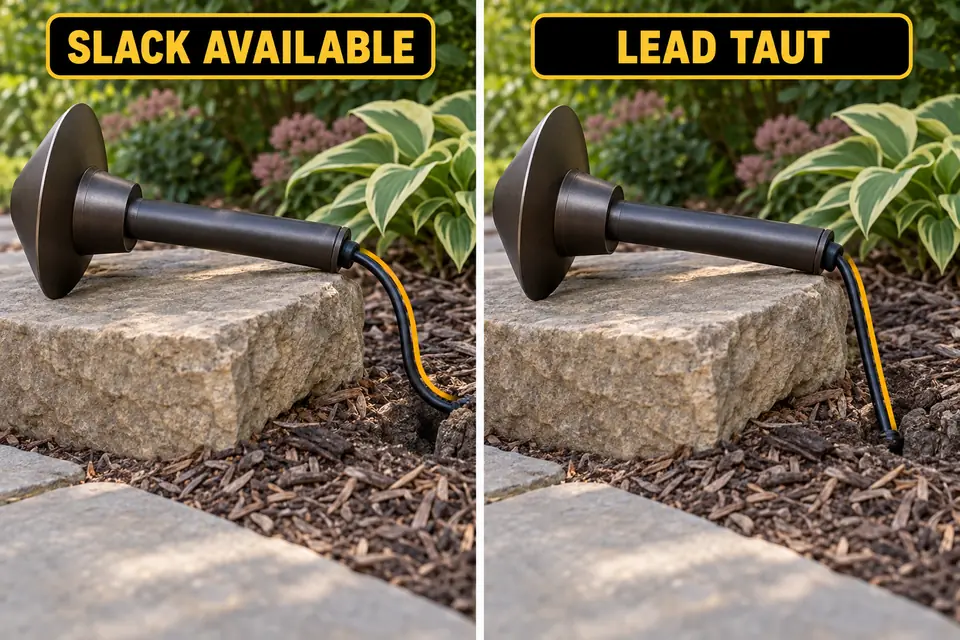
Available cable slack sets the limit on how far you can move a wired fixture. Establish that limit before lifting or rotating the body; discovering it by pulling can load the cable entry or buried connection.
First identify the supply type. A self-contained solar light has no external supply lead to manage. Line-voltage equipment or uncertain wiring belongs outside this mechanical repair scope; have a qualified electrician handle that uncertainty.
For a wired low-voltage light, isolate the supply before handling it. A dark lamp or timer set to “off” is not sufficient isolation. Keep the fixture resting on the ground or another stable support so its weight does not hang from the lead.
A relaxed curve in the accessible cable may provide room for limited movement. A lead already drawn straight provides no such margin. Cable disappearing into soil does not tell you how much slack exists underneath.
Stop if moving the fixture straightens the lead, shifts its buried connection, or pulls at the cable entry. Do not tug to retrieve more cable or rotate the body against a restrained lead.
Cut insulation, exposed conductor, or a pulled cable entry means the job is no longer just a stake replacement. Investigate damage to the buried lighting cable before returning the light to service. A mechanically sound replacement cannot compensate for unresolved wiring damage.
Repair Couplers and Stability Limits
A repair coupler deserves consideration only when its documentation supports the particular fixture connection and repair application. A coupling sold to extend an intact stem is not automatically suitable for bridging a fracture.
Where a documented repair system applies, a coupler may preserve sound parts of the existing assembly. Its trade-off is an additional joint whose engagement, retention, and cable clearance must all meet the specified requirements.
A generic sleeve that happens to slide over the broken pieces establishes none of those conditions. It may hold the light upright briefly while leaving the joint free to rotate or concentrating force on already cracked material.
Reject a coupler approach if it cannot engage the required length of sound material, retains a split attachment, pinches the lead, or remains loose after correct assembly. Do not compensate with improvised packing, glue, or drilling through a stem that carries wiring.
For a separately replaceable stake, a compatible replacement is the simpler choice when no documented fracture-repair system exists. For a cracked integral fixture attachment, surrounding the stake with a sleeve leaves the damaged connection in place.
A coupler therefore needs a specific supported application to justify keeping the broken assembly. The fact that it conceals the fracture or holds the light upright during installation is insufficient.
Preventing Repeat Mower and Soil Stress
A secure reset needs both a sound fixture joint and firm ground support. If the stem moves within its connection while the stake stays still, packing more soil around the stake will not fix the joint. If the assembly rocks as one piece in disturbed soil, the ground support needs attention.
Install the chosen support according to its own instructions. Do not hammer on the assembled light head or assume every stake is driven into the ground the same way. The VOLT PRO path-light installation instructions, for example, show separate stake installation followed by fixture attachment and designated wire routing. That is a model-specific method, not a universal procedure.
Before disturbing soil, identify the cable route. Prepare hard ground by the permitted method instead of forcing the fixture downward. Loose disturbed soil or mulch alone may not hold the replacement securely. Restore support around the stake without trapping or tensioning the lead.
Check the actual mower wheel, deck, and trimmer route. If contact remains likely, a small local position change may be necessary, provided the existing cable arrangement allows it. Where path lights are too close to the walkway edge, replacing the support without addressing that conflict leaves the new part vulnerable.
Before returning the light to service, confirm:
- The fixture attachment seats securely without persistent joint movement.
- The stake has firm soil support and does not continue rocking.
- Any supply lead remains untensioned and unpinched.
- Routine mowing and trimming can pass without contacting the assembly.
Recheck after the first mowing and after rain if disturbed soil settles.
Keep the fixture when a compatible service part can restore a sound connection. Replace the damaged assembly when it cannot.
The repair is complete only when the light stands independently of its wiring and routine maintenance can pass without striking it again.