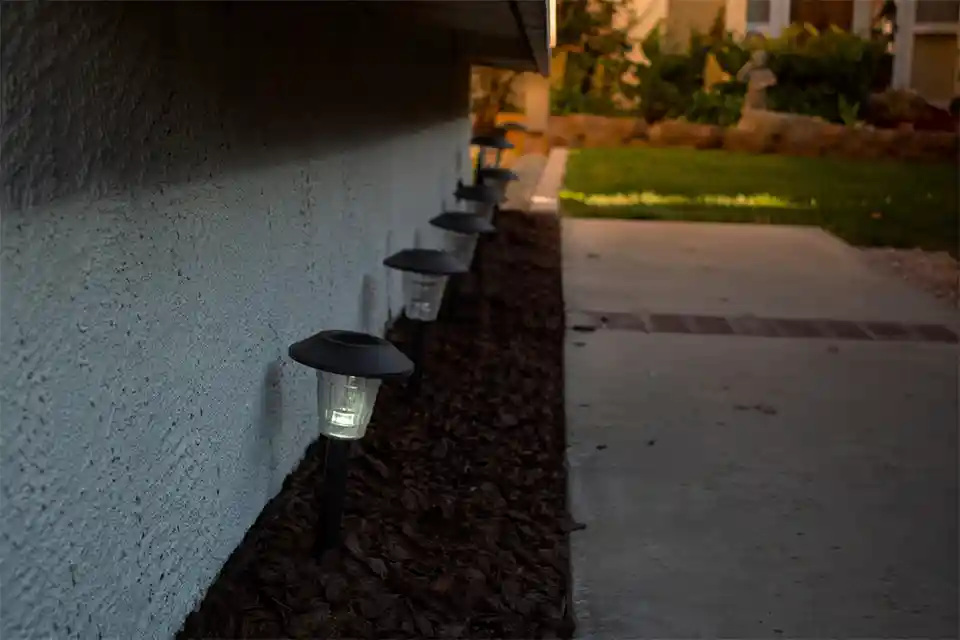
If solar path lights start losing charge soon after installation under a roof overhang, the most likely problem is not a bad battery. It is weak daily charging caused by placement. Most small path lights need about 6 to 8 hours of useful direct sun to perform well.
Under an eave, a light may still see daylight and even switch on at dusk, but that is not the same as collecting enough energy for a normal overnight run. If a new light fades after 1 to 3 hours instead of lasting roughly 6 to 10 hours after a sunny day, shade is usually the real cause.
That is why this issue gets misread so often. Owners see a light turn on and assume the site is fine. Or they see early decline and blame the battery. In this scenario, the battery is often just showing the effect of a poor charging location.
Why roof overhangs cause this specific failure pattern
A roof overhang creates stable daily shade during the most productive charging hours. That is more damaging than brief clouds or scattered shade because the light misses the same strong sun window every day. On compact solar path lights, the panel area is small, so even a modest placement error can cut runtime hard.
Bright daylight is not enough
This is the first wrong assumption to clear out. A panel under an overhang may sit in bright ambient light and still miss the direct exposure that actually recharges the battery. “Looks sunny” and “charges well” are not the same condition.
New lights can hide the problem for a few nights
A new fixture may arrive partially charged or get one decent charge before the real pattern shows up. That delay makes people think the battery suddenly failed. More often, the light has simply fallen into a chronic half-charged cycle.
That is why battery swaps often waste time here. If the panel gets only 1 to 3 hours of real sun, a fresh battery stores a slightly better version of the same daily shortage.
Related charging mistakes also show up in Sun Exposure Issues Affecting Solar Lights and Why Are My Solar Light Batteries Dying So Quickly, but roof overhang shade is easier to prove because the shadow pattern is so repeatable.
Quick checks that tell you more than a battery replacement
Check the panel between 11 a.m. and 2 p.m.
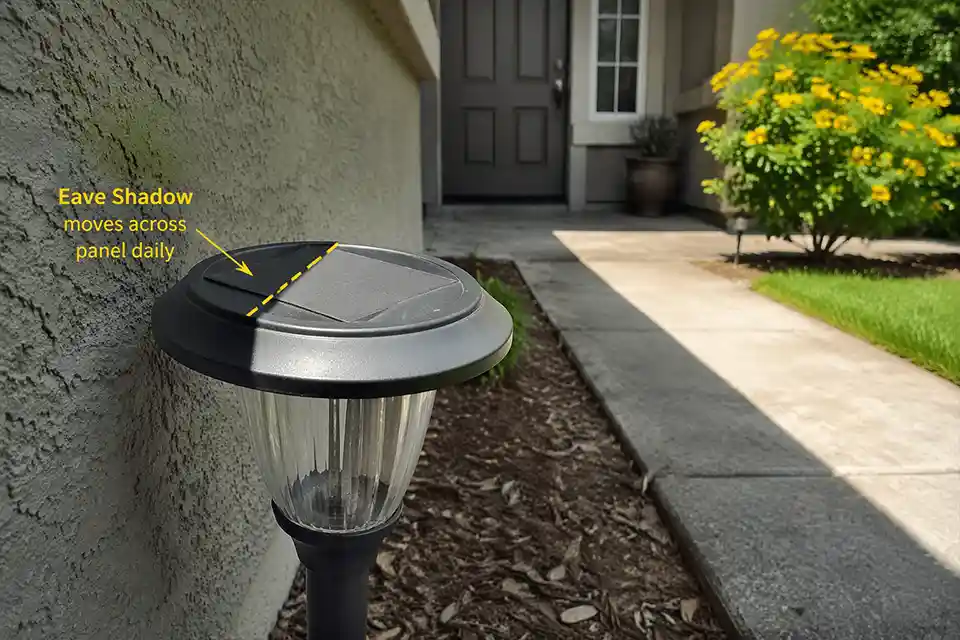
Do not judge the location early in the morning or near sunset. If the panel stays shaded for most of the late-morning to early-afternoon window, the site is weak even if the area looks bright at other times.
Compare runtime, not just whether the light turns on
A weakly charged solar light can still glow at dusk. That does not mean the location is healthy. Runtime is the better signal. Good placement often gives about 6 to 10 hours after a strong sunny day. Chronic overhang shade often leaves you with about 1 to 3 useful hours.
Move one light before you move the whole row
Take one fixture from under the overhang and place it in a spot with 6 to 8 hours of direct sun for 2 clear days. Leave a matching light in the original location. If the moved light runs much longer, the diagnosis is basically finished.
If your solar pathway lights are completely dead, it is worth checking the basics behind solar lights that stopped working.
Healthy placement vs overhang placement
| Condition | Direct sun on panel | Likely runtime pattern | Best decision |
|---|---|---|---|
| Good open placement | 6-8+ hours | About 6-10 hours | Keep in place and clean periodically |
| Borderline placement | 4-6 hours | About 3-6 hours | Test relocation before replacing parts |
| Shaded under overhang | 2-4 hours | About 1-3 hours | Move outward or change product type |
| Deep eave or recessed entry | 0-2 hours | Very weak or inconsistent | Compact solar stake lights usually stop making sense |
| Good site, older fixture | 6-8+ hours | Drops despite strong sun | Then test battery condition or replace fixture |
What usually wastes time
Cleaning the panel helps less than people think
Yes, clean it. Dirt can reduce charging. But when the main problem is architectural shade, cleaning is a small gain, not the real fix.
A bigger battery is not a real workaround
This is where the standard fix stops making sense. A larger battery only helps if the panel can refill it. In a low-input site, a larger battery often changes expectations more than results.
Brighter replacement lights can shorten runtime
A brighter LED head demands more from the same small panel. So the “upgrade” can look better for the first part of the evening and then die earlier than the old fixture.
The same false-fix pattern also appears in How to Fix Solar Lights With Uneven or Dimming Output and Best Solutions for Solar Lights Not Turning On at Night.
If the lights have to stay under the overhang
This is the decision point many articles avoid. Sometimes you cannot move the light line farther out because of walkway width, hardscape layout, HOA limits, or the way the front entry is built. In that case, the question is no longer “Which battery should I try?” It is “What setup still makes sense in a shaded location?”
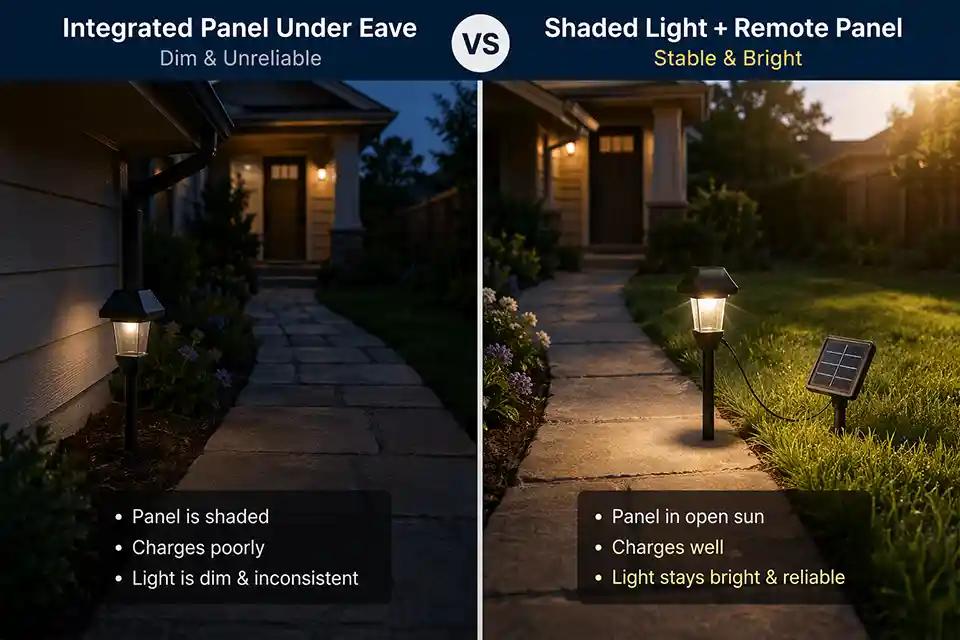
Best fix: use a light with a separate solar panel
If the fixture must stay in shade, the panel should not. A model with a remote panel lets you keep the light where you want illumination and move the charging surface into full sun. That is usually the smartest solar-based fix for this layout.
Acceptable compromise: treat them as accent lights
If you only want a soft edge glow for the first 1 to 3 hours after dusk, the shaded location may still be usable. But that is a lower expectation, not a repair. It may work for decorative guidance. It is not the same as dependable all-evening path lighting.
The honest boundary: sometimes solar is the wrong fit
If the walkway needs reliable visibility well into the evening, and the panel cannot be moved into direct sun, compact solar path lights are often the wrong tool. This is especially true on north-facing entries, deep porches, and recessed front doors where the eave blocks most of the useful charging window.
What changes with season and site orientation
Seasonal weakness is real, but it should not be used to excuse a bad placement. In northern states, lower winter sun and shorter daylight hours make an already weak site perform even worse.
A shallow south-facing overhang may be borderline but usable in summer. A deep north-facing entry may never become a strong solar site at all.
That is why Seasonal Problems in Solar Lights and Weather Effects on Solar Lights Runtime matter here, but they do not override placement. Seasonal decline changes output. Overhang shade changes the whole charging math.
Pro Tip: Mark the midday edge of the eave shadow with painter’s tape on one sunny day. If the fixture line stays inside that shadow for most of the charging window, stop troubleshooting the battery and change the placement plan.
When replacement is actually justified
Replace the battery only after you confirm the panel gets a real 6 or more hours of direct sun and the light still performs poorly after 2 to 3 clear charging days. Replace the fixture when the panel lens is badly clouded, the contacts are corroded, or the unit stays weak even in a verified sunny test location.
One detail matters here: “turns on” is a very low bar. For an entry path, useful performance is not whether the light glows at sunset. It is whether it stays bright enough long enough to do the job.
The bottom line
When solar path lights lose charge under a roof overhang, the more likely cause is usually inadequate daily sun, not a mysteriously bad new battery.
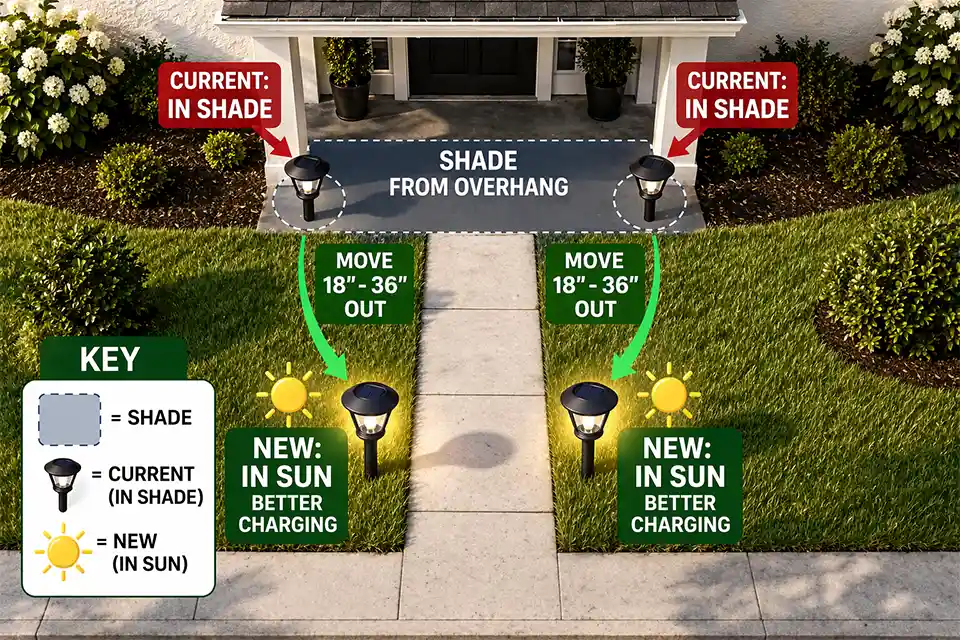
Test the site first. If you can move the lights outward, do that before replacing parts.
If you cannot, use a separate-panel design or accept shorter decorative runtime.
And if the entry needs dependable all-evening visibility, this is often the point where compact solar stake lights stop being the right answer.
For broader official guidance, see the U.S. Department of Energy.