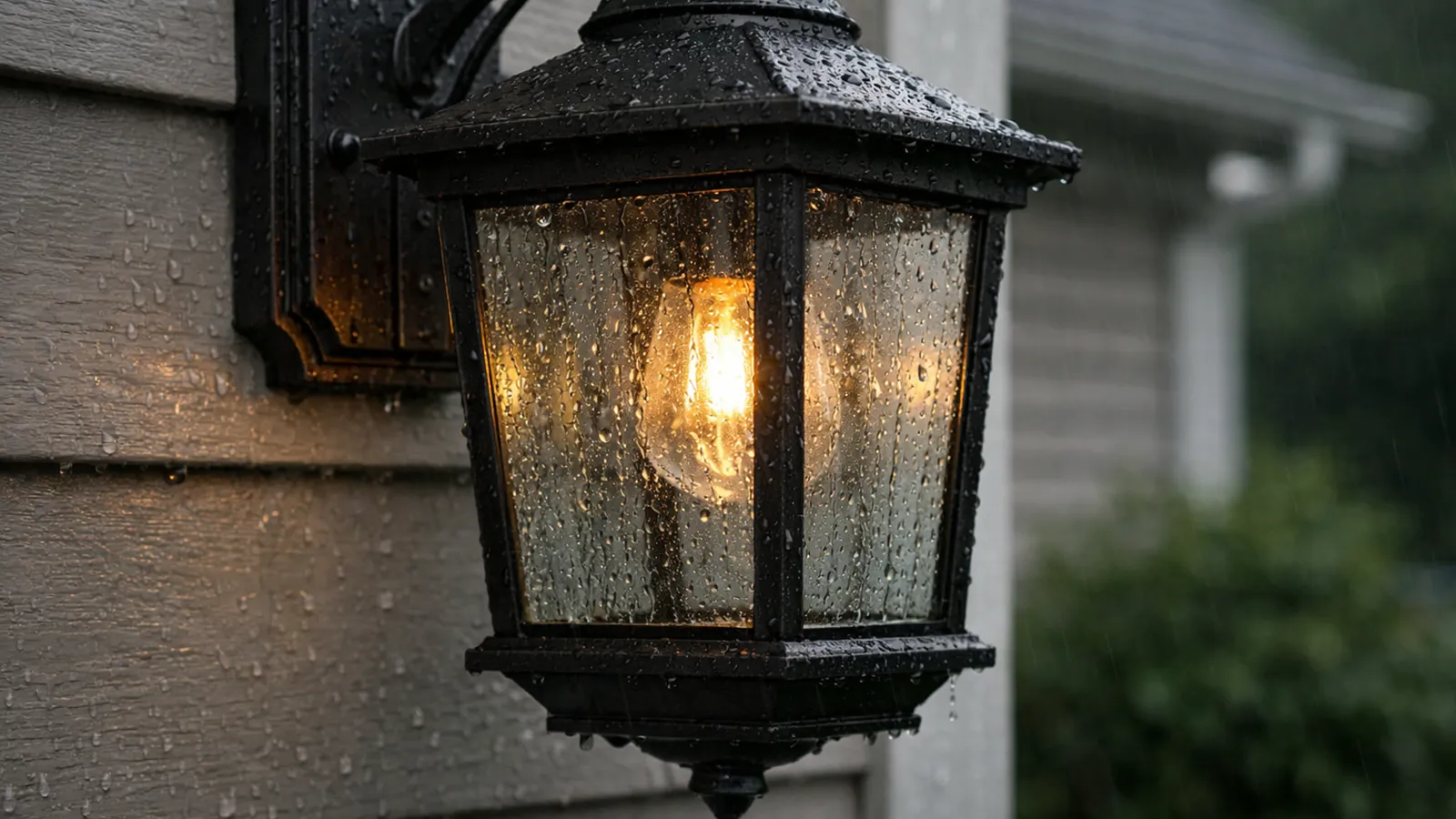
You turn on the porch light after a rainy evening and notice something off. The glass looks hazy, and tiny droplets cling to the inside as if the fixture has been sweating. That small visual change is often the first sign that water has made its way inside.
At first, the light may still work normally. It shines, it responds to the switch, and nothing seems urgent. But the presence of moisture means the protective barrier between outdoor weather and live electrical parts is no longer doing its full job.
Over time, that quiet intrusion can shift how the fixture behaves. What begins as foggy glass can turn into flickering, rust, or repeated bulb failures that seem random from the outside.
How Water Actually Enters a Sealed Outdoor Fixture
After a heavy rain, you might expect water to pour in through the glass. In reality, the path is usually less obvious. The moisture often slips in through tiny gaps you cannot see during everyday use.
Several conditions quietly create those entry points:
-
A slightly uneven mounting surface that prevents full gasket contact.
-
Aging rubber seals that have hardened or cracked over the years.
-
Small gaps between the fixture base and siding.
-
Wind-driven rain hitting the fixture from an angle it was not designed to block.
Temperature swings also play a role you can actually notice. On warm afternoons followed by cool nights, air inside the fixture contracts. That shift can draw humid outside air into the housing, which later shows up as condensation on the glass.
In coastal or very humid areas, even clear skies do not guarantee dryness. The air itself carries enough moisture to slowly build up inside if seals are no longer tight.
The Difference Between Condensation and Direct Water Intrusion
Some mornings, the glass looks foggy but clears by midday. Other times, you may see actual water collecting at the bottom of the fixture. These two patterns look similar at first glance, but they signal different issues.
Condensation usually appears as:
-
A light mist across the inside of the glass.
-
Small droplets that fade as the day warms up.
-
No visible pooling at the base.
Direct water intrusion tends to show up as:
-
Standing water at the bottom of the housing.
-
Droplets that remain even during warm daylight.
-
Water lines or mineral stains inside the glass.
When you repeatedly see fogging after cool nights, pressure and ventilation imbalance may be at play. When water stays trapped for days after rain, the seal itself is likely compromised.
Even repeated condensation, which seems harmless at first, can slowly affect internal metal parts. You may not see the corrosion right away, but the fixture will feel the impact over time.
Why Trapped Moisture Changes Electrical Behavior
The evening light flickers once, then steadies. A week later, it does it again after another storm. That small inconsistency often connects back to moisture sitting where it should not be.
Electricity flows best across clean, dry metal. When moisture settles on contact points, oxidation begins. As that thin layer of corrosion forms, resistance changes and the current no longer moves as smoothly.
You may notice:
-
Brief flickers after rainfall.
-
A slight delay before the light reaches full brightness.
-
Bulbs burning out faster in one fixture than others.
-
GFCI outlets tripping without a clear reason.
The change rarely happens overnight. A fixture can work for months while corrosion slowly builds at screw terminals and socket contacts, only revealing itself through subtle performance shifts.
Signs the Fixture Is Already Compromised
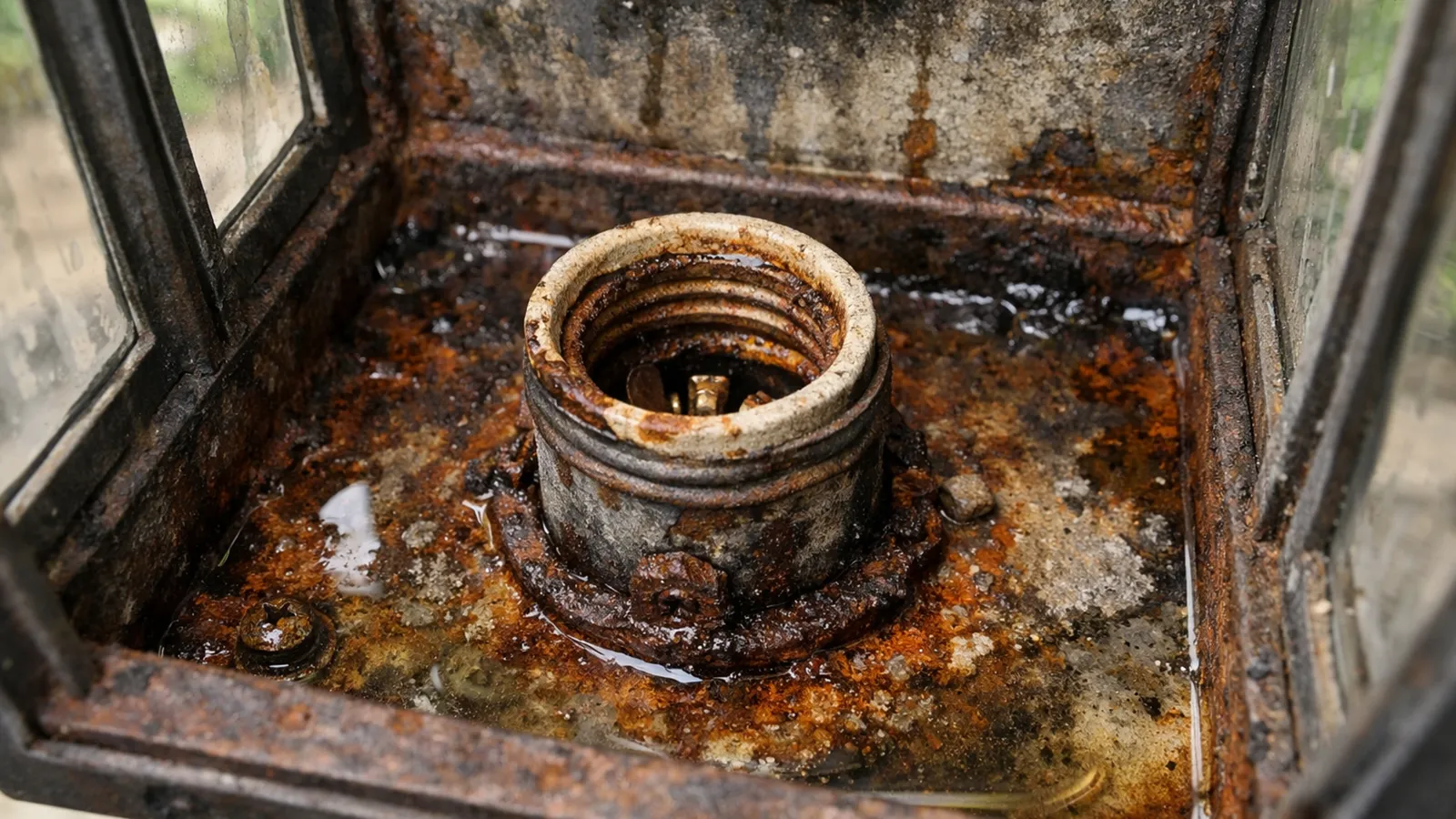
You remove the bulb and notice a faint orange ring around the socket. That early rust stain is often the first physical clue that moisture has been sitting inside longer than expected.
Other signs tend to show up gradually:
-
Repeated bulb burnout in the same fixture.
-
Dark streaks or water marks on the inner glass.
-
Flaking paint around the base.
-
A breaker that trips during or after storms.
By the time rust is clearly visible, internal screws and contact plates have likely been exposed more than once. The damage is usually deeper than what the glass reveals.
Even if the light still turns on, those physical changes signal that the internal environment has shifted from dry and stable to damp and corrosive.
Environmental Factors That Accelerate Water Problems
One fixture under a wide roof overhang stays clear for years. Another, mounted just a few feet away but more exposed, begins fogging within a season. Placement makes a noticeable difference in how quickly moisture becomes a problem.
Several environmental triggers increase stress on outdoor light fixtures:
-
Direct exposure to wind-driven rain.
-
Sprinkler systems spraying upward toward the housing.
-
Freeze-thaw cycles that expand trapped water.
-
Shaded areas where fixtures dry slowly after storms.
-
Coastal air with higher salt content.
In colder climates, you may see cracks appear after winter. When trapped water freezes, it expands and pushes against seams and glass panels. Even small expansions can widen tiny gaps over time.
In humid or wooded areas, fixtures often stay damp long after rainfall ends. That extended moisture contact shortens the window for drying and lengthens the period when corrosion can quietly develop.
Moisture intrusion rarely announces itself with a dramatic failure. It usually builds through repeated exposure, small sealing weaknesses, and environmental stress that adds up season after season.
Moisture Migration Inside the Fixture Assembly
You notice the porch light works fine during dry weeks, then starts acting strangely after a stretch of damp weather. Nothing looks broken from the outside, yet something inside has changed. That shift usually begins with how moisture travels once it enters the housing.
Water does not simply sit at the bottom. It moves along metal surfaces, follows screw threads, and settles around wire connections. As temperatures rise and fall, that moisture evaporates and reforms, repeating a cycle that slowly alters internal conditions.
Over time, this pattern creates layered effects:
-
Corrosion forms first on exposed fasteners.
-
Oxidation spreads to socket contacts.
-
Electrical resistance increases gradually.
-
Heat distribution becomes slightly uneven.
You may only sense this as a faint flicker on humid nights or a light that seems less steady after rain, even though it looks dry by morning.
Why does my outdoor light only act up after rain but look normal the next day?
You flip the switch during a storm and the light hesitates, dims, or flickers. The next afternoon, it behaves as if nothing ever happened. That on-and-off pattern creates doubt because the fixture appears clear when you check it in daylight.
Why does it flicker only when it rains?
Moisture temporarily changes the path electricity takes across contact points.
Why does it stop flickering when the weather clears?
Internal warmth dries surface moisture and restores partial stability.
Why is there no visible water inside the glass?
Condensation often forms on internal metal parts that are not directly visible.
Why does the breaker trip at night but not during the day?
Cooler nighttime air increases condensation and reduces tolerance at corroded junctions.
Why does this happen more in spring or fall?
Rapid temperature swings during those seasons intensify expansion and contraction inside the housing.
The confusion usually comes from timing. The behavior follows humidity and temperature shifts more closely than visible water levels.
Electrical Resistance Shifts Under Moist Conditions
On a damp evening, the light may take a moment longer to reach full brightness. That subtle delay often reflects small changes in resistance inside the fixture. Moisture does not need to flood the housing to influence performance.
Several mechanical changes occur together:
-
Oxidation creates a thin insulating layer on metal.
-
Contact pressure weakens as corrosion expands.
-
Micro-arcing may occur at unstable points.
-
LED drivers respond more sensitively than simple filaments.
At first, the issue may only appear during storms. As corrosion deepens, instability begins showing up even during mild humidity changes.
Corrosion Progression Patterns
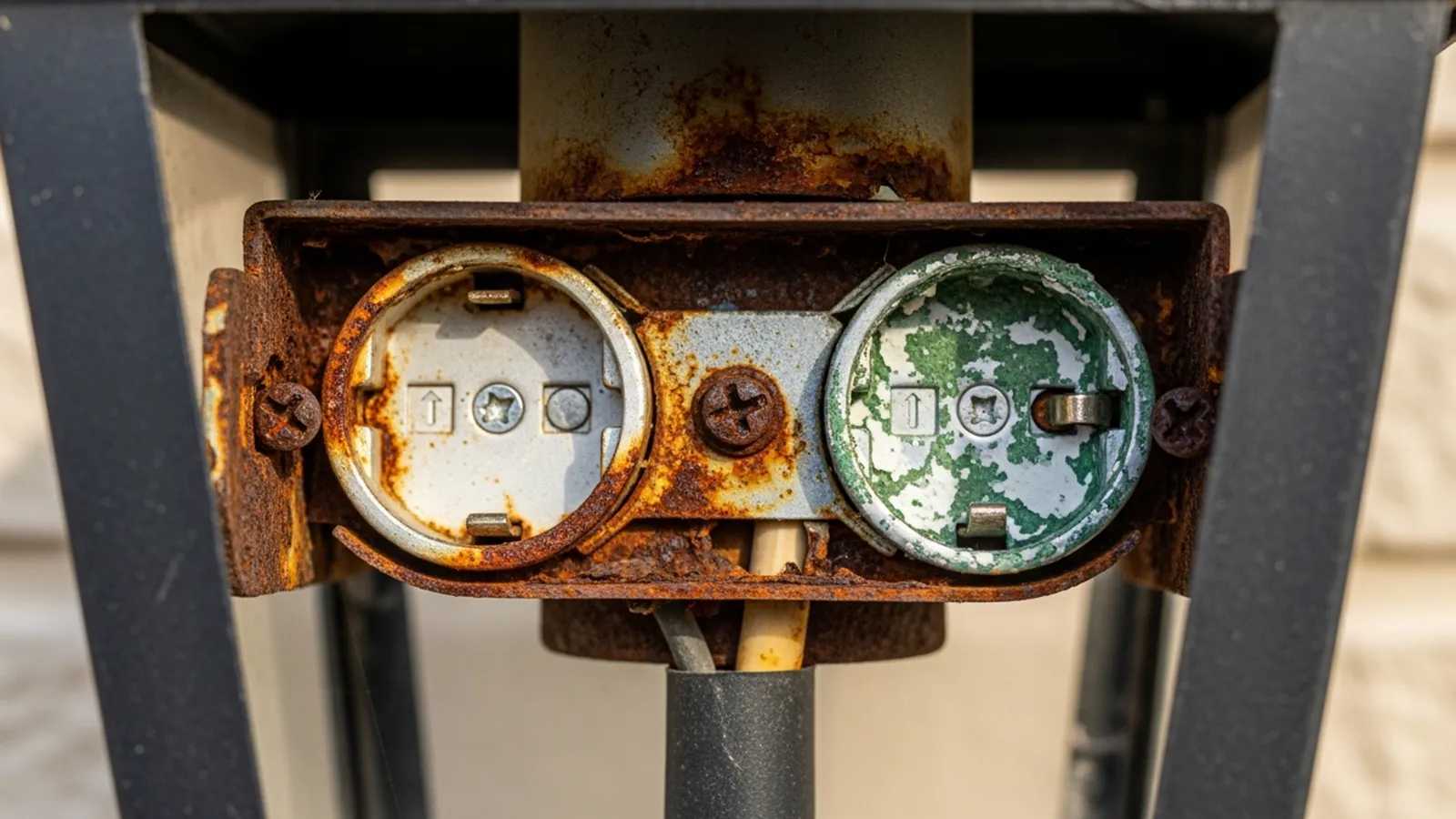
You remove the bulb and see faint discoloration around the socket. Months later, that tint may turn rough and flaky. Corrosion tends to follow a visible pattern before full electrical failure occurs.
| Phase | What You See | Performance Change | Structural Effect |
|---|---|---|---|
| Early | Light orange staining | No obvious malfunction | Surface oxidation only |
| Developing | Rough socket texture | Occasional flicker | Reduced contact firmness |
| Advanced | Heavy rust at base | Frequent intermittent failure | Mounting bracket weakening |
| Severe | Cracked or pitted terminals | Repeated breaker trips | Structural instability |
This pattern shows that cosmetic changes often appear well before complete failure, offering subtle clues in everyday use.
Environmental Exposure Variables
Two identical fixtures can age very differently depending on where they sit. One under a wide overhang may stay stable for years, while another exposed to wind-driven rain begins degrading within a season.
Environmental differences often include:
-
Direct sprinkler spray hitting the lower housing.
-
Freeze-thaw expansion widening seams.
-
Coastal air accelerating oxidation.
-
Shaded areas slowing post-storm drying.
You may notice one side of the house developing rust faster than the other. That uneven aging usually reflects exposure patterns rather than manufacturing defects.
System-Level Interaction With Circuit Protection
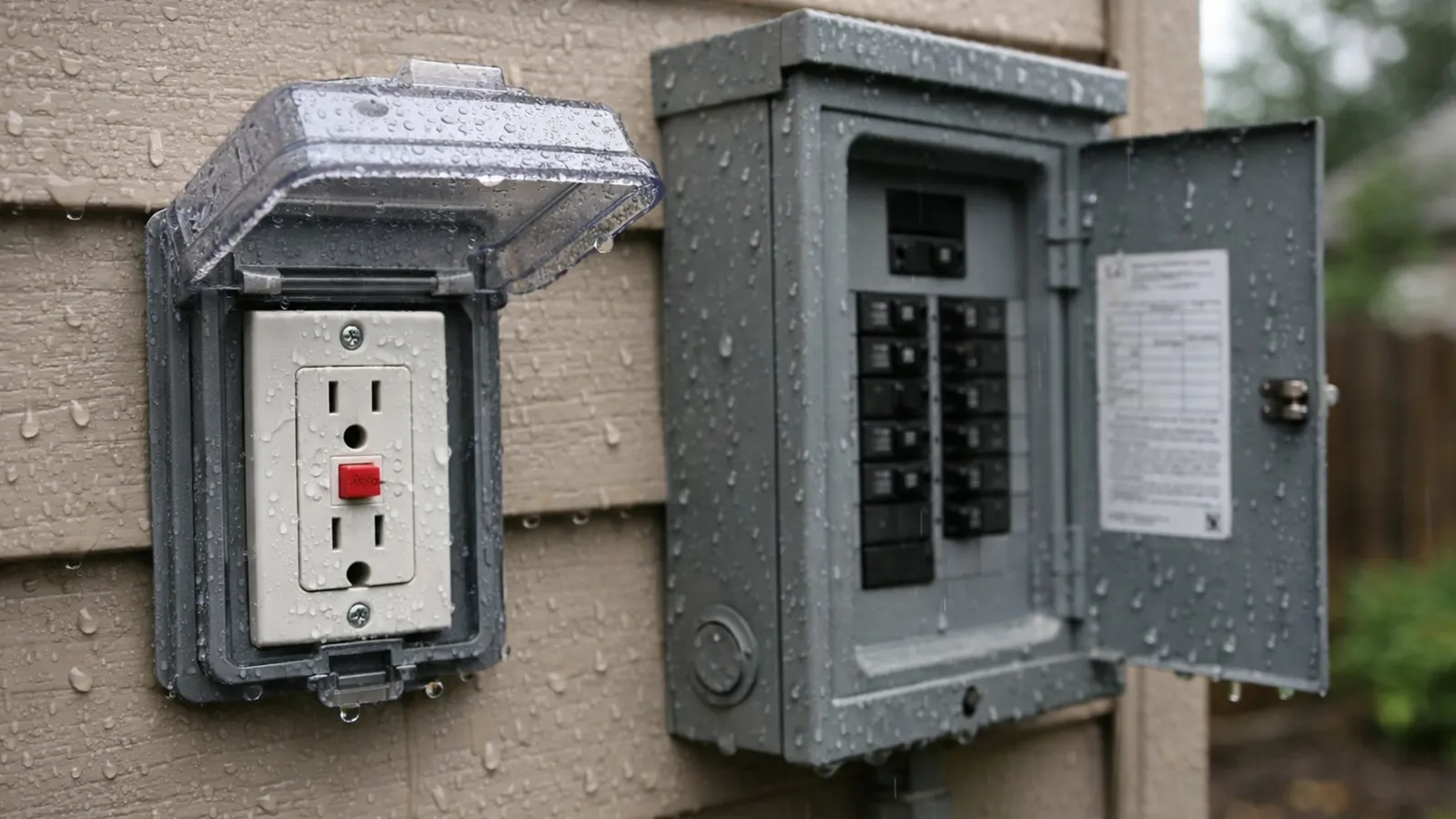
After a heavy storm, you reset the GFCI and the light works again. A week later, it trips once more during damp weather. That cycle signals interaction between moisture intrusion and protective circuitry.
You might observe:
-
Breakers tripping only during rainfall.
-
GFCI outlets resetting repeatedly.
-
Timers behaving inconsistently on humid nights.
These responses are protective reactions to leakage currents forming inside the fixture. As corrosion progresses, those protective interruptions often become more frequent, even when the light appears functional between events.
Over time, what begins as occasional instability can evolve into a recurring system response, indicating that the internal condition of the fixture has shifted beyond simple surface moisture.
When Replacement Becomes the More Stable Path
A fixture that has been opened, dried, and resealed more than once often tells its own story. The glass may be clear today, but rust around the socket or mounting screws hints that internal conditions have already shifted. At a certain point, the structure of the housing no longer supports consistent electrical stability.
Minor corrosion limited to surface screws may allow continued monitoring. Moderate corrosion at socket contacts introduces recurring flicker and inconsistent startup. Severe corrosion at the mounting base or terminal points usually signals structural compromise rather than a cosmetic issue.
When internal metal has lost thickness or rigidity, performance may briefly recover after drying, yet instability returns with the next humidity cycle. In those cases, replacement often restores system balance more predictably than repeated internal cleaning.
Corrective Adjustments at the Mounting Surface
A newly installed fixture can still take on moisture if the wall surface beneath it is uneven. Small gaps between siding and mounting plate quietly create pathways for runoff. Over time, that water migrates into the electrical box rather than away from it.
Stability improves when the mounting surface sits flush and level. Even compression across the gasket prevents channel formation along the upper edge. Fixtures installed over warped siding or cracked panels tend to show recurring intrusion patterns regardless of material quality.
In homes exposed to heavy rain or sprinkler spray, repositioning the fixture slightly under an overhang can reduce direct water impact. That spatial shift often changes long-term moisture behavior without altering electrical design.
Drainage direction also matters. When water naturally flows downward and away from the housing instead of pooling behind it, internal moisture cycles shorten noticeably.
Material and Component Upgrades Under Persistent Exposure
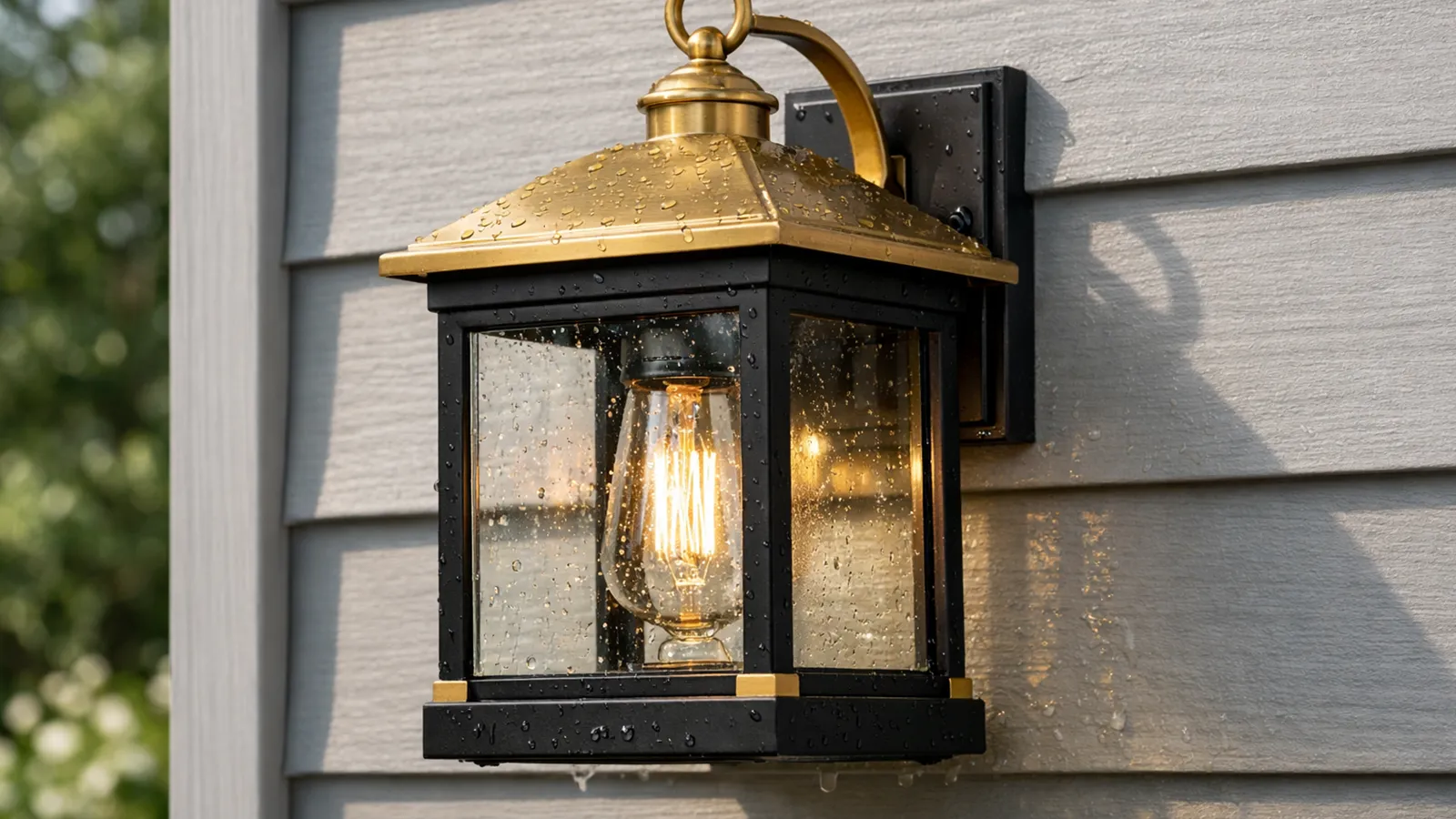
In climates with high humidity or coastal air, metal choice significantly affects longevity. Solid brass and powder-coated aluminum resist oxidation longer than thin painted steel. Over multiple seasons, that material difference becomes visible around fasteners and seams.
Integrated LED units with sealed driver compartments reduce exposed contact points. Fewer open metal junctions mean fewer areas where moisture can alter resistance patterns. Under heavy environmental stress, these designs often maintain performance more consistently.
Gasket quality also influences durability. Softer, high-density sealing materials maintain compression better across temperature swings. When seals retain elasticity, expansion and contraction cycles are less likely to widen intrusion gaps.
Material upgrades do not eliminate exposure, but they slow the progression of internal corrosion under recurring moisture cycles.
A Focused Structural Reset Scenario
A homeowner removes a severely corroded lantern and installs a wet-rated fixture on a leveled, properly sealed mounting surface. The electrical box is adjusted to sit flush, and gasket compression is uniform across all edges. After the next heavy storm, the fixture interior remains dry and startup behavior stabilizes.
This shift illustrates how coordinated structural changes alter moisture dynamics. The improvement does not come from drying alone, but from correcting the physical pathways that previously allowed intrusion. When mounting alignment, sealing integrity, and material resistance work together, internal humidity cycles diminish.
Performance differences often appear first during transitional seasons. Where flicker once occurred during cool, damp evenings, brightness now stabilizes immediately. Over time, the absence of corrosion spread confirms that the environmental balance inside the housing has changed.
Self-Assessment: Evaluating Moisture Severity
Before deciding on monitoring or replacement, observable indicators help clarify severity level.
-
Light fogging disappears within hours of sunrise.
-
No standing water is visible at the fixture base.
-
Socket contacts show only light surface discoloration.
-
Breakers or GFCI devices trip only during extreme storms.
-
Mounting screws remain structurally firm.
-
Glass panels show no cracking or seam separation.
-
Rust is limited to exposed fastener heads.
-
Interior wiring insulation remains intact and flexible.
If multiple indicators show advanced corrosion, repeated tripping, or structural weakening, deeper corrective intervention may be necessary.
Monitoring Patterns After Intervention
Following adjustment or replacement, performance trends reveal whether the structural balance has improved. A stable fixture typically shows consistent brightness regardless of humidity shifts. Start-up timing remains predictable after rainfall.
Seasonal transitions provide useful benchmarks. Early autumn evenings and spring storms often reveal lingering vulnerabilities. When the fixture remains dry and electrically steady through those cycles, internal moisture migration has likely been reduced.
Environmental stress does not disappear, but its impact changes. As exposure continues year after year, structural integrity rather than temporary drying determines whether water intrusion returns or remains controlled.
For broader electrical safety guidance related to exterior installations, refer to the National Electrical Code (NEC) published by the National Fire Protection Association (NFPA).