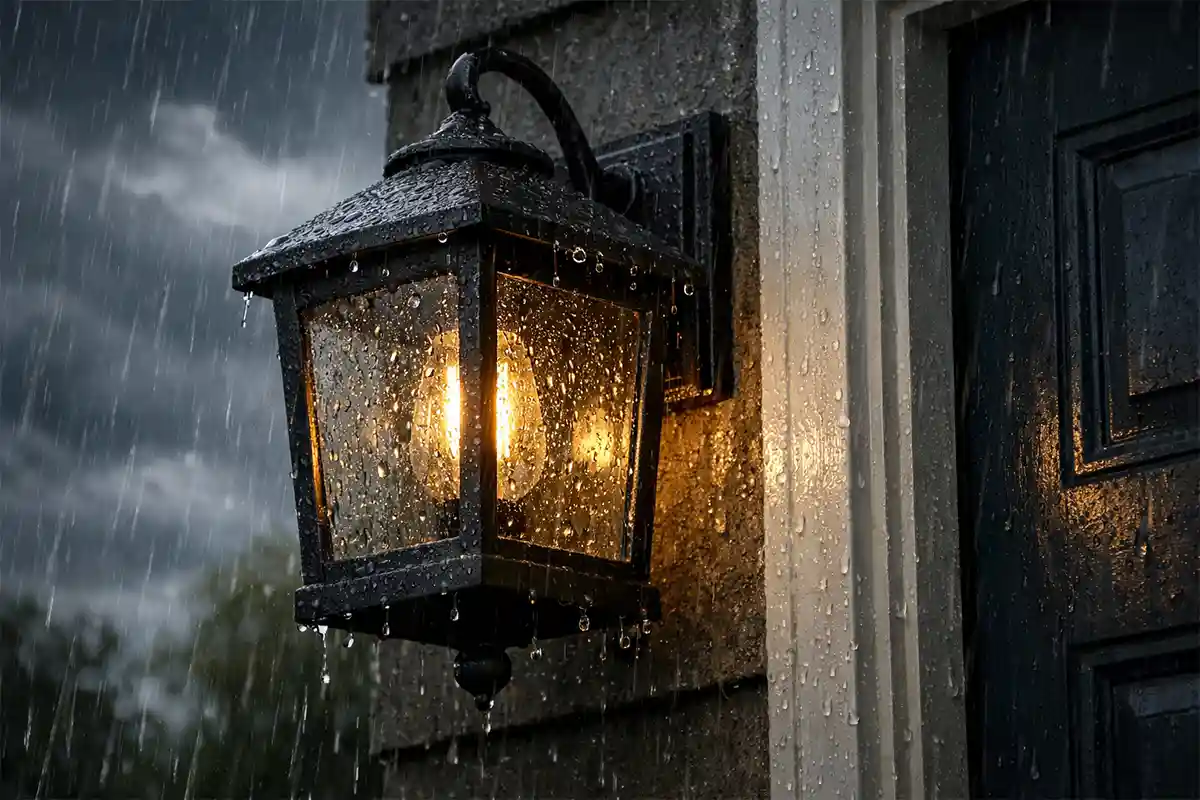
Outdoor lights are built to face the weather, yet they are not sealed like waterproof containers. Over months and years, repeated rain changes how water moves around the fixture. Small gaps that once seemed harmless slowly turn into entry points.
Most failures do not start with a dramatic short circuit. They begin with moisture finding its way inside during ordinary rainstorms. The damage builds slowly until one storm finally reveals it.
How Rainwater Actually Enters an Outdoor Fixture
After a windy storm, you might notice droplets inside the glass or a faint rust ring near a screw. That is usually the first clue that rain is getting in. Water rarely pours straight through the front; it sneaks in from edges and seams.
Rain reaches the inside in a few common ways:
-
Wind pushes water sideways into tiny gaps.
-
Water runs down siding and slips behind the backplate.
-
Roof runoff hits the top of the fixture repeatedly.
-
Caulk shrinks and leaves hairline openings.
Most wall lanterns are designed to shed water, not block it completely. If the fixture tilts slightly backward or the wall surface is uneven, water can sit longer than intended. Over time, even small amounts that enter during each storm begin to matter.
Roof edges are another overlooked factor. When a gutter overflows, concentrated streams hit the fixture directly. That steady impact stresses seals much faster than light rainfall would.
Early Warning Signs of Rain-Related Lighting Stress
You may not see water dripping out, but the behavior of the light starts to change. A brief flicker during a storm or a dimmer glow after heavy rain often signals internal moisture.
Homeowners commonly notice:
✔️ Flickering only during or right after rainfall
✔️ A breaker that trips during storms but resets later
✔️ Foggy or damp glass that clears in dry weather
✔️ Rust forming around mounting screws
These signs are easy to ignore because the light usually works again once things dry out. But each wet-dry cycle leaves a small mark inside the fixture. Over time, those small changes add up.
Sometimes what looks like rain intrusion is actually trapped humidity. Understanding why condensation forms inside outdoor fixtures helps distinguish between internal humidity imbalance and direct rain intrusion. Knowing the difference prevents chasing the wrong cause.
Fixture Ratings and Why They Matter in Rain Exposure
You might assume any “outdoor” label means the light can handle direct rain. In reality, ratings make a big difference. A damp-rated fixture is meant for covered areas, while a wet-rated one is built for open exposure.
Using the wrong type in an exposed spot often leads to slow failure. Damp-rated units may lack:
-
Reinforced gaskets
-
Fully sealed wiring compartments
-
Corrosion-resistant hardware
The fixture may look sturdy on the outside, but its internal design reflects where it was meant to be installed. Placing it under open sky changes the conditions it faces every time it rains.
Even when installation meets electrical code, water patterns around the home can create extra stress. A light mounted below a roof valley or near heavy splash zones deals with more water than its rating assumed.
The Structural Weak Points That Accelerate Failure
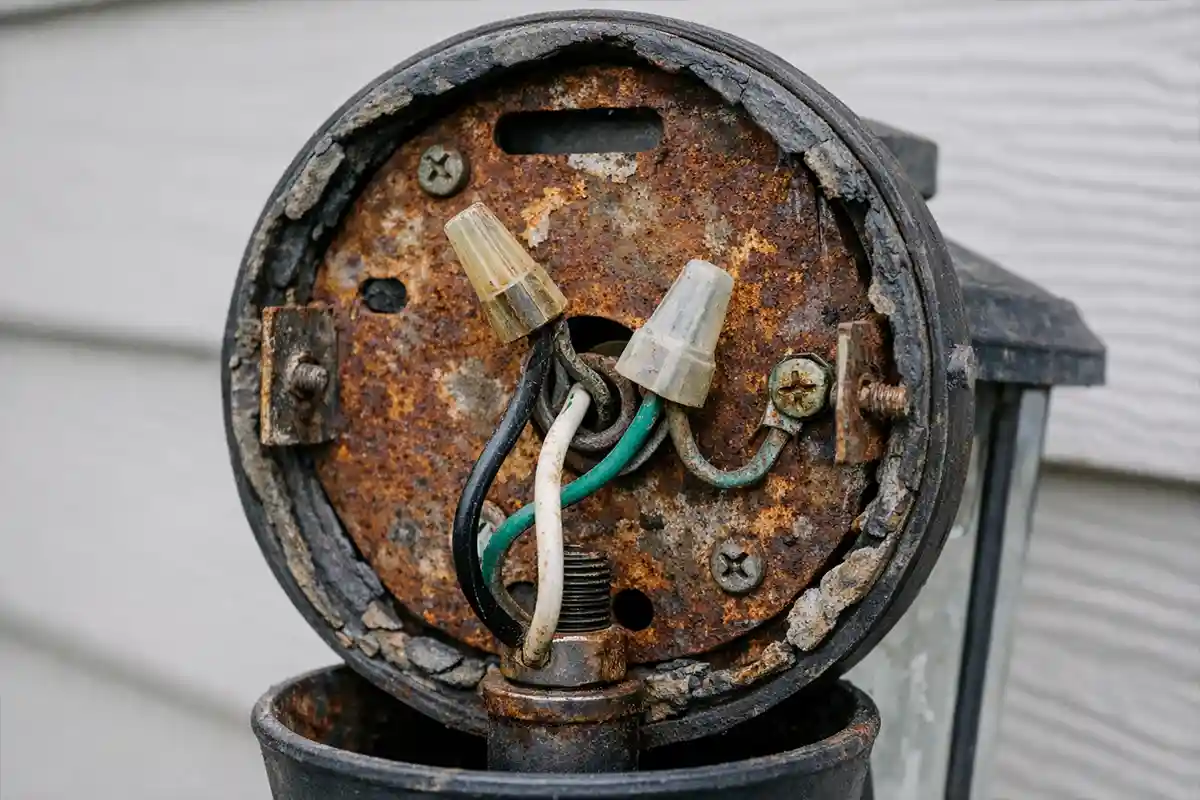
When a fixture fails after a storm, the damage often traces back to a few predictable spots. The base where the fixture meets the wall is one of them. If that seal weakens, water can slip directly into the junction box.
Other vulnerable points include:
-
Compressed gaskets that no longer spring back
-
Drain holes clogged with debris
-
Screws made from mixed metals
-
Wiring connections exposed to repeated moisture
Drain holes are meant to help, but they can work against the fixture if blocked. Water that cannot escape sits at the bottom of the housing and slowly attacks metal parts.
Inside the fixture, moisture reaching electrical connections speeds up corrosion. Long-term corrosion inside outdoor light connections is one of the primary pathways from minor moisture exposure to electrical failure. That process often stays hidden until the light suddenly stops working.
Why Failure Often Appears Sudden After a Storm
Everything seems fine for months, then one heavy storm hits and the light goes out. It feels sudden, but the damage usually builds long before that night.
Repeated rain exposure creates:
-
Gradual corrosion at contact points
-
Slight increases in electrical resistance
-
Small insulation breakdown over time
-
Looser mechanical connections
The final storm is often just the tipping point. A surge of moisture or a quick temperature drop during rainfall pushes already weakened parts past their limit.
In colder climates, freeze-thaw cycles add another layer. Water that seeps into tiny cracks expands when frozen, widening those gaps. Each winter makes the next storm a little more stressful for the fixture.
Rain exposure is rarely a single-event problem. It is a pattern that slowly reshapes how the fixture handles electricity and moisture, setting the stage for deeper performance issues.
Electrical Consequences of Repeated Rain Intrusion
You reset the breaker after a storm and the light comes back on, but something feels off. The glow looks slightly uneven, or it takes a second longer to reach full brightness. That subtle shift is often where electrical stress from rain begins to show.
Moisture inside a fixture changes how electricity moves across connections. Even a thin film of water mixed with dust can allow tiny amounts of current to travel where it should not. Over time, that creates:
-
Slight resistance increases at terminals
-
Extra heat at connection points
-
Gradual weakening of insulation
-
Intermittent contact instability
These changes are rarely dramatic at first. The fixture still works, which makes the issue easy to dismiss. But each storm adds another small layer of internal wear.
GFCI outlets often react before visible failure appears. If a light trips only during heavy rain, it usually signals minor leakage inside the fixture. That trip is a protective response to imbalance, not a random electrical glitch.
Rain Exposure and Electrical Behavior Shift
| Observed Symptom | What’s Happening Internally | Why Rain Triggers It | Long-Term Risk |
|---|---|---|---|
| Flickering during storms | Moisture creates micro-current paths across terminals | Water lowers insulation resistance temporarily | Accelerated terminal corrosion |
| Breaker trips only in heavy rain | Leakage current increases beyond safe threshold | Conductive moisture bridges hot/neutral imbalance | Repeated GFCI nuisance trips |
| Light appears dim after rainfall | Contact resistance rises due to oxidation | Moisture film interferes with metal-to-metal contact | Heat buildup at connection points |
| Condensation inside lens | Trapped humid air cycles with temperature change | Rain increases internal humidity load | Ongoing internal corrosion |
| Rust around mounting screws | Galvanic reaction between dissimilar metals | Persistent moisture film enables ion exchange | Structural weakening of baseplate |
| Light works again when dry | Temporary drying restores partial conductivity | Evaporation reduces surface leakage | Damage continues invisibly over time |
Material Degradation Under Wet Conditions
You might notice rust creeping around a screw head or discoloration near the base. Those cosmetic signs often reflect deeper changes inside. Rainwater does not need to pool to cause damage; a persistent damp environment is enough.
Inside many fixtures, different metals sit close together. When moisture bridges them, a slow chemical reaction starts. That reaction gradually weakens contact surfaces and reduces clamping strength.
Common outcomes include:
-
Corrosion forming on terminal screws
-
Flaking or bubbling paint near seams
-
Loss of spring tension in socket contacts
-
Brittle plastic near heat-generating parts
Plastic parts also suffer when UV exposure and rain combine. Over time, they lose flexibility and develop fine cracks around stress points. Those tiny fractures make it easier for future rain to enter.
Water Retention and Drainage Design Limitations
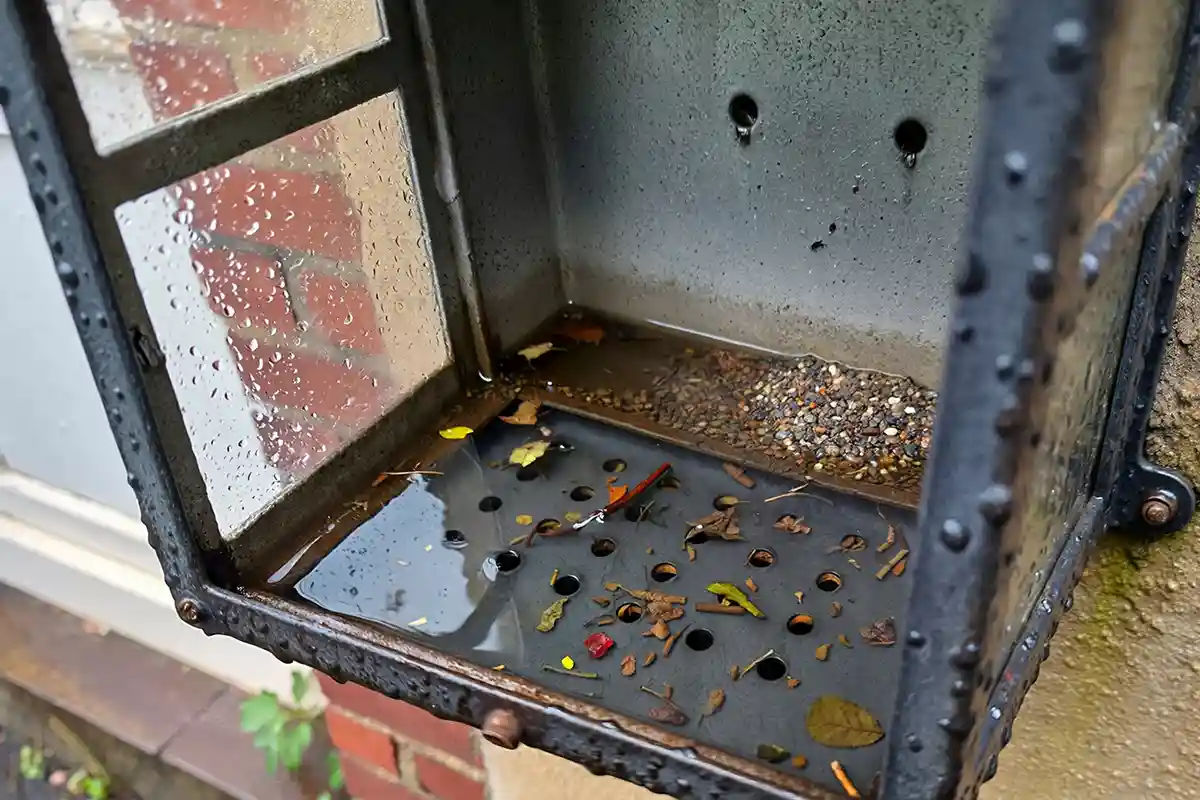
After a storm, you might see water sitting at the bottom of the glass enclosure. It looks minor, but that standing moisture can linger longer than expected. Many fixtures rely on small drain holes rather than sealed systems.
Problems start when drainage does not work as planned. That can happen because:
-
Insects block weep holes
-
Dirt and debris collect at the base
-
The fixture tilts slightly backward
-
Caulk seals trap water instead of guiding it away
When water stays inside, daily temperature changes make things worse. Warm daylight expands moisture into vapor, and cooler nights turn it back into condensation on wires and sockets. This repeated cycle speeds up corrosion even between storms.
Over time, mineral residue builds up as trapped water evaporates. Those deposits change how electricity behaves at connection points, increasing the chance of future failure.
Why Does My Outdoor Light Only Flicker When It Rains?
You walk outside during a downpour and notice the porch light blinking slightly. The next day, under clear skies, it works perfectly. That pattern creates confusion because the problem seems tied only to rain.
Rain changes temperature, humidity, and electrical balance at the same time. The flicker usually reflects a temporary shift in internal conductivity rather than a completely failed component.
Is it normal for an outdoor light to flicker only during heavy rain? No, consistent rain-related flickering usually points to moisture reaching internal contacts.
Could humidity alone cause this without visible water? Yes, high humidity can allow slight leakage across terminals even if you do not see droplets.
Does cold rain make the problem worse? Often yes, because rapid cooling can tighten or shift already weakened connections.
If the bulb looks fine, can the fixture still be the issue? Yes, the bulb may be stable while the socket or wiring behind it is compromised.
Will the problem disappear once everything dries out? It may seem to, but repeated wet-dry cycles usually make the flicker return more frequently.
These patterns show that rain-triggered flickering rarely starts overnight. It usually reflects gradual internal wear that becomes noticeable only under wet conditions.
Climate Patterns That Intensify Rain Damage
In coastal neighborhoods, salt spray mixes with rain and settles on fixtures. That combination speeds up corrosion far more than fresh water alone. Over time, metal parts thin faster than homeowners expect.
In northern regions, freeze-thaw cycles add mechanical stress. Water that seeps into seams expands when frozen, widening gaps for the next storm. Each winter can slightly increase vulnerability.
In humid southern climates, fixtures may never fully dry between storms. That constant dampness keeps corrosion active even without visible rainfall.
Moisture does not act in isolation. A broader understanding of how moisture damages outdoor lighting systems reveals why repeated environmental stress gradually compromises internal components. Rain is simply one visible part of a longer environmental pattern.
Performance Threshold: When Repair Becomes Unreliable
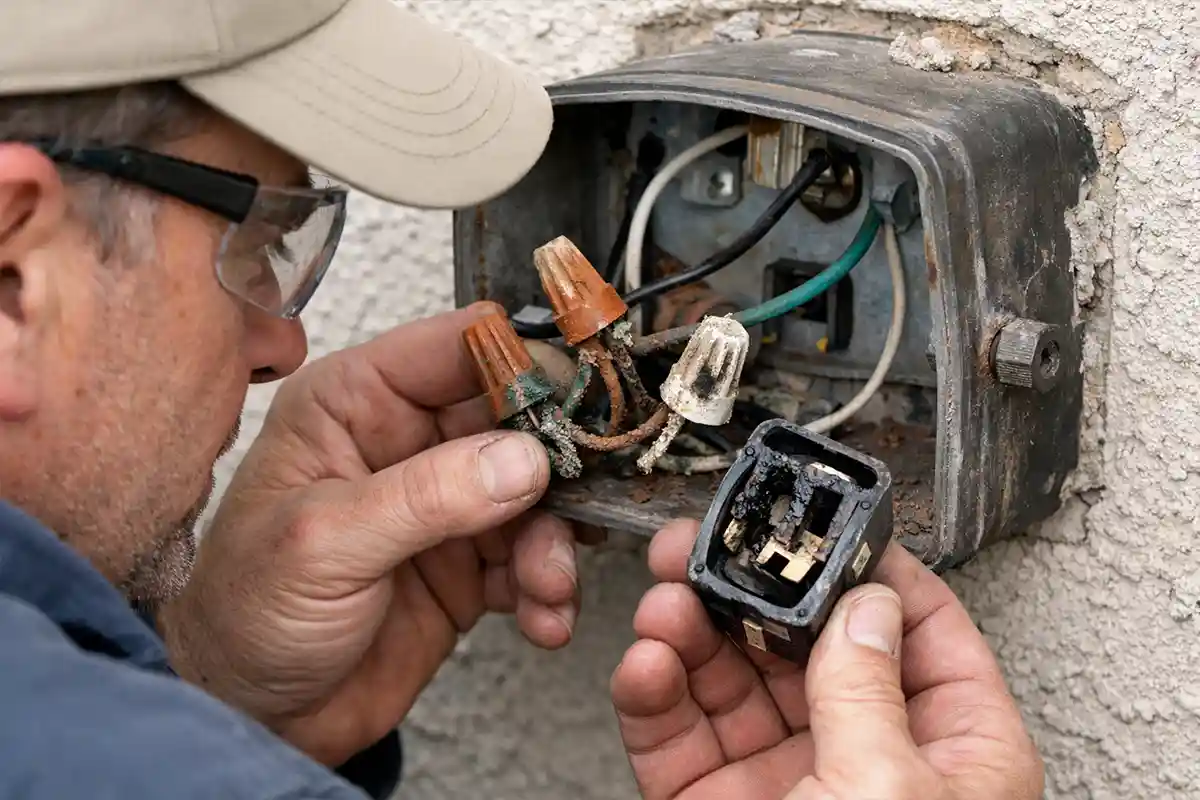
You dry the fixture, reseal the edges, and it works again for a few weeks. Then another storm hits and the outage returns. That cycle often means internal damage has moved beyond surface moisture.
Certain signs suggest repair may no longer restore long-term reliability:
-
Darkened or brittle wire insulation
-
Deep rust pitting on mounting plates
-
Loose socket contacts that no longer grip firmly
-
Burned or overheated wire connectors
Once corrosion reaches conductor strands, resistance remains elevated even after drying. The fixture may operate, but its safety margin narrows.
At that stage, the issue is less about one storm and more about cumulative structural stress. Understanding where that threshold sits helps explain why some lights repeatedly fail after rain while others remain stable for years.
Installation Factors That Reduce Rain Intrusion Risk
A fixture mounted tightly against flat siding behaves very differently from one sitting on uneven brick. In real homes, walls are rarely perfectly smooth, and that small gap behind the backplate can quietly collect water during storms. Over time, that hidden channel becomes the main path for rain intrusion.
Small installation differences often change how rain interacts with the fixture:
-
Slight backward tilt that lets water sit along the top seam
-
Missing or uneven sealant around the mounting plate
-
Junction boxes recessed too deeply into siding
-
Fixtures installed directly under heavy roof runoff
When water repeatedly slips behind the fixture, it bypasses the visible glass and enters from the rear. That is why some lights look dry from the front yet still develop internal corrosion.
Sealant aging also shifts performance. What once formed a flexible barrier can shrink and crack after seasons of sun exposure. Those hairline openings may not be visible from a distance, but they change how wind-driven rain behaves around the fixture.
Selecting Fixtures Built for Direct Rain Exposure
A lantern installed under a covered porch experiences a different life than one mounted on an open fence post. The label “outdoor” does not always reflect how much direct rain a fixture can realistically handle. Over time, that mismatch shows up as recurring moisture problems.
Fixtures designed for full exposure typically include:
-
Thicker gaskets that maintain compression
-
Enclosed wiring chambers separated from the lens area
-
Corrosion-resistant screws and brackets
-
Coatings that resist both UV and water breakdown
Material choice also shapes longevity. Marine-grade aluminum and stainless components hold up better in coastal rain, while thin stamped steel deteriorates faster once coatings are compromised.
Design simplicity matters as well. Fixtures with multiple decorative seams create more potential entry points. In heavy rain climates, fewer joints often translate to fewer long-term vulnerabilities.
Practical Upgrades That Break the Rain-Damage Cycle
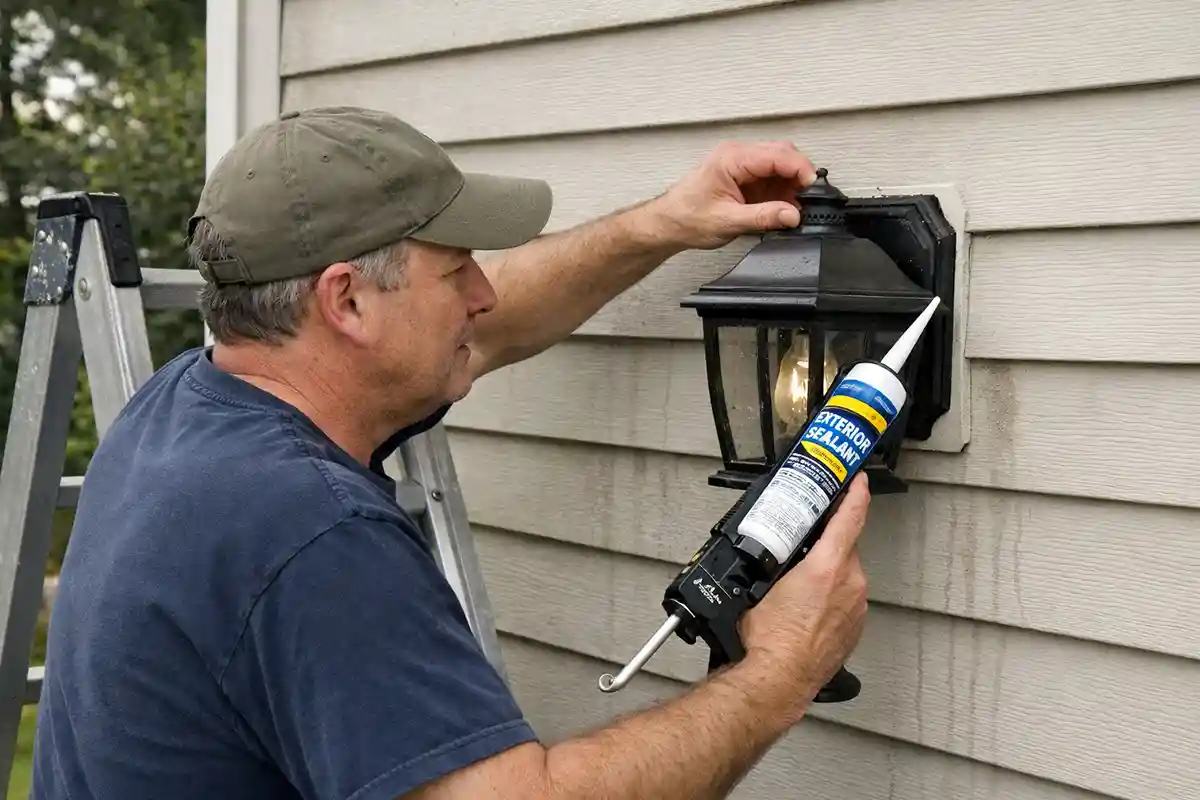
Sometimes the turning point is not replacing the bulb again, but changing how the fixture sits against the wall. A small adjustment in angle or resealing the backplate can noticeably reduce how much water reaches the interior during the next storm.
Real-world improvements often involve spatial or component changes rather than repeated temporary fixes:
-
Redirecting roof runoff with a small drip edge
-
Repositioning sprinklers that spray directly onto the fixture
-
Upgrading from damp-rated to wet-rated in exposed areas
-
Replacing heavily corroded mounting hardware instead of reinstalling it
When these adjustments are made, storm-related flickering often disappears. The light behaves consistently even during steady rainfall, which signals that moisture is no longer reaching critical electrical points.
If repeated repairs have already failed, a broader evaluation of system exposure patterns can clarify why the same issue keeps returning. Understanding the surrounding structural and environmental context often explains recurring rain-related instability.
Environmental Adjustments That Extend Fixture Lifespan
A fixture placed beneath a clogged gutter faces a very different water load than one protected by proper drainage. In many homes, the light itself is not the primary issue; the water path around it is.
Environmental shifts that reduce stress commonly include:
-
Repairing gutters that overflow during heavy storms
-
Trimming branches that funnel concentrated rain onto the housing
-
Adjusting hard surfaces that cause splash-back toward the wall
-
Improving siding transitions where water sheets downward
In humid climates, airflow also changes drying time. Fixtures surrounded by dense foliage remain damp longer after rain, which keeps corrosion active. Opening up that space allows surfaces to dry more quickly between storms.
These changes are not dramatic renovations. They are subtle shifts in how water moves and how long it lingers, and over time they reshape the fixture’s exposure pattern.
Recognizing When Stability Has Truly Returned
After environmental and structural adjustments, the next storm becomes less stressful to watch. The light turns on without hesitation, and there is no flicker when rain intensifies.
Attentive homeowners often notice quiet confirmations like these:
These moments do not feel dramatic, but they signal that the balance between exposure and protection has shifted back into alignment.
From here, rainfall becomes part of the normal backdrop again instead of a trigger for doubt. When installation, material durability, and surrounding drainage patterns work together, outdoor lighting returns to steady performance through changing weather conditions.