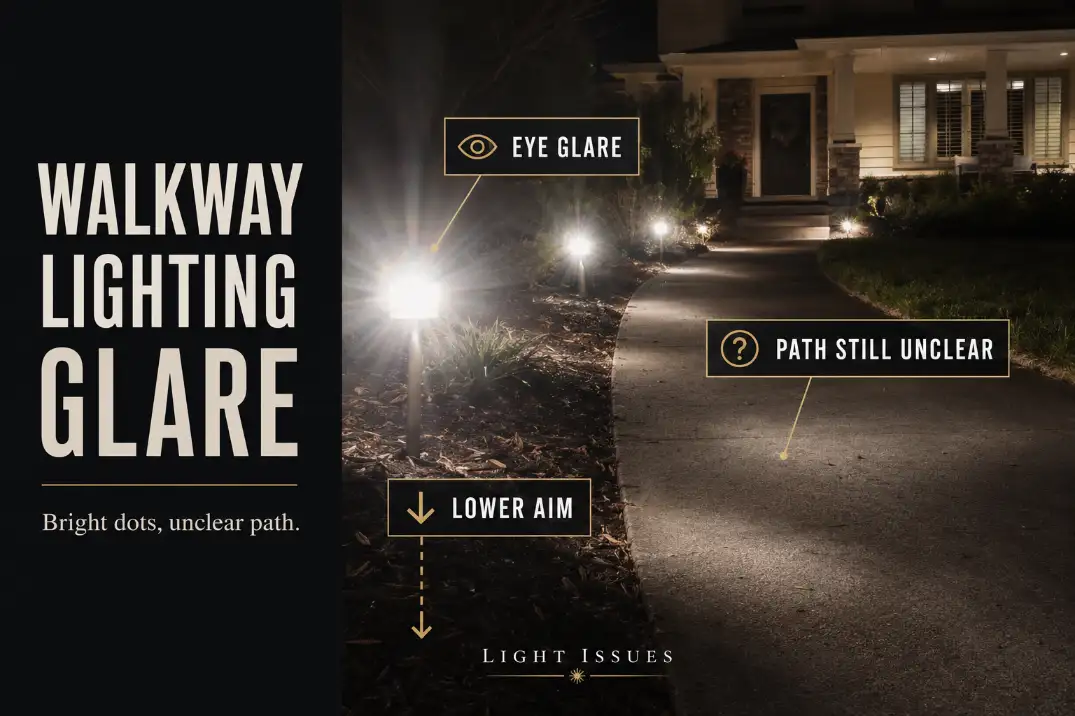
Walkway lighting creates glare when the visible fixture becomes brighter than the walking surface. Good guidance hides the light source, sends the beam downward, and makes the next edge, step, or turn readable before the fixture itself grabs attention.
The first checks are simple: stand 25–40 feet away, walk toward the path, and notice what your eye finds first. If you see glowing lenses before you can read the walkway edge, the lights are not guiding you.
Healthy path lighting should make the route understandable within the first 2–3 seconds of approach. Glare does the opposite. It makes the fixture feel bright while the ground still feels uncertain.
This is different from a weak-output problem. Weak lights look dim everywhere. Glare often looks bright from a distance but still fails where it matters: at the edge, turn, step, or entry transition.
Why Walkway Lighting Turns Into Glare
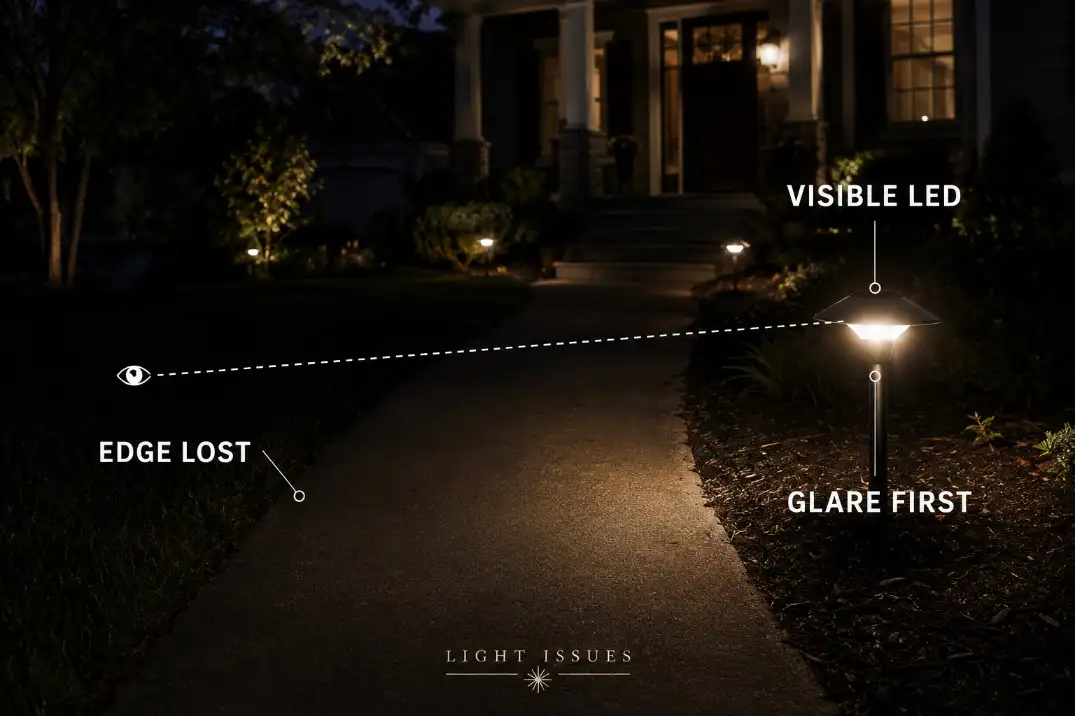
If the lamp or LED is easier to see than the path edge, the walkway light is creating glare, not guidance. The fixture may be working electrically, but visually it is asking your eyes to look at the wrong thing.
The visible source becomes the problem
Most residential path lights sit about 12–24 inches above grade. That height can work well when the lamp is hidden under a cap or hood. It becomes harsher when the LED, clear lens, or glowing side panel is visible from normal standing height.
The common mistake is treating glare as proof that the light is strong enough. In reality, the light source may be too exposed while the walking surface still receives uneven light. A fixture can look bright from the street and still fail the person using the walkway.
The path loses its visual edge
Guidance depends on low, useful contrast. You need to see where concrete meets lawn, where the walkway turns, where the first step begins, or where the porch transition starts. If the brightest part of the scene is a row of small lamps, the eye follows the lamps instead of the route.
That is why walkway glare often feels confusing rather than simply uncomfortable. The yard looks lit, but the walking decision still feels unclear.
What Homeowners Usually Misread First
The first thing to rule out is not weak lighting. It is misdirected lighting. More brightness, more fixtures, or tighter spacing can make the problem worse when the light source is already exposed.
More fixtures can create more confusion
When path lights are placed every 3–4 feet, the walkway can start to look like a dotted runway. That may seem organized, but it can reduce comfort because every fixture becomes another bright point in the eye line.
A typical residential walkway often reads more naturally with lights spaced around 6–8 feet apart, but spacing is not the first fix if each fixture is glaring. First hide or soften the source. Then judge whether the spacing is actually uneven.
If the fixtures sit right on the edge of the walking surface, glare and physical placement can overlap. The issue is closely related to Why Path Lights Are Too Close to Walkway Edges because a light that is too close to the path can shine directly into a person’s field of view.
Brighter bulbs often waste time
The most common disappointing fix is installing a brighter lamp. If the fixture exposes the LED or lens, increasing output may brighten the fixture face more than the path. The walkway looks more intense, but not more readable.
A useful threshold is practical: if you can see the lamp, LED chip, or bright lens from 20–30 feet away at normal standing height, fixture control matters more than bulb strength. In that condition, lower output, warmer color, shielding, or a different fixture style usually helps more than another brightness upgrade.
Pro Tip: Test one fixture before changing the full run. Cover the visible lens from the walking direction with your hand. If the path immediately feels easier to look at, glare control is the priority.
The Glare Versus Guidance Test
A path light passes the guidance test when you notice the walkway edge before you notice the glowing fixture. This test is more useful than judging the lights from a porch, window, or product photo.
Check the approach, not the fixture
Stand where a guest would first see the walkway. Walk toward the path and ask three questions:
| Night check | Good guidance | Glare problem |
|---|---|---|
| First thing you notice | Path edge or route | Glowing lens or cap |
| 25–40 ft approach | Walkway reads softly | Bright dots dominate |
| First 2–3 seconds | Direction feels clear | Eye jumps to fixtures |
| First 10–15 ft | Edge, step, or turn is readable | Surface still feels uncertain |
| After rain | Slight reflection only | Wet surface feels harsh |
| Fix priority | Shield and aim | Do not add more fixtures yet |
The key is not whether the light is visible. Outdoor lights are visible at night. The question is whether the visible source becomes more important than the walking surface.
Separate glare from uneven lighting
Glare and uneven lighting can appear together, but they are not the same problem. Uneven lighting creates bright and dark patches on the ground. Glare creates bright points in the eye line. If you fix spacing before fixing glare, you may simply create a more evenly spaced row of uncomfortable lights.
For a walkway that has both harsh points and dark gaps, the order matters. Reduce visible source brightness first. Then evaluate whether the pattern still needs spacing correction. For a deeper spacing diagnosis, Why Pathway Lights Look Uneven at Night is the more specific next read.
How to Fix Walkway Glare Without Overlighting
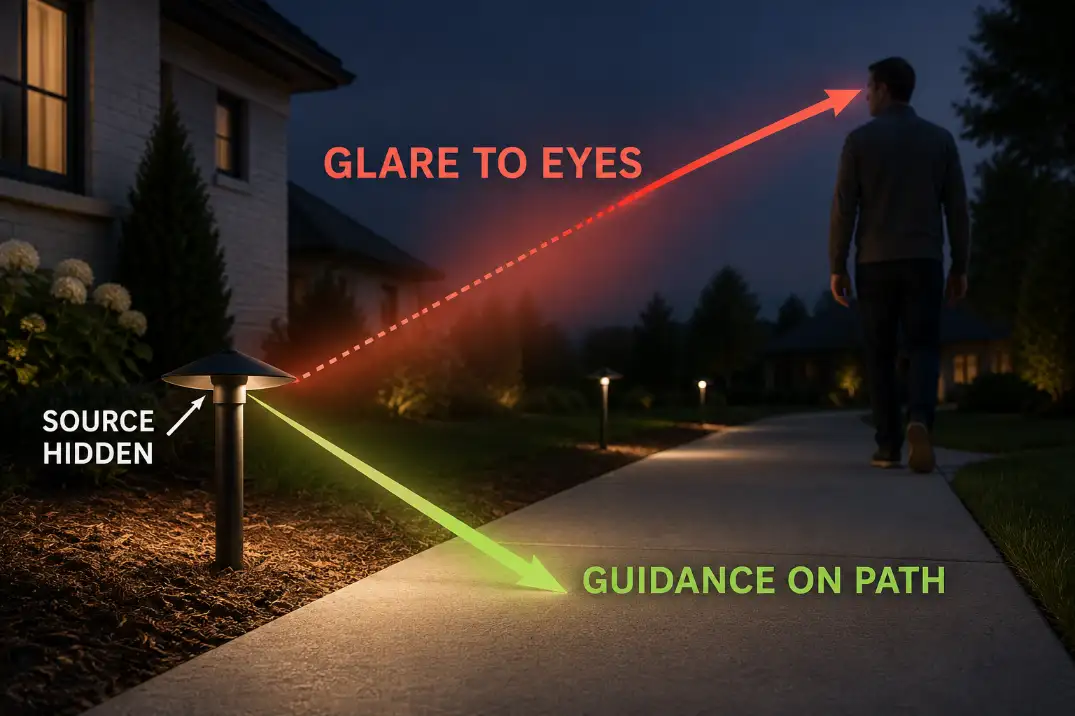
Fix glare in this order: hide the source, aim the beam down, then adjust spacing. That sequence prevents you from solving the wrong problem first.
Hide or soften the source
Look at each fixture from the direction people actually walk. If the lamp is exposed, try a shielded cap, deeper hood, frosted lens, lower-output lamp, or louvered fixture face.
A warmer lamp around 2700K usually feels softer in a residential walkway than a cool 4000K lamp, especially near pale concrete, white stone, or light-colored pavers.
Color temperature will not fix a bad fixture by itself, but it can reduce the sharpness of glare once the source is controlled.
Aim the light toward the walking edge
The best path lighting does not try to flood the whole front yard. It reveals the next few feet of route. A soft 2–4 foot spread along the walkway edge is usually more useful than a wide sideways splash across shrubs, windows, or eye level.
Small placement changes can matter. Moving a fixture 6–12 inches farther into the planting bed may change the viewing angle enough to reduce glare while keeping the path readable. That is especially true on narrow front walks where the fixture sits too close to the person’s natural line of sight.
Adjust spacing only after glare drops
Once the source is hidden and the beam is lower, walk the route again. If the path still alternates between hot spots and dark patches, spacing may need work. If the route now feels calm, the original issue was probably not spacing at all.
This is also where broader placement problems may show up. A walkway that competes with porch lights, garage lights, wall fixtures, or post lights may need a larger layout correction.
In that case, How to Fix Poor Outdoor Light Placement is more useful than treating the walkway as a single isolated line.
When the Fixture or Layout Needs Replacing
If one lower-output test and one aiming test do not reduce glare, the fixture style or layout is probably the real problem. Repeating bulb changes after that point usually wastes time.
The fixture style is fighting the site
Clear lenses, exposed LED pucks, and wide-open side-glow fixtures can all look appealing in a store image. They are less forgiving beside narrow concrete, reflective pavers, wet surfaces, or curved walkways. The fixture may not be defective. It may simply be the wrong glare profile for that path.
A deeper hood, shielded downlight-style path fixture, or louvered face can solve more than repeated lamp swaps. The better fixture is not always the brightest one. It is the one that lets the path appear before the source.
Reflective surfaces can raise glare temporarily
Wet concrete, glossy stone, pale pavers, and snow can bounce light back toward the eye. After rain, a walkway may feel harsher for 30–90 minutes depending on drainage, air temperature, and surface texture.
In northern winters, snow along the edge can make an acceptable fixture feel much brighter because the surrounding surface becomes reflective.
This is easy to underestimate. The fixture has not changed, but the surface has changed how much light reaches your eyes.
Competing lights can break the guidance
Porch lights, garage sconces, post lights, streetlights, and security fixtures can all affect how a walkway reads. If a bright porch light pulls the eye upward while path lights create glare below, the entry may feel busy rather than safer.
That broader effect is one reason brighter outdoor lighting can reduce visibility. If the whole front yard feels harsh but still unclear, Why Brighter Outdoor Lights Can Make Visibility Worse explains the larger visual pattern behind the walkway problem.

What Actually Creates Better Walkway Guidance
Better guidance comes from selective light, not maximum light. The path should become easier to understand without making the fixture visually dominant.
Prioritize decision points
Do not treat every foot of the walkway equally. The most important areas are the first step onto the path, a curve, a step, a grade change, and the final transition near the front entry. If those points are clear, the walkway can feel safer with less light overall.
That is where glare control and safety overlap. A bright path can still fail if it does not clarify where the foot should go next. For safety-focused placement, How Path Lights Improve Walkway Safety gives that decision layer more room.
Let darker areas stay quiet
A walkway does not need to glow evenly from end to end. Some darkness around the route helps the useful light stand out. When every fixture, shrub, wall, and path edge is lit at the same intensity, the scene can flatten visually.
The strongest walkway lighting is restrained. It hides the source, lights the edge, reveals the turn, and avoids the eyes. That is the difference between lighting that guides movement and lighting that only announces itself.
Questions People Usually Ask
Are path lights supposed to be visible?
The fixture can be visible, but the lamp or LED source should not dominate your view. If the glowing lens grabs attention before the path edge does, the light is creating glare.
Is walkway glare caused by too many lights?
Sometimes, but the more likely cause is exposed source brightness or poor beam direction. Too many lights make the problem worse when each fixture is already glaring.
Should I replace all the path lights?
Not first. Test one fixture with lower output, better shielding, or a slight relocation. If that does not improve comfort, the fixture style or layout may need changing.
Can glare make a walkway less safe?
Yes. Glare can make steps, edges, surface changes, and turns harder to read. A walkway that feels bright but makes people squint is not providing good guidance.
Outdoor lighting works best when it is useful, targeted, low-level, controlled, and warm-colored, a principle reinforced by DarkSky’s Five Principles for Responsible Outdoor Lighting.