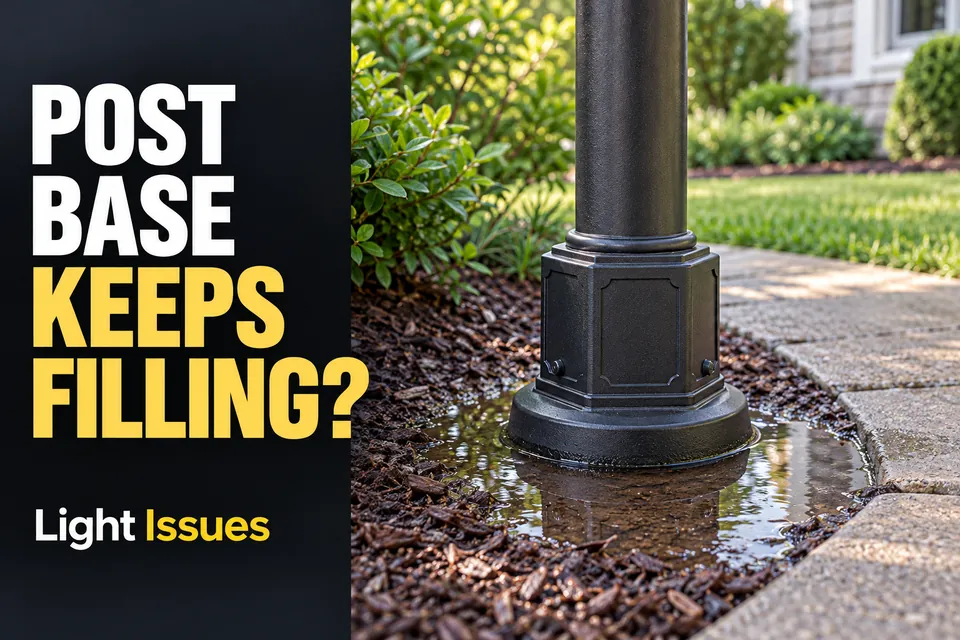
A post-light base that keeps filling with water needs a repair that addresses three things: the water source, its route into the post, and the electrical connections it can reach. Replacing the lantern addresses only one possible entry point. Emptying the cavity leaves the route unchanged.
Start by separating confirmed water inside the base from a puddle around it. Exterior ponding helps direct the investigation, but it cannot reveal conditions behind a closed cover. Note whether filling follows runoff, irrigation, snowmelt, or prolonged ground saturation; leave internal inspection to an electrician.
Fix Boundary: Do not touch the wet post, reach into its base, or try to empty it. If you can switch the circuit off from a dry, safe location, leave it off pending electrical assessment; do not approach flooded electrical equipment to disconnect it.
Fixture Leak vs Groundwater at the Base
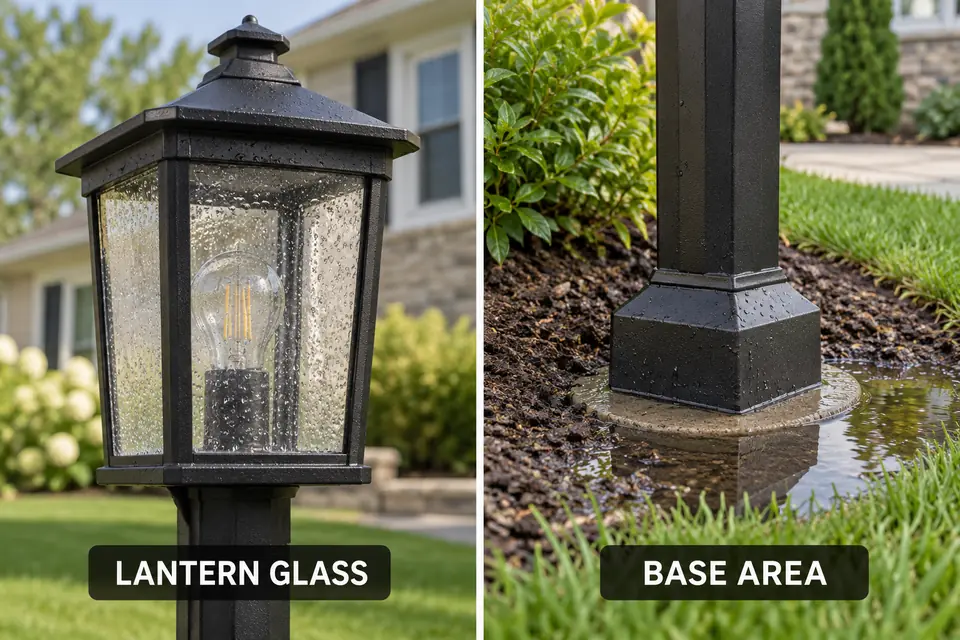
Locate the water before blaming the lantern. A fixture leak can contribute to base accumulation only where the fixture and post provide a continuous route downward. That route depends on the construction; droplets on the glass do not establish it.
Fine glass haze has a different diagnostic role. If the symptom is limited to moisture that appears only at sunrise, follow that pattern separately. Glass fogging alone does not explain a base that repeatedly fills with standing water.
Clear glass does not rule out entry through another upper joint, post opening, or cable route. Likewise, saturated soil beside the post makes a lower entry path worth investigating, but it does not prove groundwater is the source.
Keep three observations separate: what is happening at the lantern, what surrounds the base, and what an electrician has confirmed inside it. A post can have glass condensation and a separate below-ground water problem at the same time.
Drainage, Conduit, and Handhole Paths
Use the relationship between filling and surrounding water conditions to choose where the investigation starts. Ponding during runoff directs attention toward surface entry; filling associated with lingering saturation keeps below-ground routes in question. Observe from a dry location during normal weather or an existing irrigation cycle, without adding water to test the installation.
Surface Runoff Around a Low Base
A depression beside a walkway or planting bed can collect runoff against the post. Irrigation may repeatedly wet the same location even when rainfall is light. Soil or mulch built up around a lower opening can also change its exposure.
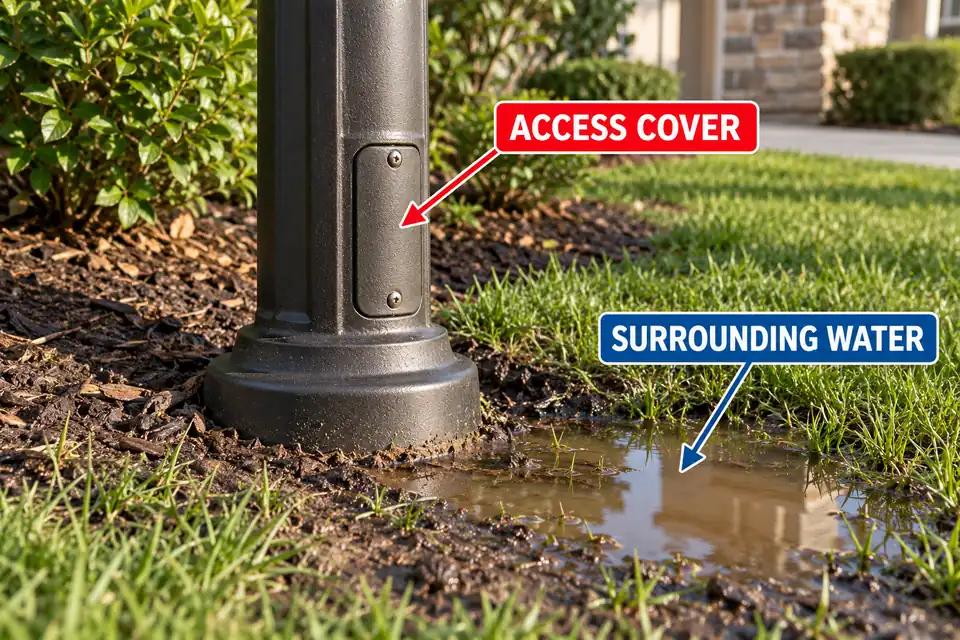
Ponding makes the base perimeter and access-cover condition relevant inspection points. Internal assessment must establish whether that water enters the post or simply sits beside it.
Saturated Ground Below the Surface
When surrounding soil remains saturated, water in a connected cavity may have little opportunity to drain outward. Removing an exterior puddle does not necessarily change the water conditions below ground.
A dry-looking soil surface is incomplete evidence: deeper ground may remain wet after the top layer dries. Refill associated with prolonged saturation supports a drainage investigation, without establishing the precise underground route.
Conduit and Lower Access Openings
Underground conduit can contain and convey water. Depending on its elevations and connections, it may provide a route from another wet location toward the post. Water in conduit does not, by itself, prove that the conduit is broken.
A post’s handhole is its lower access opening. This differs from a separate in-ground handhole enclosure serving the wiring. Not every residential post has either arrangement, so the inspection must follow the actual installation.
A missing or displaced access cover can admit rain or splash. A fitted cover, however, cannot prevent water arriving through a different route below it.
Each observation narrows the investigation only so far.
| Observation | Path worth investigating | What it does not prove |
|---|---|---|
| Water ponds around the base during runoff | Surface entry at the base or a low opening | That the exterior puddle reaches the wiring cavity |
| Reported filling follows prolonged ground saturation | Below-ground communication and limited drainage | That groundwater is the only source |
| Internal refill has been reported while the surface looks dry | Conduit transport or persistent subsurface water | That conduit is damaged |
| Access cover is displaced or has nearby water staining | Rain or splash entry around the opening | That this is the only entry path |
Give these observations to the professional assessing the post. They help prioritize inspection without requiring you to open a wet compartment.
Why Pumping It Out Is Temporary
An emptied base shows that stored water was removed. It says nothing about whether the next rain, irrigation cycle, or period of saturated ground will fill it again.
If the base was previously emptied, report when water returned and what the weather or irrigation was doing. That history can help narrow the investigation. Do not repeat the emptying process to create another test.
An apparently dry cavity also says little about components that were wetted. Residue, corrosion, or insulation damage may remain after visible water disappears.
Adding gravel, drilling a hole, or sealing every seam is equally uncertain without understanding the installation. Gravel cannot create a drainage outlet where none exists, and indiscriminate sealing can obstruct manufacturer-provided drainage features. Before accepting a drainage fix, establish where the water is expected to go when the surrounding ground is already wet.
Protecting Connections Above the Wet Zone
Connection elevation helps only when the revised arrangement remains suitable for the installation. An electrician may be able to reposition connections away from recurring accumulation, but no universal height above a puddle or old water mark makes them safe.
The arrangement must preserve required access, support the conductors appropriately, and use components suited to the exposure. Moving an unsuitable connector higher does not change its rating, and future water levels may exceed the previous mark.
Existing damage is a separate decision. Signs of corrosion in outdoor light connections may require component or conductor replacement even after the water source is corrected. Repositioning a damaged splice does not restore it.
Connector suitability depends on conductor type, electrical rating, the complete sealing system, and installation instructions. Wet-location, direct-burial, and submersible suitability are not interchangeable descriptions. A general “outdoor” label does not establish whether a connection can tolerate its actual exposure.
The electrician must assess both the revised placement and the condition of previously wetted parts before return to service. Higher placement is one possible protection measure, not a substitute for that assessment.
When the Base or Conduit Needs Rebuilding
Rebuilding becomes relevant when a limited repair cannot correct the identified entry path or provide a suitable electrical arrangement. A damaged cover with a confirmed local leak may need a focused repair; persistent filling without an established source needs further investigation before reconstruction is chosen.
Movement changes that judgment. If you also have a post that keeps leaning as soil settles, the support and ground conditions need assessment alongside the water problem. Cover repair alone cannot resolve an unstable base.
An electrician handles wiring condition, connection protection, conduit assessment, and safe return to service. A drainage professional addresses persistent saturation, runoff collection, and whether the site has a feasible way to manage that water. Structural deterioration may require additional qualified assessment.
The work may need coordination where site water repeatedly reaches the electrical installation. Damaged conduit, settlement, or a connection compartment that cannot be suitably protected can justify broader work. Wet conduit alone is not a replacement verdict; the repair proposal should identify the defect being corrected and how the revised arrangement handles the exposure.
Once the wet-base condition has been professionally addressed, any remaining lighting failure can be investigated through other reasons an outdoor post light stops working. That keeps unrelated bulb or control faults from distracting from the original water problem.
Before treating the repair as complete, ask what now limits water entry or accumulation and what protects the connections if moisture returns. Comparable natural wet conditions help check recurrence externally; internal verification and the decision to restore power belong to the electrician.
UL’s guidance on sealed wire connector systems explains why conductor compatibility and application-specific markings matter when selecting connection protection.