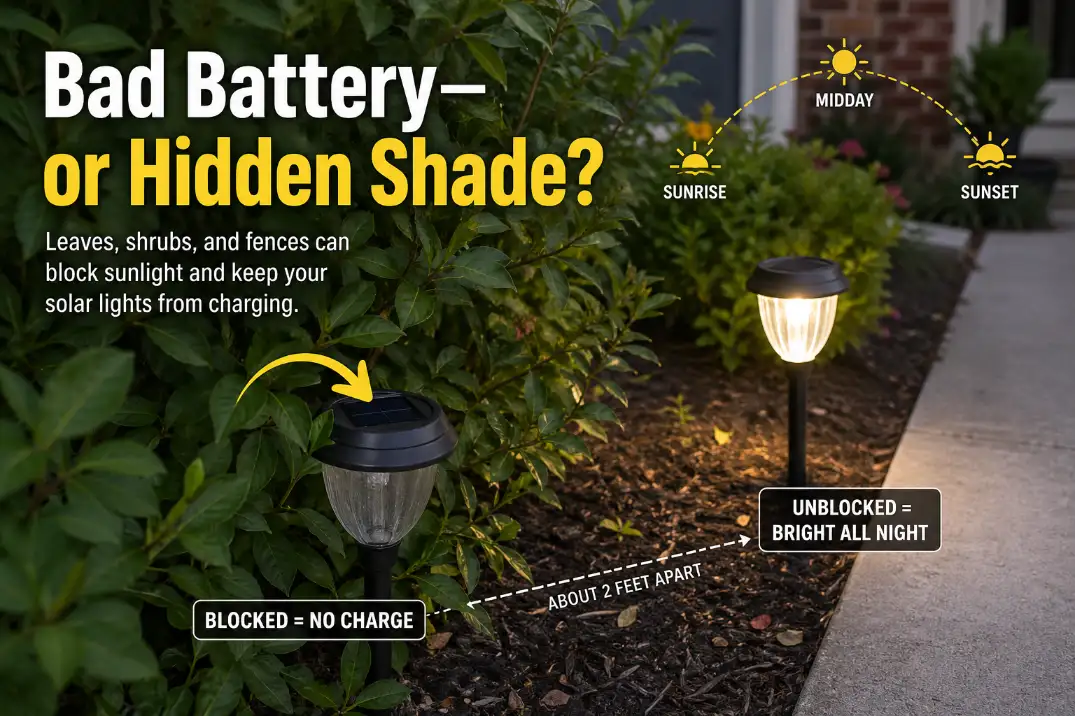
Solar garden lights usually fail near overgrown bushes because the charging cycle breaks before the light itself does. If only the lights beside shrubs are dim, shut off after 30–90 minutes, or stop turning on while open-area lights still run 6–8 hours, the first suspect is blocked sunlight, not a bad bulb.
Check the panel between 10 a.m. and 2 p.m.; if leaves cast shade across it during that window, the battery may never receive a full charge.
The useful test is simple: clear the panel, clean it, then give the light 1–2 sunny days. If runtime improves, the fixture is still usable. If it stays weak after 48–72 hours in open sun, then the battery or fixture deserves attention.
Why Bushes Make Solar Garden Lights Fail
The visible symptom is dim light, but the cause is poor charging
A solar garden light can look broken at night even when the real failure happened all day. The panel did not collect enough energy, so the battery enters the evening already low. That creates weak output, early shutoff, flickering, or no light at all.
This is why replacing the battery too early often disappoints. A new battery under the same shaded panel will still be undercharged. The location has to pass first.
Filtered daylight is not the same as direct sun
A panel can look bright to your eyes and still charge poorly. Leaves scatter and block usable light, especially when the panel is small and flat. For dependable performance, many small garden lights need about 4–6 hours of direct sun, not just general daylight.
That makes shrub shade more serious than it appears. A light may receive morning brightness, then lose the strongest charging window once the bush shades it at midday.
This same charging principle also explains broader sun exposure issues with solar lights, but overgrown shrubs are easier to miss because they change slowly.
The Bush Problem Often Shows Up Late
The light may work fine after installation
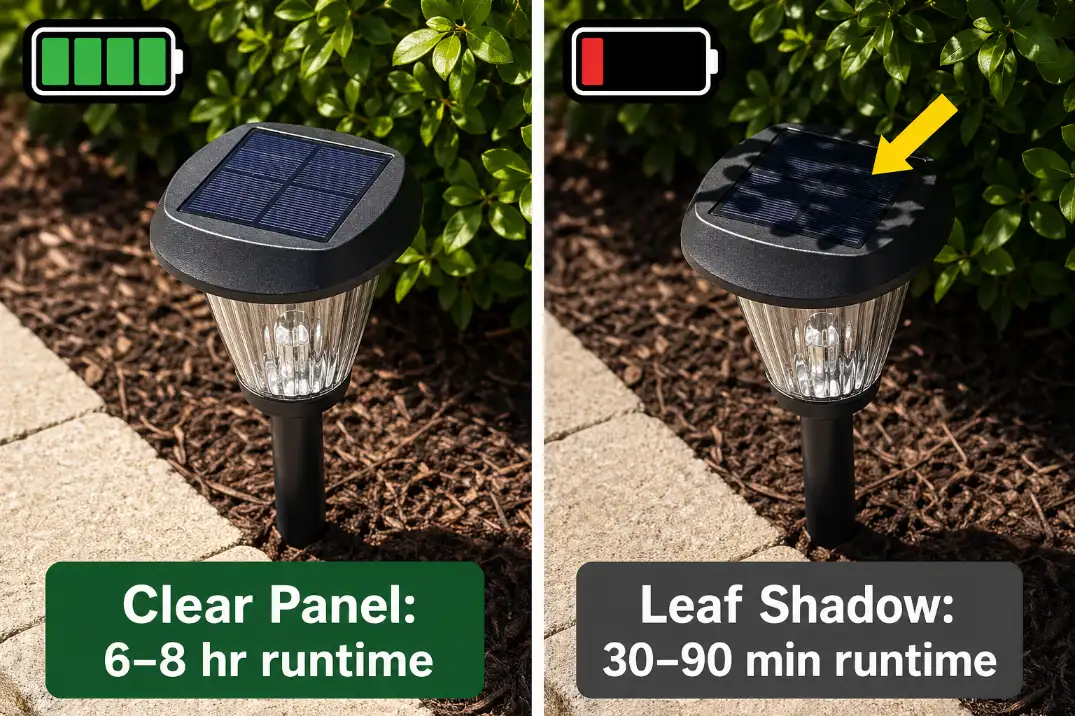
This issue often appears weeks after the light was installed, not on day one. A shrub that looked harmless in early spring can push new growth over the panel by early summer. In fast-growing beds, the panel can go from clear to shaded in 4–8 weeks.
That delayed failure matters. If the same light worked well at first and declined as the plant filled in, the fixture probably did not “suddenly go bad.” The charging environment changed.
Seasonal conditions can make the same spot worse
In humid regions like Florida or the Southeast, dense foliage and fast regrowth can keep panels shaded for much of the growing season. In northern states, late fall debris and lower winter sun can make a borderline location fail even after the shrub stops growing.
In dry areas, dust and pollen on a shaded panel can make an already weak charge even weaker.
This is why a quick trim may help for a week but not solve the problem. If the shrub naturally grows back over the panel within 2–3 weeks, the light is in the wrong spot.
If your solar lights seem to charge all day but still stay dark at night, this guide can help you understand why solar lights fail to work properly.
Quick Diagnostic Checklist
Use this table to decide whether the problem is shade, dirt, placement, or battery wear.
| What you see | Most likely meaning | Best next move |
|---|---|---|
| Leaves touch or cover the panel | Physical blockage | Trim or move the light |
| Runtime drops below 2 hours | Battery is not fully charging | Test in open sun for 48 hours |
| Light recovers after pruning | Fixture is probably fine | Maintain clearance or relocate |
| Shade returns in 2–3 weeks | Location is not sustainable | Move the light 12–24 inches |
| Panel has sap, pollen, or mineral spots | Surface loss adds to shade | Clean, then retest |
| Light works in open sun but not near bush | Site failure, not fixture failure | Change placement |
What People Usually Misread
“It gets daylight” is too vague
The useful question is not whether the panel sees daylight. It is whether the panel gets direct sun during the strongest part of the day. If the light is under leaf shade from late morning through midafternoon, it may never build enough charge for a full night.
Solar lights affected by trees behave in a similar way, especially when shade expands across the panel after installation. If the problem is coming from taller landscape growth rather than shrubs, the same diagnosis applies to solar outdoor lights not charging under tall trees.
A quick panel-cover test can be misleading
Covering the panel by hand may make the light turn on, but that only proves the sensor can detect darkness. It does not prove the battery is charging well. A shrub can make the panel “think” it is dark while also starving the battery.
That distinction matters because sensor behavior and charging performance are separate problems. A light that turns on for a few seconds during a hand-cover test can still fail after sunset.
The Fix: Prune, Clean, Then Decide
Trim for panel exposure, not just neatness
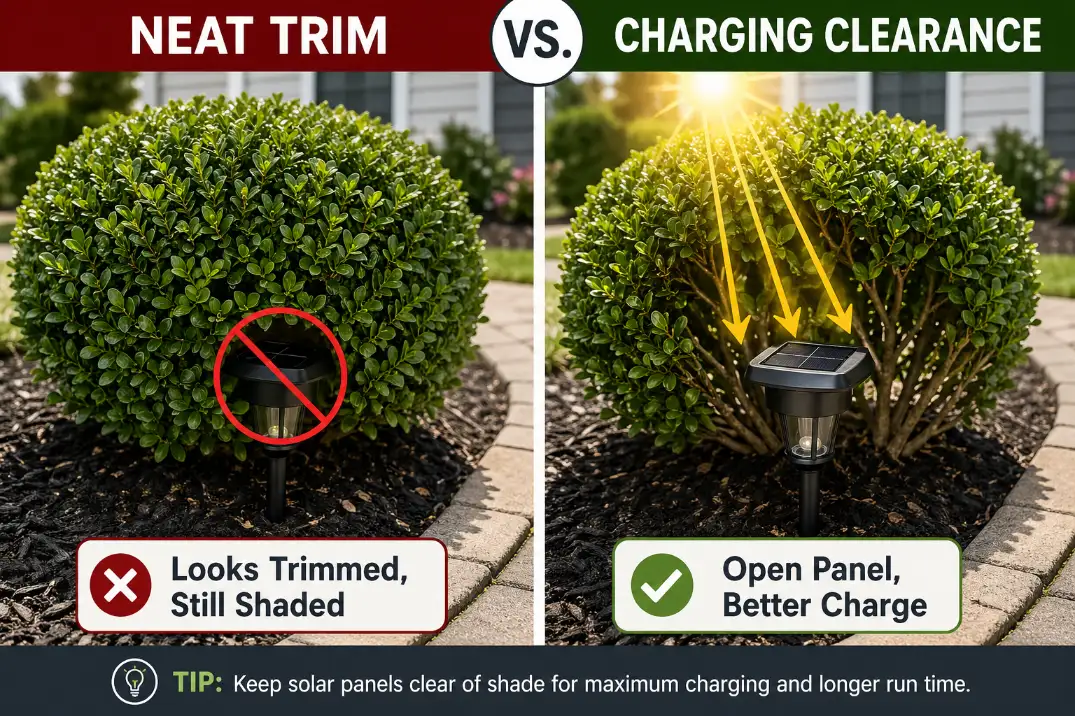
A cosmetic trim often leaves the real problem intact. Shaping the outside of the bush may still leave a leafy shell over the panel. What matters is a clear sky window above the solar cell.
Aim for at least 12 inches of open space around the light head and no leaf shadow across the panel during midday. Selective thinning is usually better than shaving the front of the plant because it opens small light gaps without ruining the shrub’s shape.
Pro Tip: Check the shadow on the panel at midday, not just in the morning. Morning sun can make a bad location look better than it is.
Clean what the bush leaves behind
Bushes do more than cast shade. They can drop sap, pollen, petals, dust, mulch splash, and leaf debris onto the panel. A thin film may not ruin a good location, but it can push a borderline shaded light into failure.
Wipe the panel with a damp microfiber cloth, not an abrasive pad. If sprinklers hit the fixture, look for white mineral spots on the panel or lens. That pattern overlaps with solar path lights affected by irrigation spray, especially when lights fail fastest near wet planting beds.
Move the light when pruning becomes a maintenance loop
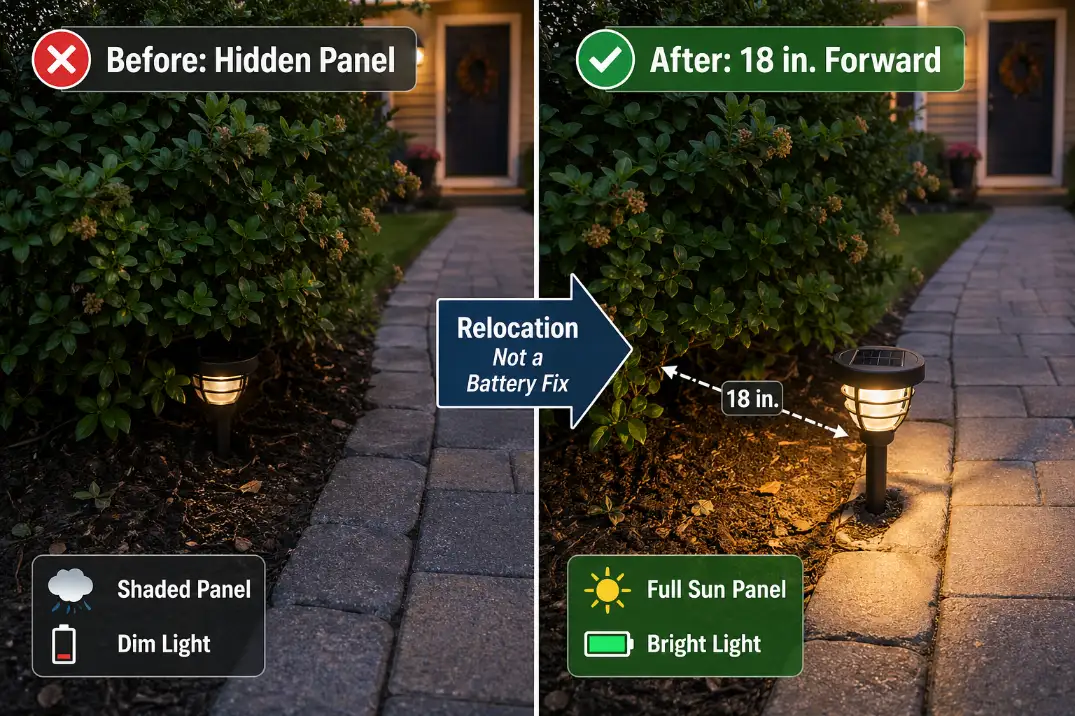
Sometimes the smartest fix is not cutting more. If the shrub is a privacy hedge, foundation plant, or flowering feature, repeated pruning for a small stake light is the wrong priority. Move the light 12–24 inches toward the walkway edge, or use a model with a separate remote solar panel.
The decision point is practical: if the panel becomes shaded again within 2–3 weeks of trimming, relocation beats maintenance.
When It Is Not Really a Bush Problem
Artificial light can stop a charged light from turning on
If the light charges well in open sun but refuses to turn on at night, nearby artificial light may be hitting the sensor. Porch lights, driveway fixtures, and streetlights can make a solar garden light think it is still daytime.
That is different from shrub shade. Bushes usually cause weak charging and short runtime. Artificial light usually causes a charged light to stay off. If that fits your yard, compare the symptoms with solar lights not turning on near streetlights.
Battery replacement only makes sense after a location test
A battery that has been repeatedly undercharged can wear down. But battery replacement should come after the open-sun test, not before it.
Move the light to a clear sunny area for 48–72 hours. If runtime improves strongly, the battery still has useful life. If it remains dim or dies quickly after that test, replacement may be justified. For a broader battery-focused pattern, see why solar light batteries die so quickly.
Best Repair Order
1. Expose the panel first
Clear leaves from the panel and create open space around the light head. Do this before touching the battery.
2. Clean the panel
Remove pollen, sap, soil splash, and mineral film. A dirty shaded panel has two charging problems at once.
3. Test in open sun
Place the light where the panel gets direct sun for two full days. This separates a bad location from a bad fixture.
4. Move or upgrade if shade returns
If the shrub quickly regrows into the panel, move the light. If the light must stay near the plant, choose a solar fixture with an adjustable or remote panel.
5. Replace the battery last
Only replace the battery if the light still performs poorly after 48–72 hours in a good charging location. Otherwise, the battery is being blamed for a sunlight problem.
The main decision is simple: if the light improves in open sun, stop replacing parts and fix the location. If it stays weak after several strong charge cycles, then the battery or fixture has earned suspicion.
Questions People Usually Ask
How long should solar lights take to recover after trimming bushes?
Most should improve after 1–2 sunny days. If they remain weak after 3 sunny days with a clear panel, test the battery or fixture.
Can solar garden lights charge through leaves?
They may collect a little energy through filtered light, but usually not enough for dependable all-night runtime. Filtered shade often creates short, weak output rather than true charging.
Is it better to prune the bush or move the light?
Move the light if the shrub is meant to stay dense or regrows over the panel within a few weeks. Prune only when you can keep a reliable 4–6 hour sun window.
Can one overgrown bush affect several lights?
Yes, if several lights sit along the same hedge or planting bed. But most stake lights have individual panels, so each light should be checked separately.
For broader guidance on placement and sunlight needs, the U.S. Department of Energy outdoor solar lighting guide is a useful reference.