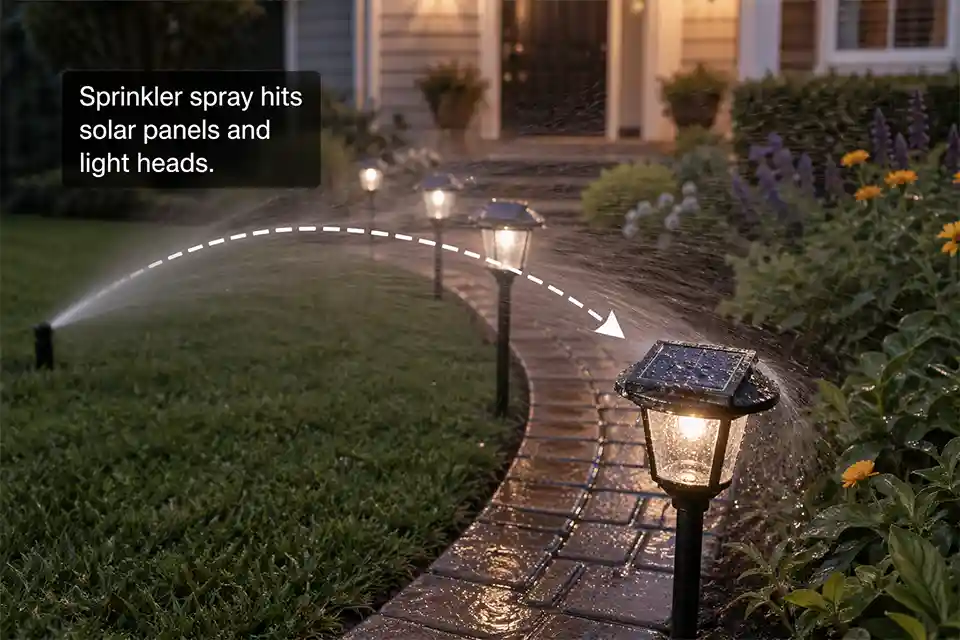
If solar path lights start failing soon after the irrigation system begins running, the most likely cause is repeated overspray, not a random dead battery.
Start with three checks right away: whether the sprinkler stream hits the panel or top cap directly, whether the panel is still wet or spotted 1–2 hours after sunrise, and whether runtime has dropped below about 3 hours after a clear day with 6+ hours of sun.
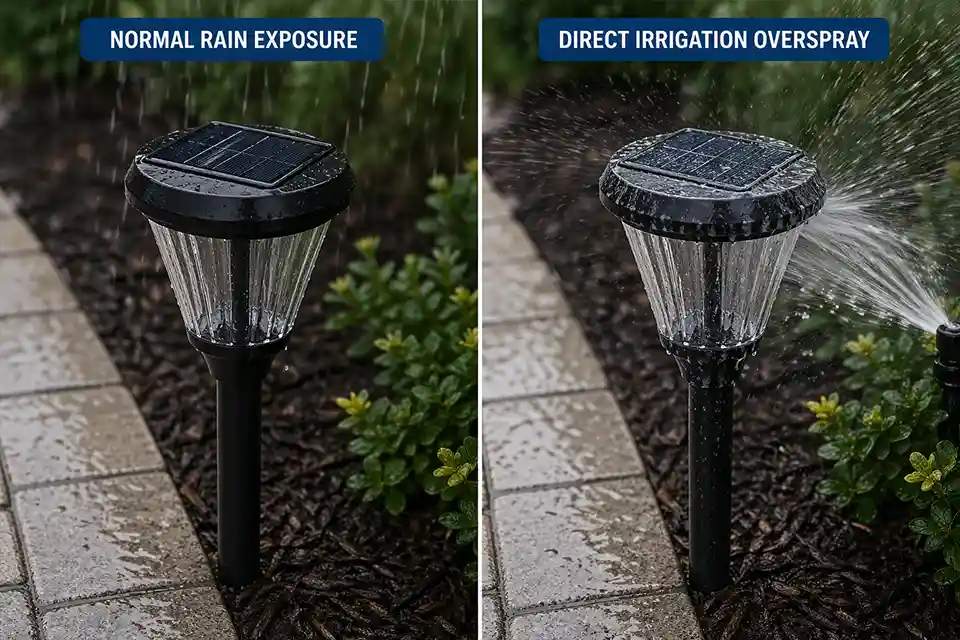
That pattern matters because irrigation damage does not behave like ordinary rain. Rain usually passes over the fixture. Sprinklers hit from the side, repeat on schedule, and often leave mineral film behind. In this scenario, the visible symptom is dimming, flickering, or erratic switching.
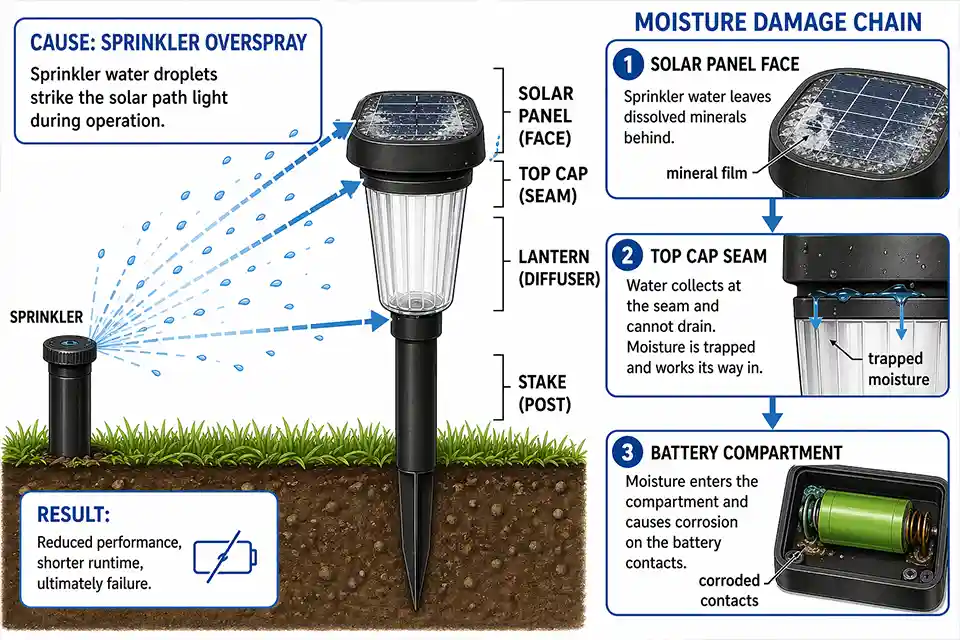
The underlying mechanism is usually undercharging, moisture intrusion, or contact corrosion caused by repeated spray.
The first distinction that actually matters
Rain is not the same as irrigation spray
This is where a lot of troubleshooting goes off course. People see “outdoor rated” and assume any water exposure is basically the same. It is not. Rain usually wets the fixture briefly and from above.
Irrigation spray can hit the same seam or panel for 10–15 minutes per zone, 3–5 times a week, often from the side and at close range.
That repeated side impact is more aggressive than it sounds. It drives water toward the top cap seam, battery cover, and sensor area while also drying into a mineral film. A light can survive ordinary weather and still degrade fast once sprinkler season starts.
That is also why this issue is closer to outdoor lighting losing power when irrigation starts than to a generic seasonal performance dip.
The panel is often the first weak point, not the battery
The most commonly wasted fix here is replacing the battery before looking at the panel surface and spray pattern. If the panel is cloudy with hard-water residue, charging drops before the battery is truly bad.
In real yards, one sprayed light may run only 1–3 hours while a nearby protected light of the same age still runs 6–8 hours after the same sunny day.
That comparison tells you more than the battery date ever will. Symptom and cause are not the same thing: short runtime is the symptom; chronic undercharging from overspray and residue is often the cause.
Quick diagnostic checklist
- The sprinkler stream hits the light head or panel from roughly 2–4 feet away
- The panel stays wet, spotted, or hazy 1–2 hours after sunrise
- Runtime falls below 3 hours after a full clear charging day
- The light works better after several dry days, then worsens after irrigation nights
- The battery compartment shows white residue, rust tint, or green corrosion
- Nearby lights outside the spray arc still perform normally
What people usually misread first
“Waterproof” is often overstated
A light can be suitable for outdoor use and still be a poor match for direct sprinkler exposure. Many inexpensive solar path lights tolerate splashing and rain but not repeated pressurized spray at close range. Readers often overestimate the housing and underestimate the damage from mineral buildup.
That distinction becomes even more important when choosing replacements. Near irrigation zones, a higher-protection fixture makes more sense than the cheapest decorative option. If a product is only lightly protected, bad placement will catch up with it quickly.
A new battery can temporarily hide the real problem
A fresh battery may improve performance for a few nights, especially in warm weather. That can fool people into thinking the problem is solved. Then runtime collapses again because the panel is still undercharging or the contacts are still being exposed to moisture.
This is one reason broad solar-light advice often underperforms in real sprinkler scenarios. The root cause is not just “weak battery behavior.” It is a repeated environmental trigger.
That overlaps with why solar outdoor lights fail so quickly and what’s really causing it, but the irrigation version is more specific and usually easier to confirm if you look at the spray path first.
The failure buckets that matter most
Bucket 1: Dirty panel, no internal damage yet
This is the best-case version. The light is dim or short-running, but the panel just has film, spotting, or grass residue. The battery compartment is dry. There is no visible corrosion. In that case, the problem is mainly charging loss.
A panel like this can often recover if you clean it properly and stop direct overspray. If runtime climbs from 2–3 hours to 5+ hours after one or two clear days, replacement is probably unnecessary.
Bucket 2: Moisture is getting inside the housing
This is more serious. You may see fogging inside the cap, droplets near the battery area, or white crust on contacts. Once moisture gets past the seal, cleaning the panel alone will not solve it.
This is where the issue starts resembling water inside outdoor light fixtures, except on a smaller and usually less serviceable product. People often underestimate this stage because the light still works intermittently. But intermittent operation is not a harmless stage. It often means the deterioration is already underway.
Bucket 3: Contact corrosion or electronics damage
If the light flickers after watering nights, stays weak even after a clear recharge day, or dies early despite a clean panel, the battery contacts or internal electronics may already be compromised. At that point, repeated repair attempts become poor value, especially with low-cost fixtures.
One practical thing I see missed a lot is that once corrosion reaches springs, tabs, or board connections, the light may never return to stable behavior even if it can be revived briefly.
What IP rating changes, and what it does not
Better protection helps, but it does not fix bad placement
If the light sits near irrigation, protection level matters more than people think. A lightly protected fixture may survive weather but fail quickly when exposed to direct spray several times a week. A better-sealed replacement is a smarter choice in sprinkler zones.
But this is the part worth saying clearly: higher protection does not make direct overspray a good idea. Even a better fixture will collect mineral film if the panel keeps getting sprayed. IP protection helps with water entry. It does not solve undercharging from residue and spotting.
Use fixture choice as prevention, not as an excuse
If you are replacing the light anyway, look for features that reduce repeat failure:
- better water protection for irrigation-adjacent use
- a gasketed battery compartment
- replaceable batteries without flimsy covers
- a taller head that sits above the usual spray line
- installation outside the nozzle arc, not just barely beside it
That is a much better long-term fix than buying the same low-cost light again and hoping placement will somehow stop mattering.
Step-by-step fix that earns the effort
1. Stop the overspray first
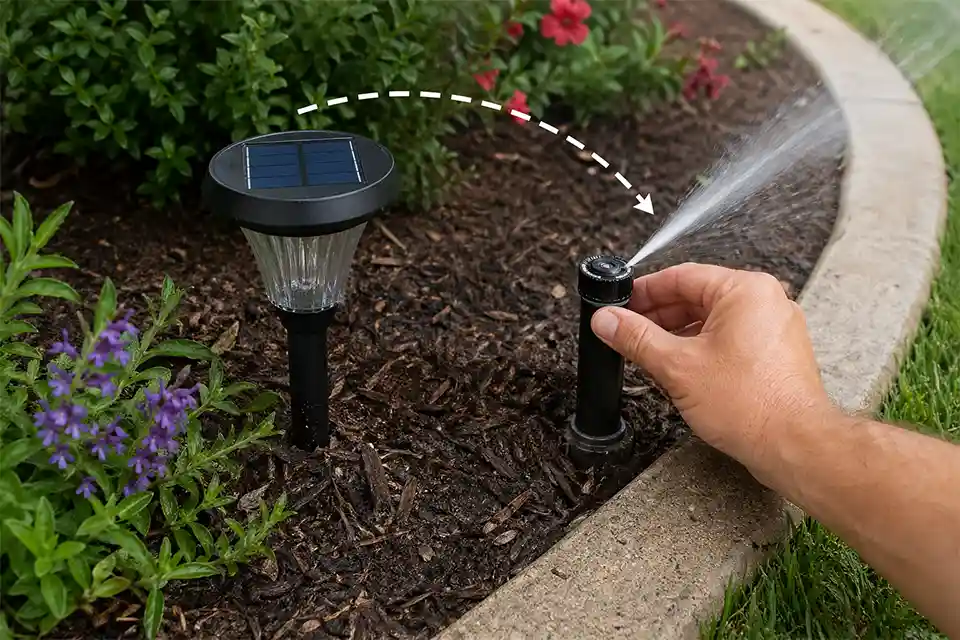
Do not start by opening the light. Adjust the nozzle angle, reduce radius, or move the fixture out of the spray path. In some yards, shifting the light just 6–12 inches works. In tighter layouts, 12–24 inches is more realistic.
If direct spray is still happening, every downstream fix is weaker than it should be.
2. Clean the panel and sensor area properly
Use water and a soft microfiber cloth first. If mineral film remains, use mild soap and rinse. Avoid abrasive pads. If the panel still looks permanently cloudy afterward, the surface may be etched rather than dirty.
That is an important threshold. A dirty panel is fixable. An etched panel often is not.
3. Check for internal moisture only if the fixture is serviceable
Remove the battery and inspect the compartment. Look for white crust, green corrosion, rust tint, or dampness. Then dry the unit indoors for 24 hours before testing again.
Blindly sealing the outside with silicone is usually a bad repair. It often misses the real entry point and can trap moisture or make future access worse.
4. Retest after a real charging cycle
Do not judge the result the same evening. Give the light at least one full clear day with 4–6 hours of direct sun. If you installed a new battery, give it up to 2–3 sunny days to stabilize before calling it a failure. Then compare actual nighttime runtime.
If the light still cannot hold roughly 5 hours in good summer charging conditions, cleanup and drying have probably reached their limit. That is when repair stops being sensible.
| What you see | Most likely cause | What to test next | Repair or replace? |
|---|---|---|---|
| Cloudy panel, no internal residue | Mineral film and undercharging | Clean panel and compare runtime for 2 nights | Usually repairable |
| Works after dry spell, weak after irrigation days | Repeated overspray | Redirect nozzle or move light | Usually repairable if caught early |
| Condensation or white residue inside battery area | Moisture intrusion | Dry for 24 hours and inspect contacts | Borderline |
| Flicker after watering nights | Corrosion or sensor moisture | Clean, dry, then retest after clear day | Often replacement soon |
| Less than 2–3 hours runtime after full sun | Battery/contact/electronics damage | Confirm with dry-day test | Usually replace |
When the standard fix stops working
Cleaning stops making sense when corrosion is visible
Once moisture damage has moved inside, the problem is no longer just “a dirty solar light.” If you see corrosion and the fixture still sits in a spray zone, cleaning is maintenance, not a solution.
Battery swaps stop making sense when the pattern keeps returning
If the light improves for a couple of days and then slides back into weak runtime, late turn-on, or flicker, the battery was probably never the main issue. That is especially true if nearby unsprayed lights remain stable.
Cheap fixtures often lose value fast after the first internal leak
Repeated opening, drying, and resealing can be reasonable on a higher-quality serviceable light. It usually makes less and less sense on budget path lights with thin plastic seams and simple battery springs. Once the seal is compromised, the same failure tends to come back.
That is where why your outdoor light works fine until it rains becomes useful context, but with irrigation the trigger is even more repeatable and easier to prove.
What changes under different U.S. conditions
Hard water makes panel problems show up sooner
In parts of Arizona, inland California, Nevada, and Texas, hard irrigation water can leave visible spotting quickly. That turns a water-exposure issue into a charging issue faster than people expect.
Humid regions make drying slower
In Florida and other humid coastal areas, a fixture may stay damp longer after each cycle. That increases the odds of trapped moisture around seams and battery covers, even when the amount of spray seems minor.
Seasonal timing can mislead the diagnosis
In northern states and the Midwest, people sometimes blame spring startup problems on old batteries alone. But if the trouble begins only after irrigation resumes, the timing itself is diagnostic. That points back to overspray, not just winter aging.
For broader official irrigation efficiency guidance, see EPA WaterSense.