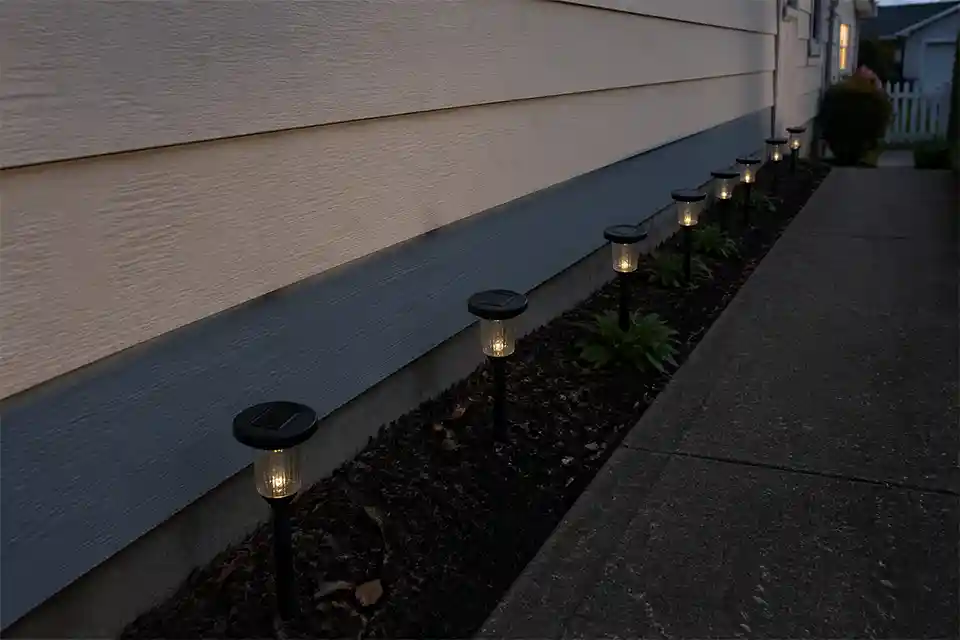
Solar garden lights that fade early along a north-facing wall usually do not need a new battery first. They usually need a different charging setup. In most US installations, the real problem is that the panel misses too much of the useful solar window, especially between about 9 a.m. and 3 p.m., when clear, direct sun matters most for charging.
If your lights now run only 1 to 3 hours after sunset, get under 4 hours of direct sun, or perform much worse along one wall than they do in an open part of the yard, treat this as a placement problem before treating it as a parts problem.
That distinction matters because this is not the same as a solar light that fails everywhere in the yard. If the weakness is concentrated along the north side of the house, the underlying mechanism is usually chronic undercharging from shade and orientation, not random battery failure. In practical terms, a standard integrated-panel path light is often the wrong product for this location.
The quick answer: the wall is usually stealing charging time
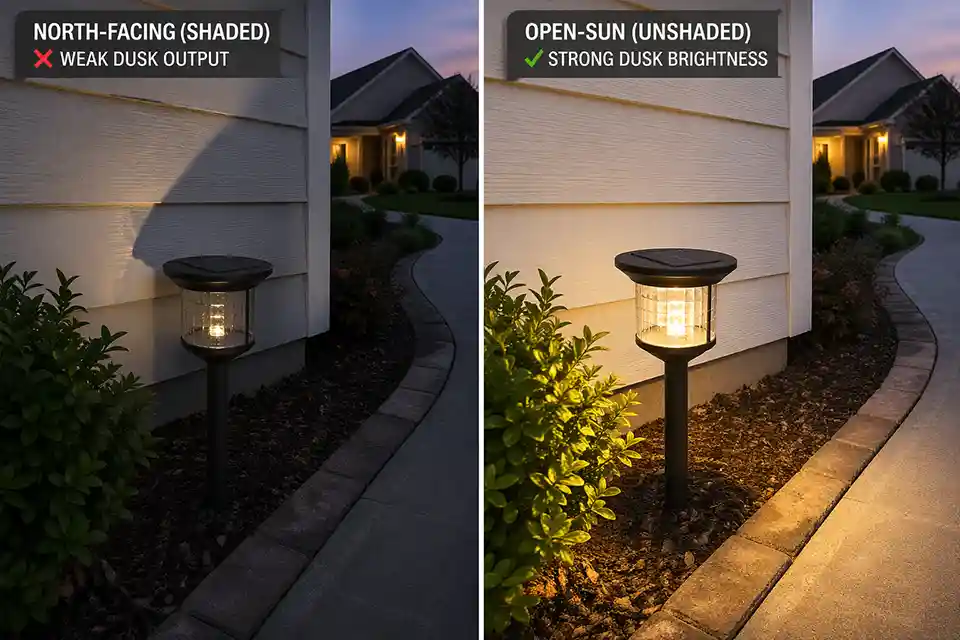
A north-facing wall in the US is working against you from the start. It usually gets less direct sun, and the wall itself often blocks low-angle light in the morning, afternoon, or both. A bright-looking side yard can still be a poor charging location if the panel spends most of the day in open shade instead of direct sun.
Bright shade is not the same as usable charging light
This is the first thing people misread. The area can look bright to your eyes and still be weak for solar charging. A panel beside a pale wall may receive plenty of daylight but too little direct sun to fully charge a small battery. That is why the lights often look normal during the day, then collapse a few hours after dark.
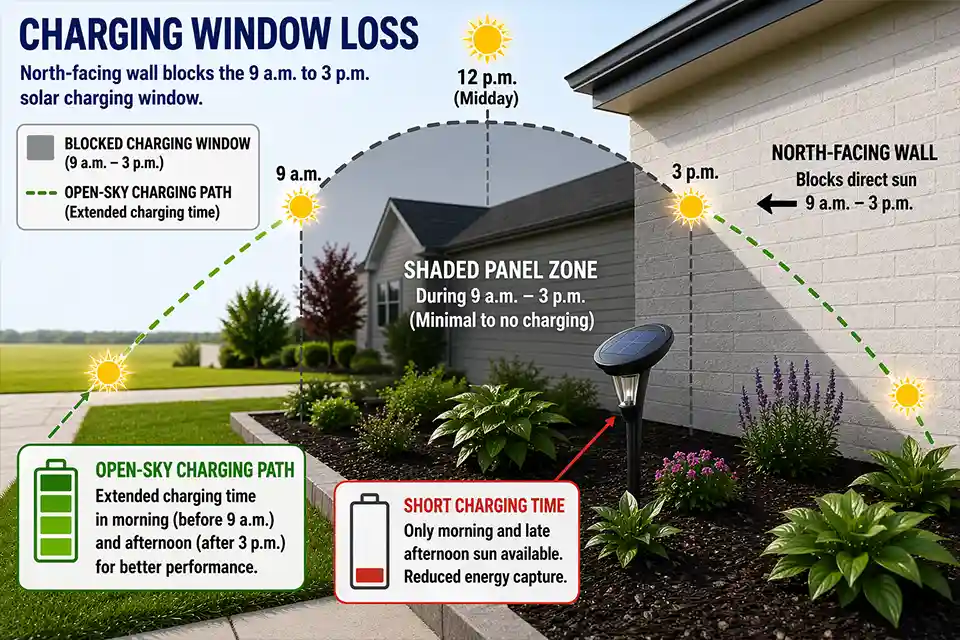
The 9 a.m. to 3 p.m. window matters more than the rest
If the panel misses most of that midday window, weak runtime is expected. A little sun at 8 a.m. or late afternoon does not compensate very well if the wall blocks the stronger part of the day. In a narrow side yard, losing that window can cut the effective charging period to 2 to 4 hours, which is usually not enough for reliable overnight path lighting.
Do this first before replacing anything
A lot of people waste time here by buying new batteries too early. Do a short elimination test first.
5-minute check before you diagnose the location
- Make sure the switch is actually ON.
- Clean the panel so dust or pollen is not adding another loss.
- Put one weak light in full sun for 2 clear days.
- Compare it with a similar light that already performs well.
- If possible, test with a known-good rechargeable battery of the correct type.
If that light suddenly runs 6 to 8 hours in open sun, you do not have a mysterious electronics failure. You have a charging-location failure.
Pro Tip: Test just one light in a sunny location before troubleshooting the whole row. A single controlled comparison usually tells you more than replacing several batteries.
What people usually misread on north-facing installs
They overestimate reflected light
Reflected light can help a little. It does not turn a poor location into a good one. Light-colored siding, concrete, or fencing may soften the loss, but it rarely makes up for a short direct-sun window.
They underestimate seasonal collapse
A marginal location can look acceptable in June and fail badly in December. If the same fixture drops from 5 or 6 hours in summer to under 2 hours in winter, that does not automatically mean the battery is bad. It often means the placement was borderline all along.
For the broader version of that pattern, Seasonal Problems With Solar Lights explains why weak placements usually fail first as days get shorter.
They blame dirt for a geometry problem
A dirty panel can reduce charging. But cleaning is a minor fix when the wall orientation is the main issue. If the panel is shaded through most of midday, cleaning may buy you a small improvement for 1 or 2 nights, not a lasting correction.
When the standard fix stops making sense
At some point, “replace the battery and try again” turns into bad economics.
Signs the location is the real limit
- The panel gets under 4 hours of direct sun.
- The wall is paired with roof overhangs, shrubs, or trees.
- Winter runtime falls below 2 hours.
- A fresh battery helps only briefly, then the same weak pattern returns.
- One open-yard test proves the fixture works much better elsewhere.
If several of those are true, the main issue is not maintenance. It is product-location mismatch.
A similar structural shade problem shows up in Solar Path Lights Losing Charge Under Roof Overhangs.
The fix that actually changes the outcome
The best fix is usually to change where the panel charges, not just what battery sits behind it.
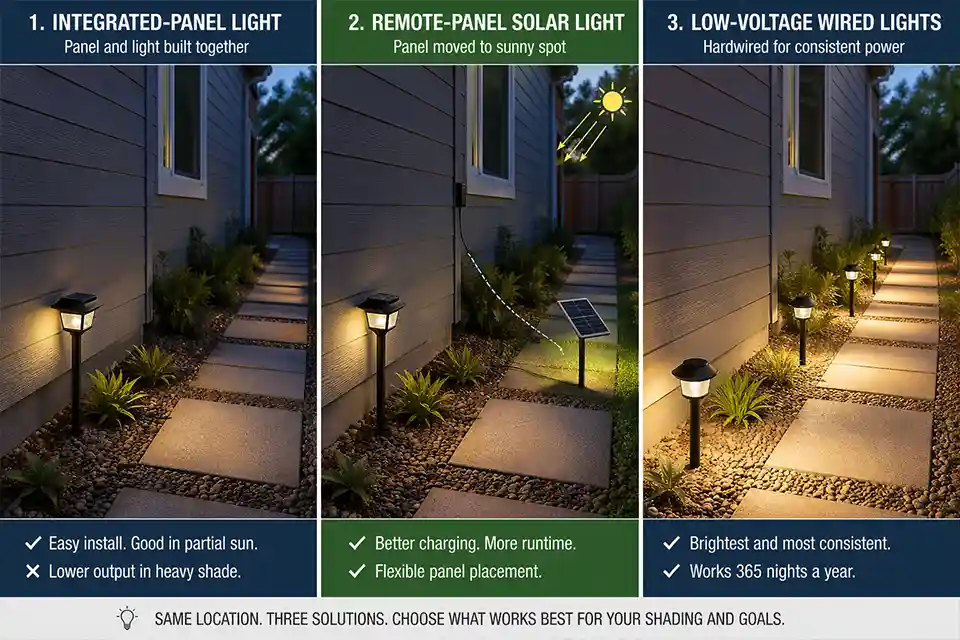
Option 1: move the whole fixture
If you can relocate the light to a spot with 6 or more hours of direct sun, performance often improves within 1 to 2 clear charging days. This is the cleanest fix when layout allows it.
Option 2: use a remote-panel solar light
This is usually the best answer when you need light near the wall but sun exists a few feet away. A remote panel lets the charging surface sit in real sun while the light stays where illumination is needed. Even moving the panel 3 to 6 feet away from the wall can materially improve runtime if it opens up midday exposure.
Option 3: switch to low-voltage wired lighting
This is the smarter choice when the wall is heavily shaded most of the year. If the site combines a north-facing wall, narrow side yard, trees, and winter underperformance, wired low-voltage lighting is often the more reliable long-term answer.
For general sun-exposure placement issues, Sun Exposure Issues With Solar Lights is the closest related read.
Which setup makes sense here?
| Setup | Best use case | Likely result on a north-facing wall | Practical verdict |
|---|---|---|---|
| Integrated-panel solar path light | Open beds and sunny walkways | Often weak if direct sun is limited | Usually the wrong first choice |
| Remote-panel solar light | Light needed in shade, panel can reach sun | Much better if panel gets midday sun | Best solar option for this scenario |
| Low-voltage wired path light | Heavy shade, year-round reliability needed | Stable output regardless of sun | Best long-term fix in hard locations |
| Standard battery replacement only | Good sun, aging battery | Helps only if charging conditions are already adequate | Often a time-waster here |
That comparison matters because north-facing wall installs often fail for a reason that looks electrical but is mostly geometric.
What counts as normal and what counts as a problem
| Condition | Direct sun | Typical night runtime | Most likely interpretation |
|---|---|---|---|
| Healthy summer placement | 6 to 8 hours | 6 to 10 hours | Normal charging |
| Borderline placement | 4 to 6 hours | 3 to 6 hours | Location is limiting output |
| North wall with heavy shade | 2 to 4 hours | 1 to 3 hours | Undercharging is the main failure mechanism |
| Good sun but weak after months | 6+ hours | Gradual decline | Battery aging or panel wear |
| Good sun but wrong on/off behavior | 6+ hours | Erratic | Sensor or switch issue |
If the light works well after a controlled sunny-location test, stop chasing deeper faults first. The symptom is dim output. The mechanism is insufficient charging time.
If the behavior is more about bad timing than weak runtime, Sensor Failures in Solar Lights Causing Wrong On/Off Behavior is the better match.
The bottom line
If your solar garden lights lose power mainly along a north-facing wall, the most likely cause is not that the batteries suddenly became bad. It is that the panels are not seeing enough direct sun during the part of the day that matters most.
In many of these installs, the fastest real improvement comes from moving the panel, changing the product type, or switching away from solar for that location.
For broader official guidance, see the U.S. Department of Energy.