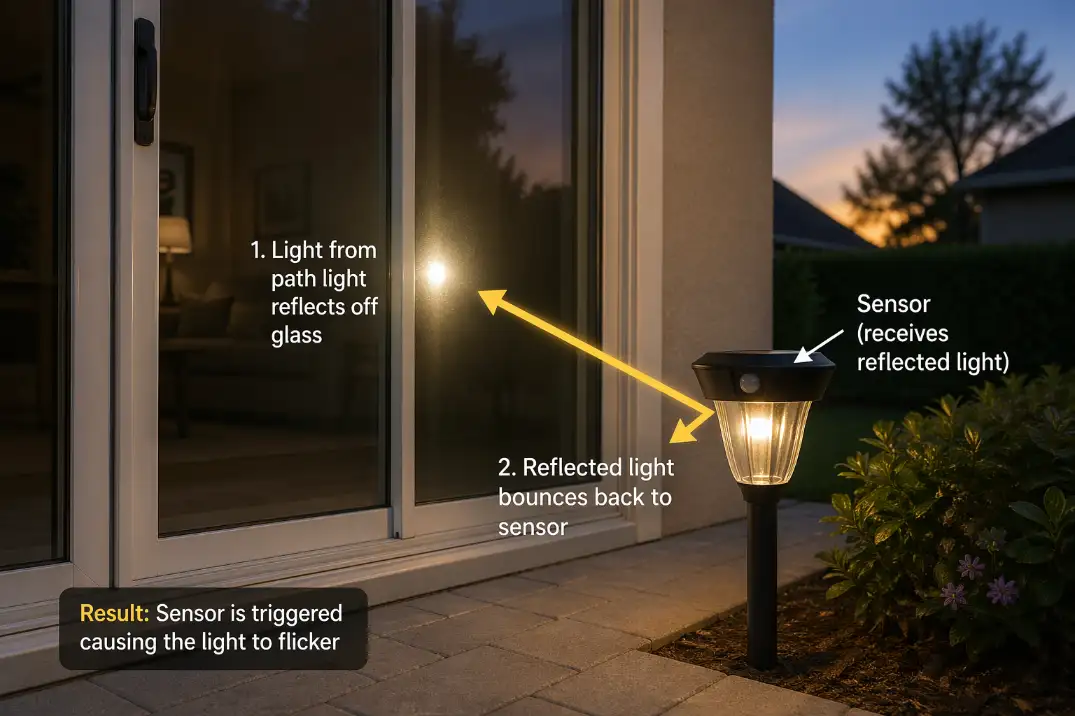
Solar lights that flicker near glass usually have a sensing problem before they have a charging problem. The sensor reads reflected light from a door, window, or glass railing, decides the area is still too bright, then drops the light out and starts the cycle again.
If the flicker appears mainly in the first 5 to 20 minutes after sunset, changes within 30 to 60 seconds when you block the reflection, and improves when you rotate the fixture 15 to 30 degrees, the glass is probably the trigger.
That pattern looks similar to low battery performance, which is why people misdiagnose it. But the behavior is different. A weak battery normally lets the light turn on, then fade after 1 to 3 hours. Reflection-triggered flicker is usually abrupt, location-specific, and tied to dusk transition rather than overall runtime.
The first decision, then, is simple: if the same light behaves normally when you move it 3 to 6 feet away from the glass, stop treating this as a battery issue. The problem is more likely optical feedback than bad storage capacity.
Why reflective glass causes flicker
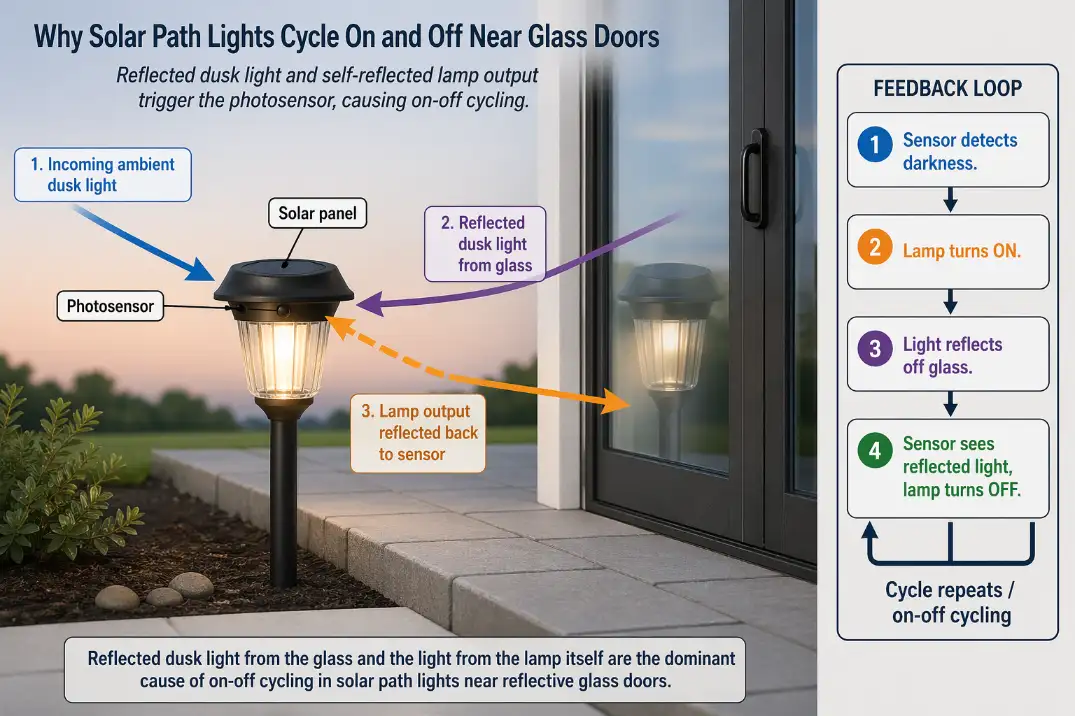
The real mechanism is sensor feedback
Most solar lights combine the panel, battery, LED board, and photosensor in one compact housing. That design is convenient, but it also makes the sensor vulnerable to nearby reflected light.
A bright patch on a glass door, a low evening sky reflection in a window, or even the fixture’s own output bouncing back off smooth glass can all reach the sensor.
Once that happens, the loop becomes predictable: the light turns on, the sensor sees returned light, the controller decides it is not dark enough, the light shuts off, the reflected signal disappears, and the cycle starts again.
This is why the flicker often looks fast, indecisive, and oddly timed instead of simply dim.
The setup becomes much more sensitive when the fixture is installed within about 1 to 3 feet of glass, faces the surface directly, or sits next to other reflective materials such as polished stone, glossy black trim, or metal rail hardware.
If the sensor has a narrow view and the reflection path is clean, even a small change in angle can change the result.
What people usually misread first
The most common wrong first move is replacing the battery. It feels logical because flicker looks electrical. But if the light still charges in full sun for 6 to 8 hours and only misbehaves in one glass-heavy spot, the site deserves more suspicion than the battery.
A second wasted fix is cleaning the solar panel first and stopping there. A dirty panel can reduce runtime, but it rarely creates rapid on-off cycling at dusk by itself.
If nearby ambient light is the bigger issue, Solar Lights Not Turning On Near Streetlights is a useful comparison because the sensor confusion is similar even though the light source is different.
Quick field test before you buy anything
Use a five-step check
Before replacing parts, run this short test:
- Watch whether flicker starts mainly during the first 5 to 20 minutes after sunset
- Cover the strongest reflection on the glass for 30 to 60 seconds
- Move the fixture at least 3 feet from the glass for one night
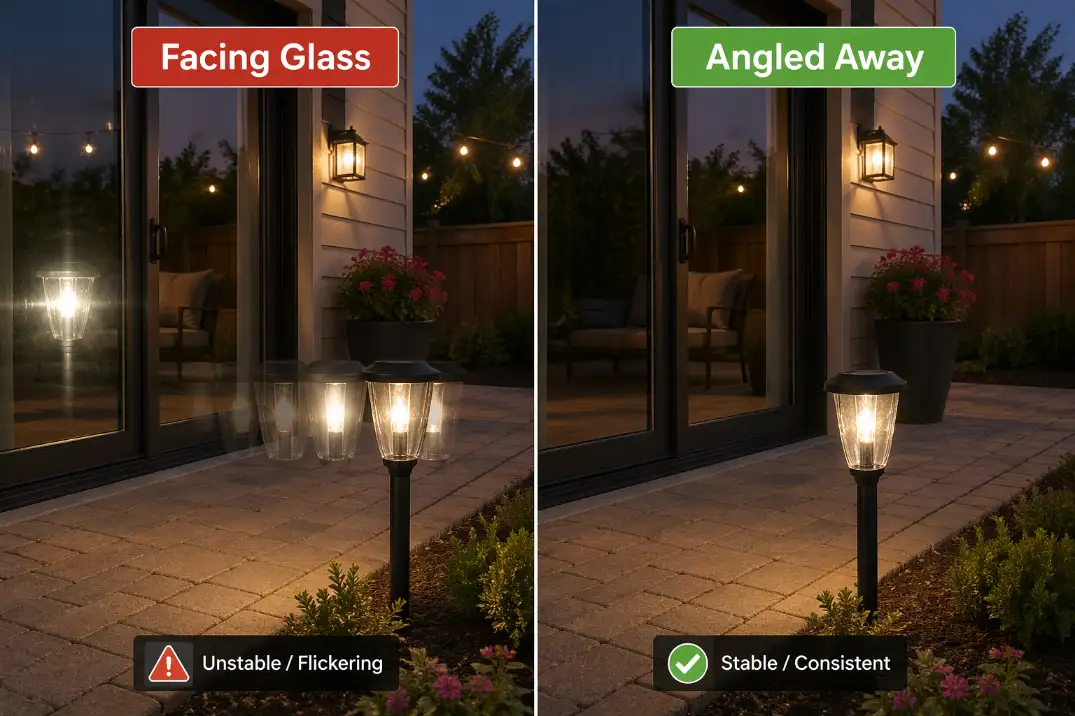
- Rotate it 15 to 30 degrees away from the reflective surface
- Compare runtime in the reflective location versus an open location after a full sunny day
If four of those five checks point the same way, you are not guessing anymore. You are seeing a site-driven reflection problem.
What this problem is not
This issue is often confused with a weak battery, moisture intrusion, or a failing controller. Those are real possibilities, but they do not deserve equal weight.
If the light turns on normally and then fades after a few hours everywhere, battery decline is more likely. If the unit fogs up, shows droplets, or gets worse after sprinkler spray or rain, moisture deserves more attention than glass.
And if the same fixture flickers in multiple non-reflective locations, the sensor board starts looking more suspicious than the installation spot.
That is the point where Water Inside Outdoor Light Fixtures or Sensor Failures in Solar Lights Causing Wrong On-Off Behavior becomes a better next step than another round of angle changes.
The fixes that actually work
Start with placement, not parts
The highest-value fix is usually repositioning. If the fixture can move, increase separation from the glass by at least 3 feet. If space is tight, rotate it just enough that the sensor no longer looks straight into the reflected zone. In practice, that modest 15 to 30 degree change often matters more than people expect because it breaks the clean feedback path.
This is one of those cases where visual neatness can work against performance. Homeowners often place the light where it looks best in daylight, especially centered beside a patio door or lined up with a window edge. That can be the worst optical position at dusk.
Poor Outdoor Light Placement Creating Dark Spots and Glare matters here because placement errors are often aesthetic first and functional later.
Then reduce the reflected signal
If relocation is not realistic, reduce the reflection path instead. A matte planter, a narrow shrub, a short divider, or a less reflective finish nearby can interrupt the bounce without blocking charging sunlight.
This is more effective than many people think because you do not need to eliminate all reflected light. You only need to reduce the amount reaching the sensor below the point where it causes false switching.
Pro Tip: Test the idea with a temporary barrier first. A dark piece of cardboard placed between the glass and the fixture for 1 minute can tell you more than a new battery ever will.
Use sensor shielding carefully
A small visor or side shield can help if the reflected light arrives from one obvious direction. Keep it small and directional. Too much shielding creates a new problem: the light may switch on too early or stay on too long because the sensor no longer sees enough ambient light.
This is where readers often overestimate dark-tinted glass. Tinted glass can still produce a strong high-contrast reflection at dusk. It is not automatically safer than clear glass.
Readers also underestimate seasonal angle changes. A setup that behaves acceptably in June can become unstable in October because evening light approaches the window at a lower, more reflective angle.
Symptom comparison that saves time
| What you see | More likely cause | Less likely cause | Best next move |
|---|---|---|---|
| Fast flicker right at dusk | Reflected light hitting the sensor | Dead battery | Reposition or re-aim the fixture |
| Stable performance away from glass | Site reflection problem | LED failure | Keep testing placement |
| Light turns on, then fades after 1 to 3 hours everywhere | Weak battery or low charge | Reflection alone | Check charge time and battery health |
| Flicker gets worse after rain or sprinkler use | Moisture intrusion | Reflection alone | Inspect lens, housing, and seals |
| Same fixture flickers in several locations | Bad sensor or control board | Glass location alone | Replace or retire the fixture |
That table is the real priority line. Reflection is more likely than battery failure when the symptom is rapid dusk cycling in one reflective location. Battery decline becomes more likely when runtime is poor everywhere, not just near glass.
When the standard fix stops making sense
The boundary for replacement
Once you have moved the fixture 3 to 6 feet, changed the angle, tested a temporary barrier, and reduced the main reflection path, the easy location fixes have already done their job. If the unit still rapid-cycles near glass and also behaves poorly in ordinary locations, stop treating the glass as the full explanation.
At that point, the better judgment is that the sensor or controller is unstable, weak, or poorly designed. Repeating the same adjustments usually wastes time. Buying another fixture with the same exposed sensor layout can waste money too, because the replacement may inherit the same weakness.
One practical detail that gets missed: if the light never charged well to begin with because of partial shade, the reflection problem can be blended with a charging problem. That is why Sun Exposure Issues in Solar Lights deserves a look when runtime is also short, not just unstable.
Best fix order
- Test the fixture away from the glass for one full night
- Move it at least 3 feet from the reflective surface
- Rotate it 15 to 30 degrees away from the reflection path
- Test a temporary barrier or a small sensor visor
- Check for moisture and weak charging only if instability remains
- Replace the fixture when the behavior follows the unit, not the site
That order prevents the most common mistake: treating a bad optical setup like a hardware failure.
For broader official guidance on lighting controls and sensor behavior, see the Whole Building Design Guide.