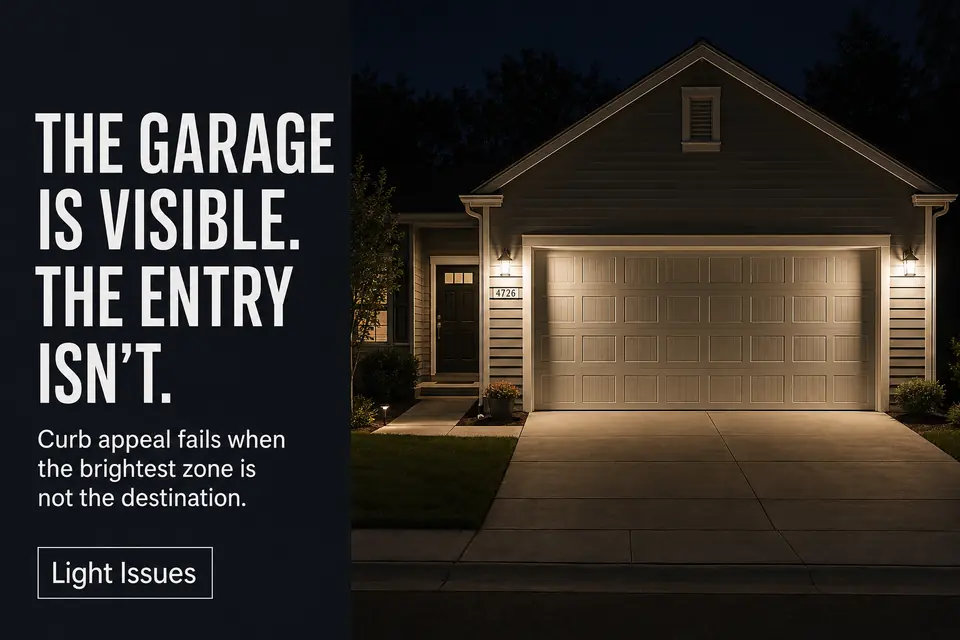
A house can be well lit at night and still make its entrance difficult to find. The usual symptom is immediate: from the street, the garage appears first, while the front door looks like a secondary opening somewhere beside it.
That is not necessarily proof that the garage lights are excessively bright or that the porch needs a stronger bulb. The underlying problem is visual hierarchy. Garage fixtures, a broad reflective door, a weakly defined entry, and a path that does not finish at the door can all direct attention toward the wrong destination.
The first check is simple: stand where a visitor would first see the house, briefly look away, and then look back. Notice what your eye identifies first. If it lands on the garage and has to search for the entrance, diagnose the full arrival sequence before changing any fixture.
Bright Garage Problem
An attached garage occupies a large part of many front elevations. Its door is also a broad, comparatively uniform surface that readily catches light. A moderate amount of illumination reflected across that plane may become more visually prominent than a brighter but smaller porch source inside a recess.
Fixture count adds to the effect. Two sconces flanking a double garage create a wide illuminated frame, while the front door may have one light tucked under an overhang. Even if the individual fixtures have similar output, the garage presents the larger and clearer nighttime shape.
This is why garage dominance should be judged from the street rather than directly beneath the fixtures. Up close, the garage lights may appear reasonable. From farther away, their emitting faces, reflected pools, and symmetrical placement can merge into the strongest feature on the house. This is one of several outdoor lighting problems that weaken curb appeal, but here the important clue is specifically where the first glance lands.
Do not assume the garage must be made dark. It still needs enough useful illumination for parking, access, and the transition from the vehicle to the house. The diagnostic question is whether it remains readable without becoming the visual destination. If the door disappears whenever the garage lights are on, the imbalance is relational: either the garage is leading too strongly, the entry is receiving too little support, or both are true.
Dark Door Problem
A porch light can be on without making the entrance legible. What the visitor needs to perceive is not merely a bright point near the door, but the door’s position, edges, landing, handle area, and relationship to the approaching walk.
Recessed entries are especially vulnerable. The garage may project toward the street while the door sits several feet behind the main facade. That geometry naturally places the entrance in deeper shadow and makes it appear smaller. A light mounted inside the recess has to reveal the entry surfaces without becoming a distracting exposed source.
Increasing the bulb output is therefore an unreliable first fix. A stronger clear-glass lantern can produce a bright point at eye level while leaving the door surface comparatively weak. The viewer sees the lamp, not the destination. If that pattern is present, investigate entry lights that create glare at the door before concluding that the porch simply needs more light.
Compare the door with the wall immediately around it. If the trim, door plane, and landing separate naturally from the recess, the entry has usable definition. If the fixture is obvious but those surfaces merge into shadow, the problem is distribution or source visibility. If everything around the door is readable but the garage still captures attention first, reducing garage dominance will usually be more effective than continuing to brighten the porch.
Weak Path Lead
Path lighting has two jobs in this situation. It must keep the walking surface readable, but it must also establish where the route ends. A series of bright pools that stops before the porch can make the walkway visible without making the entrance easier to locate.
Watch the final section of the path. If the illuminated route bends toward the door but the last several feet disappear beneath a porch shadow, the visual lead breaks at the exact point where it should become strongest. If the brightest pavement lies beside the driveway or garage apron, the ground lighting may actually reinforce the garage.
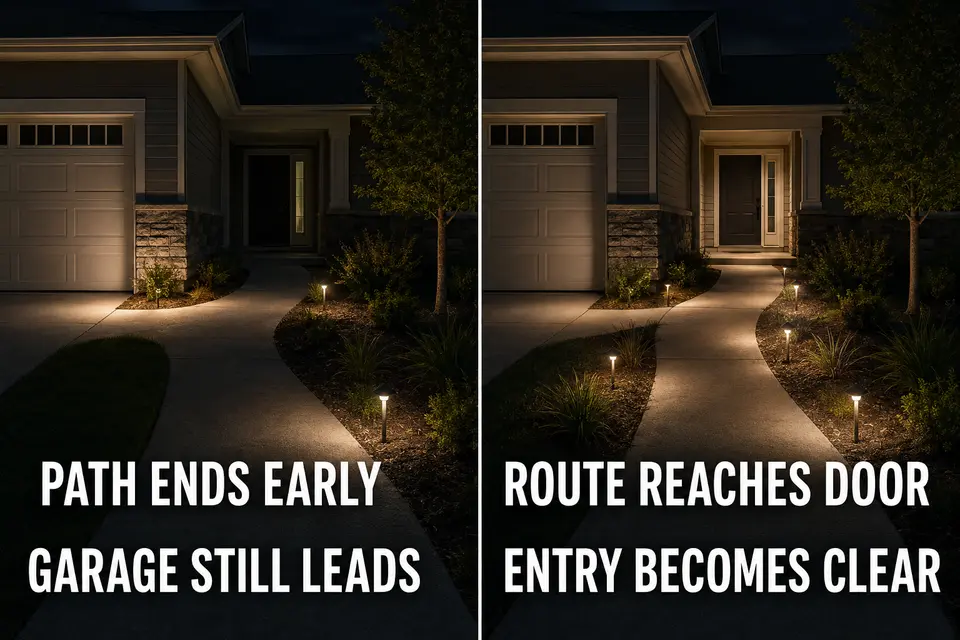
The correction is not necessarily more path light. It is a more continuous relationship between the walking line and the entry. The eye should be able to follow the ground route through its last transition and then move upward to the door. When that connection is missing, the dedicated diagnosis of front-walk lights that fail to lead to the door can help isolate whether aim, dark gaps, or misplaced brightness is breaking the route.
Avoid turning the walkway into a runway of equally bright fixtures. That gives the fixtures themselves too much visual weight and can create another competing feature. The path should provide direction quietly, with the door gaining importance as the route reaches the house.
House Number Gap
A readable house number is a small but powerful arrival cue. It confirms that the visitor has reached the correct property and helps connect the visible approach with the actual entrance. When the number disappears, the door loses one more piece of identifying information.
Check the address from the normal arrival direction, not from a few feet away. Glare across reflective numerals, low contrast against the wall, deep shadow, or placement outside the illuminated entry zone can all make the number difficult to recognize. Flooding the entire wall is rarely necessary; controlled contrast around the characters is more useful.
Location also affects hierarchy. Numbers mounted on or beside the garage may make that zone even easier to identify while the recessed entry remains anonymous. That placement is not automatically wrong, but the rest of the lighting must still make the door unmistakable. If the address itself is the weak point, diagnose house numbers that remain hard to read at night without expanding this article into a number-lighting installation guide.
The number should support the entry rather than become a separate focal object. It only needs to be comfortably readable from the relevant approach and visually connected to the route a visitor should take.
Entry Hierarchy
The correction becomes clearer once the four elements are judged together. The garage must remain functional but secondary. The path should carry the eye away from the driveway and toward the entrance. The house number should confirm arrival, and the door should provide the strongest sense of destination.
Start with relative brightness rather than isolated fixture output. If the garage door is covered by a dominant reflected patch, restraining that spill may improve the entire elevation more than adding light elsewhere. If exposed garage sources are the first thing visible, better shielding or aim may reduce their prominence while preserving useful ground illumination.
Then examine the entry for definition. The goal is not to create the brightest surface on the property. It is to make the door, landing, and surrounding edges readable enough that they form one coherent entry zone. Path guidance and address visibility should feed into that zone rather than compete with it.
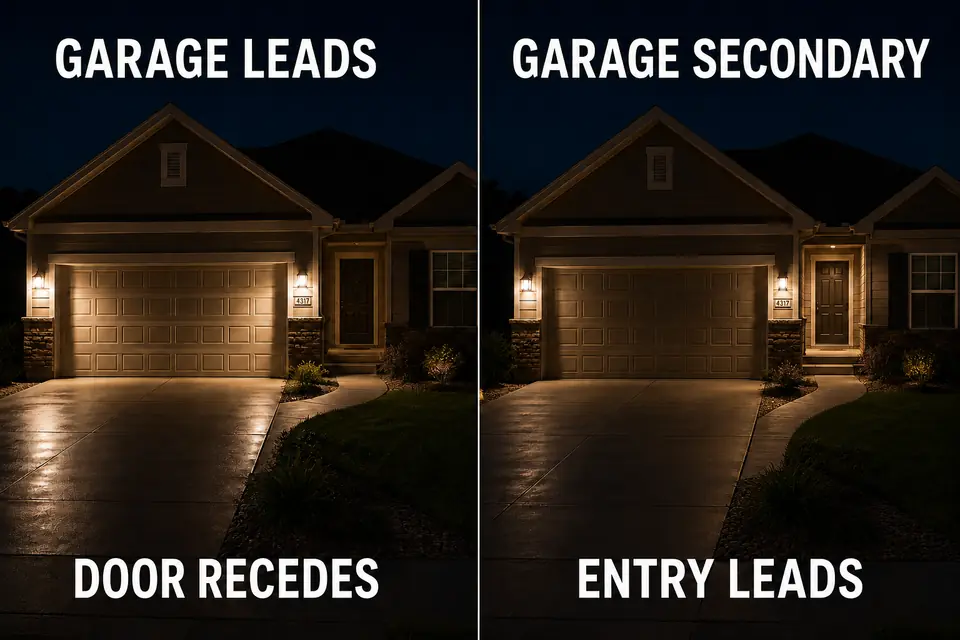
Do not correct every surface to the same level. Uniform illumination can remove the contrast that gives the elevation depth and makes the entrance distinct. If the garage-versus-door conflict is part of a broader loss of architectural separation, the related diagnosis of front-yard lighting that makes the house look flat covers that larger facade problem.
A successful hierarchy often uses less visual competition rather than more total light. The garage reads as a supporting zone, the pathway supplies direction, and the door becomes recognizable without appearing theatrical. The house should not look uniformly brighter after the correction; it should look easier to understand.
Front View
Make the final judgment after full darkness from the street, the driveway entrance, and the normal walking approach. These viewpoints reveal different failures. The street shows the overall hierarchy, the driveway entrance shows whether the garage captures the arrival, and the walking view shows whether the route transfers attention to the door.
At each position, look away briefly and then back at the house. Record the first element you recognize rather than the brightest point you can deliberately find. Then check whether your eye moves naturally from the approach to the house number and door. If it stalls at the garage, the hierarchy is still unresolved.
A phone photograph can help compare adjustments, but it should remain a secondary check. Automatic exposure may make the garage look more intense or the porch darker than they appear in person. Keep the camera position and exposure consistent if you use before-and-after images.
Change one variable at a time—garage output, source visibility, entry distribution, or path aim—and repeat the same views. That prevents a brighter door from disguising an unchanged garage problem. The finished elevation should allow the garage to do its job while making the entrance obvious without a search.
For manufacturer-neutral guidance on useful, targeted, and restrained exterior illumination, see DarkSky International’s Five Principles for Responsible Outdoor Lighting.