
When only one outdoor-lighting branch trips a shared GFCI, the branches that keep working become the control condition. They show that the useful search does not begin at every fixture or across the entire yard. It begins where the faulted branch becomes electrically different from the others.
The critical distinction is between a branch that stays dark and one that makes the protection react. A dark branch may have an open connection, failed control, or loss of supply. A branch that trips the GFCI indicates that current may be leaving its intended path whenever that branch is involved.
That pattern can identify the affected branch, but it cannot identify the failed component. The leakage path may be at the first branch-specific junction, inside a fixture, at a wet connector, or along a damaged buried run. Once the behavior is repeatable, the stronger move is to preserve the evidence and narrow the branch—not repeatedly reset the GFCI or start removing whichever fixture looks most suspicious.
Why One Branch Narrows the Search
The working branches reduce the first search area because they continue operating through the system components they share with the suspect branch. The power source remains available, and the GFCI can remain set under at least some operating conditions.
This does not prove that every upstream component is healthy under every load or moisture condition. It does make a complete upstream outage less likely and places more diagnostic weight on the point where the suspect branch separates from the working ones.
That is the opposite of a shared loss affecting outdoor lights and an exterior outlet. In that pattern, the search moves upstream toward a common protective device or supply point. When one branch alone changes the GFCI’s behavior, the useful search moves downstream from the last shared point.
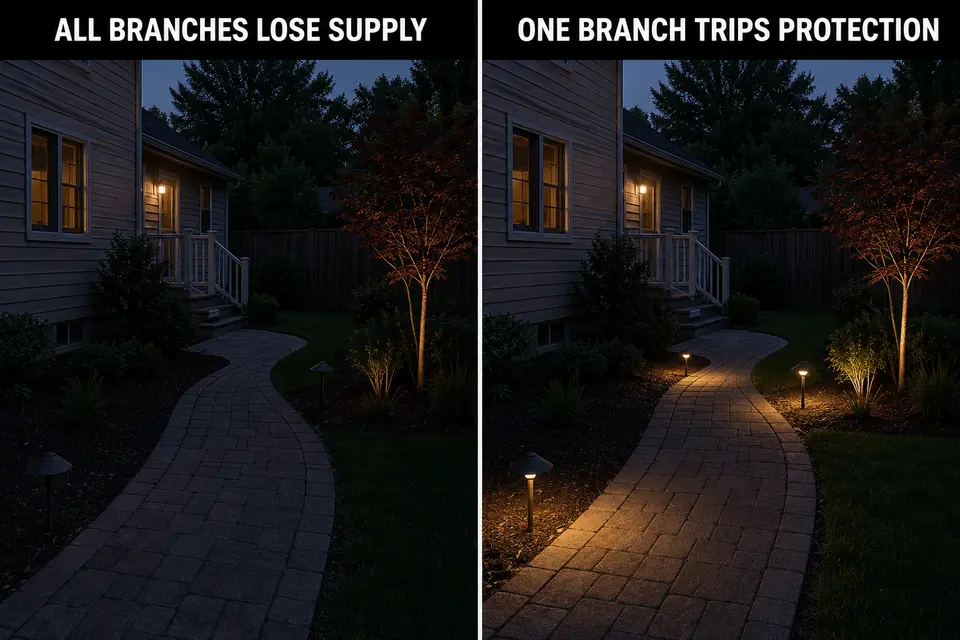
The branches still have to be identified electrically rather than geographically. Lights on opposite sides of a path may share one cable, while neighboring fixtures may belong to separate transformer outputs or controller zones. “The left side of the yard” is a location; it is not necessarily a branch.
Existing labels, installation photographs, transformer-zone records, controller assignments, and designed plug connections can establish where a branch actually separates. If those features do not reveal the boundary, guessing based on fixture position will not make the diagnosis reliable.
Disconnect Points vs Fixture-by-Fixture Guessing
The best separation point is the first existing location that divides the suspect branch from the branches that remain stable. Depending on the installation, that may be a separately controlled transformer output, an individual controller zone, a listed plug connection, or another accessible disconnect designed into the system.
A buried splice or hardwired junction does not become a homeowner disconnect point merely because its approximate location is known. Opening it changes the task from observing branch behavior to working directly with electrical connections, possibly under wet or damaged conditions.
Working from a legitimate separation point answers the central question: does including this branch change the GFCI’s behavior? If it does, the shared system before that point remains part of the working baseline. The unique cable, junctions, and fixtures after it become the area requiring investigation.
Random fixture removal does not provide the same control. Several fixtures may all be supplied through one wet junction, so replacing the darkest or most distant light can leave the leakage path untouched.
The common mistake is to assume the fixture that looks most affected must also be first in the electrical path. Physical prominence, distance from the transformer, and electrical order are three different things.
A recently replaced fixture deserves higher priority only when the trip began immediately after that exact change. Without a clear change point, branch structure is stronger evidence than convenience.
The First Wet or Damaged Location
After the suspect branch separates, inspection priority belongs to its first unique location—not automatically to its last or darkest fixture. “First” refers to electrical order after the branch point, not walking distance across the yard.
A branch-specific junction near that point may feed every later fixture. If its seal has failed or a conductor is damaged there, the entire downstream group can appear implicated even when none of the later fixtures has failed individually.
Visible clues that change inspection priority include:
- A displaced gasket or enclosure cover that no longer sits evenly.
- Moisture trails or staining below a junction or fixture entry.
- Green or white deposits associated with visible corrosion in outdoor lighting connections.
- A cracked fixture body, loose conduit fitting, or poorly supported cable entry.
- A route recently disturbed by edging, planting, staking, construction, or animal activity.
- A fault that appeared after irrigation changes or sustained rain.
These clues rank locations; they do not prove the fault. Moisture may be visible at a later fixture while the actual leakage path sits inside an earlier junction. Damp soil around an outdoor cable route is also normal and does not establish that the cable insulation has failed.

Timeline evidence can make one location more relevant than another. A trip that began after landscape edging was installed raises concern about the disturbed route. A trip that appears after irrigation reaches one bed makes connections in that wet area a stronger starting point. Neither observation replaces electrical testing, but both can prevent a technician from treating every fixture equally.
Even a visibly displaced seal should remain a lead rather than a verdict. The condition may require correction, yet concealed leakage still has to be separated from an unrelated surface defect.
Buried Run and Junction Boundaries
The safe homeowner diagnosis ends when the branch has been narrowed to wiring or connections that cannot be observed without opening, disconnecting, or excavating them. Reaching that boundary is not an incomplete diagnosis; it is the point at which visual evidence has delivered all it safely can.
Underground cable may have crushed, cut, or deteriorated insulation without leaving an obvious mark at the surface. Concealed connections can also retain moisture after exposed fixtures and soil appear dry.
Connection type determines whether a legitimate inspection point exists. An accessible weatherproof junction provides a defined service location, while a direct-burial connector may offer no homeowner-accessible view. Understanding the difference between buried connectors and accessible junction boxes explains why a branch can be confidently isolated even though its failed component remains unknown.
An electrician can divide the suspect branch at legitimate access points and evaluate individual cable sections. Insulation-resistance or other suitable testing can help distinguish leakage through cable insulation from a fault in a connection or connected fixture. The readings must be interpreted against the actual branch layout and equipment; a casual resistance check is not an equivalent test.
Fix Boundary: Keep the affected branch off and arrange professional evaluation if it repeatedly trips the GFCI, includes hardwired or buried connections, passes through standing water, has exposed cable or damaged conduit, or shows heat damage. Do not open wet junctions, excavate cable, bypass the GFCI, or change the protection rating to keep the branch energized.
The other branches continuing to work does not make the affected branch safe. It simply makes the fault boundary smaller.
Confirming the Faulted Branch
Confirmation at this stage means proving which branch changes the GFCI’s behavior—not proving which component has failed. That distinction prevents branch isolation from being mistaken for a complete electrical diagnosis.
Useful confirmation exists when one clearly identified branch repeatedly changes the protection’s behavior while the comparison branches do not. This conclusion should come only from existing controls, labels, or accessible disconnect arrangements designed into the installation.
Once that pattern is established, further trips add little diagnostic value. They do not distinguish damaged cable from a wet junction, and repeatedly energizing compromised equipment only reproduces a condition already known to be unsafe.
A GFCI that remains set with the suspect branch excluded supports the branch diagnosis, but it does not certify that every remaining component is permanently fault-free. Outdoor moisture and temperature conditions change. More importantly, the result identifies an affected branch—not a particular fixture, junction, connector, or cable segment.
Record the branch label or exact fixture group, whether the trip is immediate or delayed, recent rain or irrigation, recent landscape work, visible exterior damage, and the last time the full system operated normally. That information lets an electrician start at the first meaningful separation point rather than testing every outdoor light with equal priority.
If the protection will not remain reset after all accessible lighting branches are excluded, the diagnostic pattern has changed. Follow the separate diagnosis for a GFCI that still will not reset after the lights are disconnected instead of continuing to blame the original branch.
The practical stopping point is precise: identify the one branch that changes the result, locate its first unique service point, and preserve the visible and timeline evidence. If the remaining path is concealed, professional cable testing—not another reset or a guessed fixture replacement—is what turns branch confirmation into a component diagnosis.
The Electrical Safety Foundation International’s GFCI guidance explains how these devices respond to leakage current and protect against electrical shock.