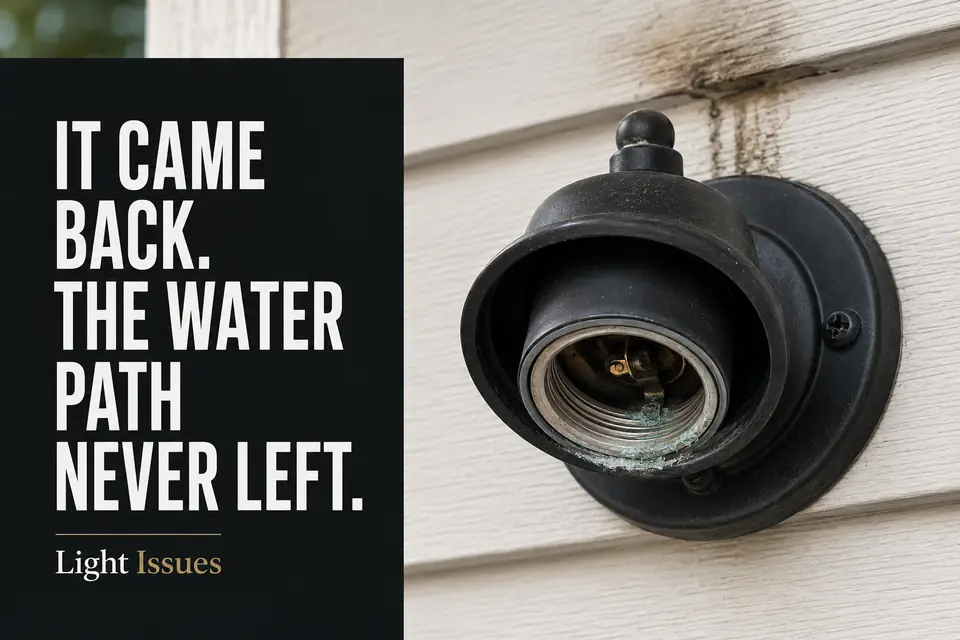
Cleaning can remove oxidation from an outdoor light socket without changing the condition that created it. If corrosion returns after the next rain, irrigation cycle, or run of cool nights, the socket does not simply need another cleaning. Moisture is still entering the fixture or remaining inside it long enough to restart corrosion.
The first new deposit is a temporary diagnostic map. Its location can point toward an entry direction or collection point, while the time between cleaning and recurrence helps distinguish direct wetting from trapped condensation. Note those clues before cleaning them away again.
Electrical safety boundary: De-energize the lighting circuit at its breaker and confirm that power is off before close inspection. If you cannot positively isolate the circuit, or damage extends beyond visible surfaces, leave the fixture off and use a qualified electrician.
Cleaning the Symptom vs Stopping the Moisture Path
The first decision is whether the cleaning removed old residue or merely reset an active corrosion cycle. It cannot restore a flattened gasket, clear a blocked drain, correct a water trail through the housing, or help a fixture that repeatedly traps condensation.
Recurrence after rainfall or sprinkler operation gives direct entry more weight. Corrosion that redevelops after repeated temperature swings, even during dry weather, makes retained humidity and condensation more plausible. These patterns do not identify the exact opening, but they determine which part of the fixture deserves attention first.
Broader moisture damage in outdoor lighting can affect housings, wiring, connections, and electronic components. Here, the narrower question is whether moisture continues to reach one lamp socket and whether that socket remains usable.
Avoid wiping away the earliest evidence as soon as it appears. Photograph the safely isolated socket, note the weather or irrigation conditions, and compare it after the next relevant event. Once several exposure cycles overlap, the original direction of travel becomes harder to read.
Where New Corrosion Starts
Location matters more than corrosion color. The first new deposit can indicate where moisture arrives or where it finally collects, while color alone cannot distinguish a leaking seal from trapped condensation.
Corrosion Beginning Near the Upper Contact
Deposits beginning around the lamp opening, upper contact area, or upper socket edge support a top-down path. Look above that point for mineral streaks, dried droplet marks, or a narrow trail running down the inner housing. Moisture may be passing a lamp seal, lens joint, upper seam, or another opening before reaching the socket.
A deposit around only one contact can also reflect localized deterioration or reduced contact pressure. It should not be treated as proof that water entered directly beside that contact.
Corrosion Beginning at the Socket Base
Corrosion returning first at the lowest part of the socket suggests collection rather than necessarily identifying the entry point. Water may have entered higher in the fixture and drained downward, or condensation may be forming throughout the housing and settling at its lowest point.
A broad haze across several interior surfaces differs from a narrow drip trail. Diffuse fogging followed by corrosion at the base supports moisture retention more strongly than one visible path from above.

Gasket, Drainage, and Venting Clues
The useful distinction here is not simply “sealed or unsealed.” Determine whether moisture is crossing a failed barrier or entering as vapor and then failing to leave.
Clues That Water Is Entering
A gasket becomes relevant when it is split, hardened, flattened, displaced, or no longer meeting the opposing surface evenly. Dirt, paint, or a pinched section can also create a narrow gap. Water marks continuing above that gasket, however, mean the apparent defect may not be the first entry point.
Follow connected staining toward the upper housing, lens edge, canopy, and rear entry area. Water can travel along a cable or pass through an improperly protected opening before appearing well below it. A dedicated explanation of water entering through cable-entry points is more useful when the trail begins at the rear or top of the fixture rather than at the lamp opening.
Fixture position also changes the path. A wall light tilted against an uneven mounting surface or installed in an unsupported orientation may direct water toward the socket instead of away from it. The corrosion remains the endpoint, not necessarily the original opening.
Clues That Moisture Is Being Trapped
When there is no connected drip trail, look at how the entire housing dries. Repeated fogging, fine droplets over a broad area, and corrosion following cool-night and warm-day cycles support trapped condensation.
More detail about condensation inside an outdoor light fixture can help distinguish brief fogging from moisture that repeatedly collects near electrical parts.
Check for an obstructed low drain point, debris holding water against the housing, or a mounting position that prevents drainage. Do not plug an unfamiliar opening merely because it appears capable of admitting air. It may be an intentional drain or vent, and closing it can turn occasional moisture into persistent exposure.

Why Grease Alone Is Not the Repair
Grease cannot compensate for a moisture path that remains active. A compatible corrosion-inhibiting or dielectric product may have a limited protective role, but it cannot restore a failed gasket, reopen drainage, correct fixture orientation, or stop water traveling through the housing.
Applying material to a damp or newly corroding socket can also conceal the return pattern that would otherwise help locate the problem. It does not make the socket waterproof or rebuild plated surfaces, contact pressure, or metal already lost to pitting.
The stronger sequence is to identify and correct the moisture path, allow the fixture to dry, and assess the socket’s physical condition. Only then can the fixture instructions determine whether an approved protective treatment has any role. If the socket is materially damaged, coating it does not move the replacement boundary.
When the Socket or Fixture Is No Longer Serviceable
Once corrosion changes the socket physically, component condition controls the decision. A socket is not serviceable merely because the bulb still illuminates.
Missing plating, deep pitting, heat discoloration, cracking, brittleness, deformation, loose contacts, or unreliable lamp retention indicate more than a surface problem. Electrical contact can become less stable as metal disappears or spring pressure weakens.
Damage beyond the socket changes the scope. Corrosion on leads, terminals, splices, or surrounding insulation belongs to the broader problem of corrosion affecting outdoor lighting connections, not an extension of socket cleaning.
| Observed condition | Decision |
|---|---|
| Light surface residue, intact socket, and a confirmed correctable moisture path | Correct the path and have serviceability reassessed |
| Deep pitting, missing plating, or loose or heat-marked contacts | Leave off and replace the damaged component if the fixture supports that repair |
| Cracked socket body or damage extending into leads or insulation | Leave off and obtain qualified electrical service |
| Moisture returns after the apparent path was corrected | Reopen the diagnosis rather than repeatedly cleaning or coating the socket |
Some fixtures accept a listed replacement socket or approved service part. Others are constructed so that replacing the entire fixture is the safer or only supported option. The fixture’s listing, available parts, housing condition, and ability to maintain weather protection—not the apparent simplicity of the socket—control that boundary.
If the housing cannot reliably keep moisture away from the socket or release condensation, replacing only the socket preserves the failure mechanism. Recurrence after an apparent correction deserves the same judgment: reopen the diagnosis before returning the fixture to service.
Where corrosion returns first tells you where to look. When it returns helps distinguish direct wetting from trapped moisture. But once pitting, looseness, cracking, or damage beyond the socket appears, tracing the water path is no longer enough; the damaged component must remain out of service.
For the final safety boundary, ESFI advises that electrical equipment exposed to water should be inspected by qualified professionals before being returned to service in its flooding and electrical safety guidance.