
If your landscape lights got dimmer right after adding more fixtures, the new fixtures probably exposed a load problem that was already close to the edge.
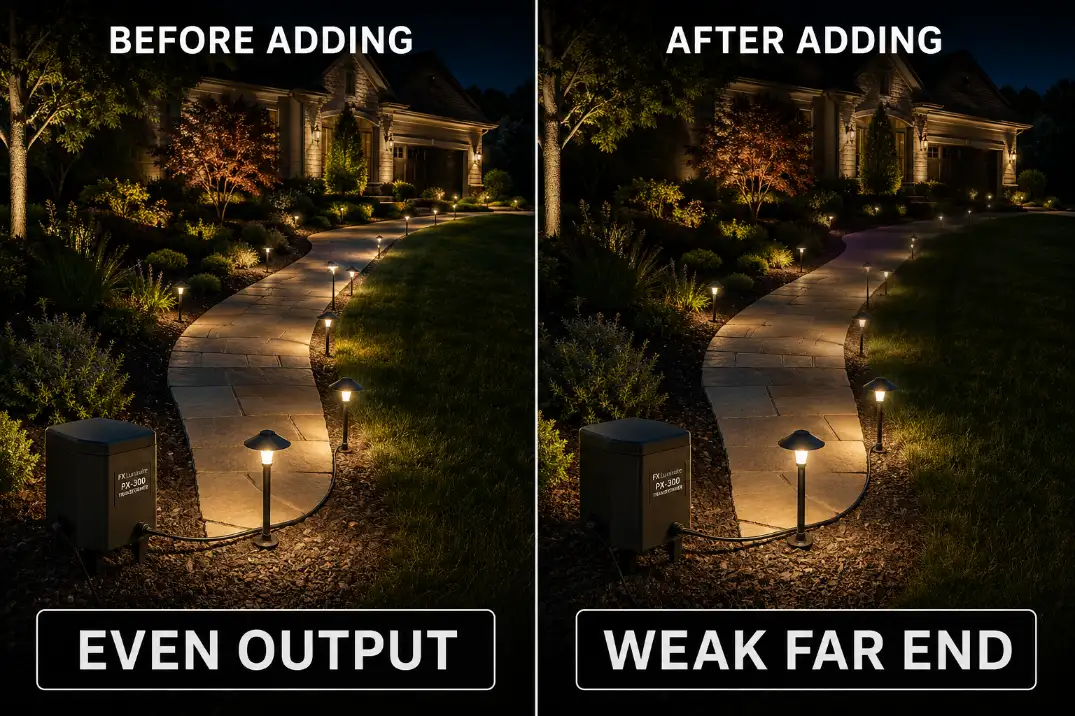
The fastest way to separate the causes is to compare the first light, the last light, and the transformer while the system is running. If only the far-end lights are dim, suspect voltage drop, wire size, or one long cable run.
If every light got dim, including the closest fixture, suspect transformer load, tap setting, or a main connection.
On many 12V low-voltage systems, visible trouble often starts when the farthest fixture is more than about 1.5V lower than the first fixture, or when it falls below the fixture maker’s recommended input range.
That is very different from normal LED fading, which usually happens slowly over months or years. A sudden drop the same night you add lights is a system behavior problem first, not a bulb-aging problem.
What Changed When You Added More Fixtures
More fixtures increase current demand
Adding fixtures does not just add more light. It asks the same transformer and cable to carry more current. More current moving through the same wire creates more voltage loss along the run, so the weakness usually appears at the farthest fixtures first.
A simple example makes this easier to see. Adding six 5W fixtures adds 30W. On a 12V system, that is about 2.5 additional amps moving through the same cable.
If the original run was already long, thin, or heavily loaded, that extra current can be enough to make the end of the line visibly weaker.
This is the key distinction: dim lights are the symptom, but voltage loss under load is often the mechanism. Replacing the dim fixture may feel logical, but it usually wastes time if the fixture is only receiving weak voltage.
A deeper explanation of that behavior is covered in Voltage Drop in Outdoor Lighting Systems, but the practical takeaway is simple: longer wire, thinner wire, more load, and more connections all make the far end less reliable.
The closest light tells you where to look
If the first few fixtures still look strong and only the last fixtures look dull, the problem is probably not the whole transformer. It is more likely the cable run, wire gauge, layout, or a weak connection downstream.
If every fixture got dim, including the first one within 10–20 feet of the transformer, the transformer side deserves more attention. That points toward total wattage, tap choice, timer, photocell, overload protection, or a main splice.
Before You Replace Fixtures, Measure Three Points
Test with the lights on
Voltage should be checked with the system under load. A disconnected or no-load reading can look fine because the cable is not doing real work yet.
Let the lights run for 10–15 minutes, then measure voltage at three places: the transformer terminals, the first fixture, and the farthest fixture.
If the transformer output looks normal but the farthest fixture is low, the cable run is the problem. If the transformer output drops under load, the transformer or total connected load is more suspicious.
If voltage drops sharply after one splice, hub, or buried connector, do not keep blaming fixture count. That is a connection problem until proven otherwise.
Use the readings to choose the fix
| Test result | Most likely issue | Better first fix |
|---|---|---|
| First light strong, last light weak | Voltage drop along the run | Shorten, split, or upgrade the run |
| All lights dim, including first fixture | Transformer load or output issue | Check total watts and transformer tap |
| Voltage drops after one connector | Bad splice, corrosion, or loose connection | Rebuild the connection |
| New fixtures dim but old ones look normal | Fixture mismatch or branch issue | Compare fixture specs and branch voltage |
| System improves when added lights are removed | Load exceeded the layout’s limit | Redesign the run before buying more fixtures |
The Most Likely Causes, Ranked
1. Voltage drop from a longer or heavier run
This is the first place to look when the farthest lights are weaker than the nearest lights. Every foot of cable adds resistance. Every added fixture increases current. Together, they can pull the far end below the fixture’s comfortable operating range.
A 30-foot run with a few LED path lights may behave fine. Stretch that same run to 100 feet, add several more fixtures, and keep the same cable size, and the last lights may suddenly look weak even though nothing is technically “broken.”
People often overestimate how forgiving low-voltage LED systems are. LEDs use less wattage than older halogen lamps, but they are not immune to poor layout. A group of small 3W or 5W fixtures can still change how the cable behaves.
2. Wire gauge that was fine before but not after
Wire size becomes more important after expansion. A cable that handled four fixtures may not handle eight fixtures across the same distance with the same brightness.
The gauge number can also confuse people. In American Wire Gauge, a lower number means a thicker cable. So 12-gauge wire is thicker and has less resistance than 16-gauge wire.
For longer main runs or growing systems, 12-gauge cable is often a safer baseline than 14- or 16-gauge cable.
The trap is assuming the original wire was correct because the system used to work. It may only have been correct for the smaller version of the system.
If you are deciding whether the existing cable still fits the expanded layout, What Wire Gauge Do You Need for Low Voltage Landscape Lighting? gives a more useful way to think about distance, load, and wire size together.
Pro Tip: Do not judge wire size by how bright the first fixture looks. The farthest fixture under load is the better test.
3. Too many fixtures on one cable run
Sometimes the transformer still has enough capacity, but one cable run is doing too much work. That is different from an undersized transformer.
The total wattage may look acceptable on paper while one long branch still performs poorly because the load is concentrated on a single path.
Fixture count can mislead here. Eight 3W fixtures are only 24W, which sounds small. But if all eight sit across a long daisy-chain run, the last fixture may still receive weak voltage after the cable has carried current past every earlier fixture.
The practical question is not only “How many watts do I have?” It is also “Where are those watts located along the run?” That is why How Many Landscape Lights Can You Put on One Cable Run? matters more than a simple fixture-count rule.
Why the Obvious Fix Often Fails
Brighter fixtures can make the system worse
A common reaction is to buy brighter replacement fixtures. That can backfire. If the new fixtures draw more watts, they may increase the same load problem that caused the dimming in the first place.
This is especially true when someone replaces several fixtures, adds a few new path lights, and expects the transformer to handle the upgrade because the system is “low voltage.” Low voltage does not mean unlimited capacity.
Raising the transformer tap has limits
Multi-tap transformers can help when used correctly. Moving a run from a 12V tap to a 13V or 14V tap may compensate for measured voltage loss on a long run. But it should not be used as a blind fix.
Use a higher tap only when the farthest fixture is low and the closest fixture will still remain inside the fixture’s safe input range.
If the first fixture is already receiving strong voltage, raising the tap may overfeed the nearest fixtures while only partly helping the far end.
A routine tap adjustment stops making sense when it becomes a way to hide a bad run design. If the run needs an unusually high tap just to make the last light look acceptable, the better answer is usually a shorter run, heavier cable, or a different wiring layout.
The Layout Fix That Changes the Outcome
Split the load instead of stretching the run
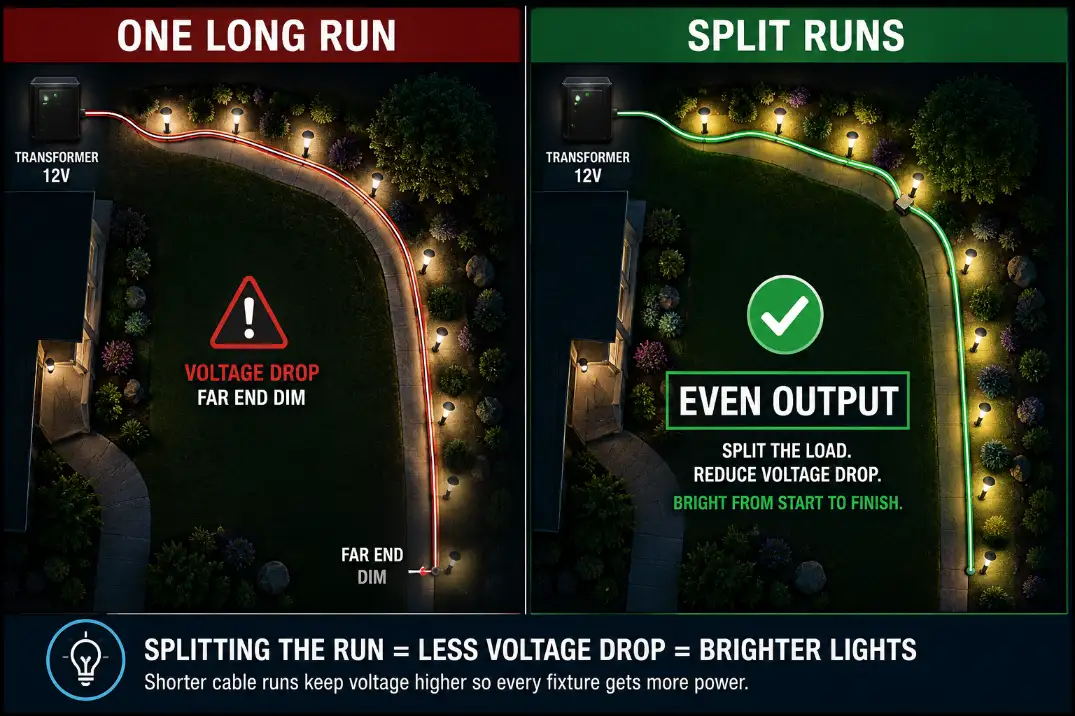
The strongest fix is often not a new fixture. It is a better layout. Splitting one long run into two shorter runs reduces the amount of current that has to travel through the same cable length.
A center-feed, hub, or two-run layout can make the same transformer and same fixtures look more even.
A daisy chain is convenient because it follows the path, but it is not always kind to brightness. Each fixture sits farther downstream from the source. When you add more lights to the end, you extend the weakest part of the system.
That is why Daisy Chain vs Hub Landscape Lighting is often the more useful decision than simply asking whether one more fixture can be added.
Use heavier cable where it matters most
If you are keeping the same route, heavier cable can reduce voltage loss. Upgrading a long main run from 16-gauge to 12-gauge can make a real difference, especially when the run carries multiple fixtures before reaching the far end.
Do not waste heavier cable everywhere equally. The main trunk from the transformer carries the most combined load. Short fixture leads or small branches matter less unless they are unusually long, damaged, or poorly connected.
Check the Transformer Without Guessing
Compare total wattage to usable capacity
Add the wattage of every fixture connected to the transformer. A 150W transformer should not be treated as a comfortable 150W lighting plan.
A practical target is to keep the connected load at or below about 80% of capacity, which puts a 150W transformer closer to 120W of comfortable planning room.
That does not mean a system instantly fails above 120W. It means you lose margin. Heat, long runs, older connections, and future additions all become less forgiving.
If the entire system got dimmer after the expansion, especially the lights closest to the transformer, review Too Many Landscape Lights on One Transformer? Watch the Load before spending time moving individual fixtures around.
Would a bigger transformer fix it?
Only if transformer capacity or output is actually the limiting problem. If the transformer voltage stays stable but the last fixture is low, a bigger transformer may not fix the visible dimming.
The same long or undersized cable run can still lose voltage before power reaches the end.
A bigger transformer makes sense when the connected wattage is too close to the transformer’s rating, the output drops under load, or future expansion needs more capacity.
It is less useful when the real problem is one overloaded branch. In that case, splitting the run or upgrading the main cable usually changes the result more directly.
Watch for transformer-side symptoms
Transformer-side problems usually look broader than one weak far-end fixture. The whole system may dim, flicker, shut off after a few minutes, or recover after cooling.
If the output voltage is unstable with the lights running, the cable layout may not be the only issue.
That is where Transformer Problems in Low Voltage Systems becomes more relevant than fixture-by-fixture troubleshooting.
When the Problem Is Not the Added Fixtures
Bad connections can show up after expansion
A weak splice may have been barely acceptable before the new load. After the expansion, that same connection can become the point where voltage drops sharply. Look for dimming that starts after a specific connector or section of cable.
Connections in wet garden beds, sprinkler spray zones, and freeze-thaw climates are worth checking closely.
Coastal moisture, humid Southeast yards, and northern winter movement can all make marginal outdoor connections less reliable over time.
If one section drops out, flickers, or changes brightness when the wire is moved, stop treating the issue as a fixture-count problem. That is a connection problem until proven otherwise.
Fixture mismatch can confuse the diagnosis
Mixing old halogen fixtures, newer LEDs, different beam spreads, and different driver designs can make brightness comparison harder.
A newer fixture may look dimmer because of beam angle, lens design, color temperature, or lumen output, not just voltage.
Still, if several fixtures all became dimmer immediately after you added more lights, do not let fixture style distract from the electrical pattern. Sudden system-wide change is more diagnostic than small differences between individual fixture designs.
Bottom Line
When landscape lights get dimmer after adding more fixtures, the added lights usually revealed a system limit. The most useful question is not “Which new fixture is bad?” It is “Where did the voltage stop arriving cleanly?”
If the far end is weak, focus on run length, wire gauge, layout, and connections. If every light is weak, focus on transformer load and output under real operating conditions.
Once you separate the symptom from the mechanism, the fix becomes much clearer: reduce voltage loss, balance the load, and stop asking one cable run to do more than it was designed to handle.
For broader official guidance on LED lighting performance and efficiency, see the U.S. Department of Energy.