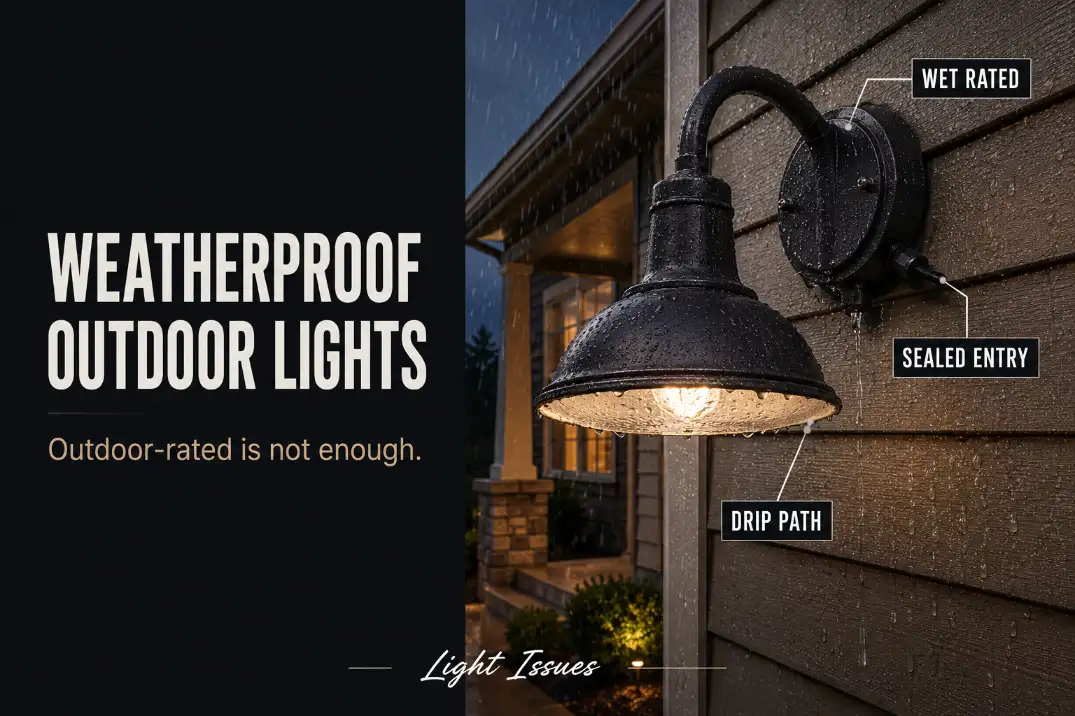
An outdoor light is weatherproof only when the fixture rating, gasket, cable entry, junction box, and mounting angle all match the water exposure it actually receives.
The first meaningful checks are simple: is the light listed for wet locations, does the gasket still compress evenly, and can rainwater drain away instead of sitting in the housing?
A light that fogs briefly after a cold night is not the same problem as a light with standing water inside the lens. If the fog clears within a few hours, watch it. If droplets remain inside for 24–48 hours, or the light flickers within 30 minutes to 2 hours after rain, treat that as water intrusion, not normal outdoor aging.
The mistake is assuming that “outdoor style” means weatherproof. A black metal lantern, floodlight, or path light can look rugged and still be wrong for direct rain, sprinkler spray, coastal moisture, or freeze-thaw exposure.
Weatherproof Means Exposure-Matched, Not Water-Proof Forever
A weatherproof outdoor light is built to resist the type of moisture it is rated for. It is not a permanent shield against every form of water. Direct rain, wind-driven rain, melting snow, sprinkler spray, condensation, heat expansion, and salt air all stress different weak points.
Damp Location and Wet Location Are Different Decisions
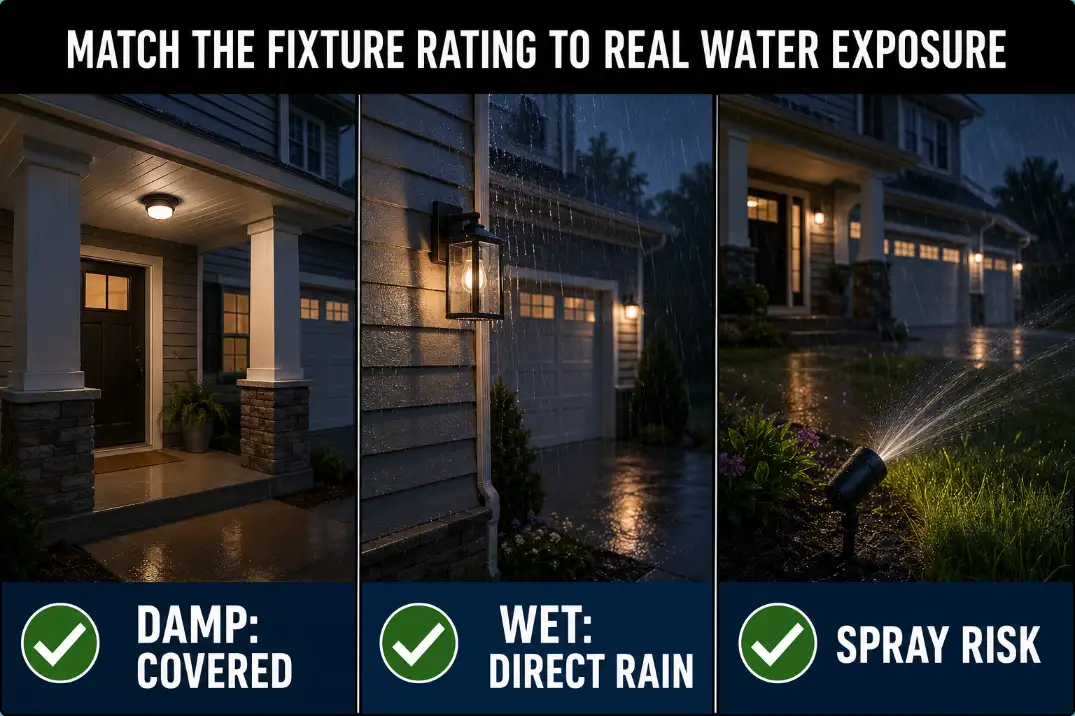
A damp-location fixture can work where moisture is present but direct water contact is limited. A covered porch ceiling, protected entry, or sheltered patio wall may qualify if rain does not actually reach the fixture.
A wet-location fixture is the better choice when the light can receive direct rain, snow, hose splash, or sprinkler spray. That includes uncovered wall lights, driveway fixtures, exposed deck lights, post lights, and many landscape lights.
This is where homeowners often overestimate protection. A 24-inch roof overhang may protect a wall light during gentle rain, but it may not protect it during wind-driven rain in a Midwest storm.
The fixture should match the wettest normal day, not the neatest version of the installation.
Weatherproof, Waterproof, and Water-Resistant Are Not the Same
Weatherproof means the fixture is designed to handle outdoor exposure within its rating. Water-resistant means it can resist some moisture, but not necessarily direct rain or sustained spray.
Waterproof is often used loosely in product language, but in real installations the rating, seals, wiring entry, and mounting surface still decide whether water stays out.
That distinction matters because the wrong fixture can survive for a few dry months and still fail after one hard storm season.

Which Weatherproof Rating Do You Actually Need?
The right rating depends less on the fixture category and more on where water can reach it. A porch light, floodlight, post light, and path light can all be “outdoor lights,” but they do not face the same moisture load.
Covered Porch or Protected Entry
A damp-rated fixture may be acceptable only when direct rain and spray do not reach the light. The key word is protected. If wind can push rain onto the fixture several times a year, choose wet-rated instead.
Condensation is still possible in covered areas, especially in humid climates, but that is different from repeated water entry. Fog that disappears after the fixture warms is usually less serious than droplets that remain inside the lens the next day.
Uncovered Wall, Driveway, or Post Light
Use a wet-location rated fixture where rain can hit the light directly. For exposed outdoor locations, IP65 or stronger is often a practical target because the fixture needs better resistance to dust and water entry than a lightly protected porch fixture.
An IP number is useful, but it is not a magic shield. If the cable entry is loose, the backplate is not sealed correctly, or the fixture is tilted so water pools in a seam, even a stronger housing can disappoint.
Sprinklers, Ground-Level Fixtures, and Coastal Air
Sprinkler spray is often underestimated because it feels less dramatic than a storm. But repeated side spray can hit the same seam every morning for weeks.
Ground-level landscape lights also face mulch moisture, splashback, and standing water after heavy rain.
Coastal air adds another layer. Salt moisture can age finishes, screws, and connection points faster than normal inland exposure.
In coastal California or humid coastal areas, a fixture that is merely “outdoor rated” may not be the smartest long-term choice if the finish and seals are weak.
| Location | Minimum Practical Choice | Main Moisture Risk | Better Decision |
|---|---|---|---|
| Covered porch ceiling | Damp-rated may work | Humidity and light condensation | Use wet-rated if rain can blow in |
| Protected entry wall | Damp or wet, depending on exposure | Side rain during storms | Match the actual rain reach |
| Uncovered wall light | Wet-location rated | Direct rain and backplate leaks | Check gasket and cable entry |
| Driveway or floodlight | Wet-location rated / IP65+ | Rain, spray, and wind | Use stronger ingress protection |
| Sprinkler zone | Wet-rated with strong seals | Repeated side spray | Redirect spray or upgrade fixture |
| Coastal location | Wet-rated plus corrosion resistance | Salt moisture | Avoid weak finishes and exposed screws |
The Parts That Actually Keep Water Out
A rating tells you what the fixture was designed to handle. The physical weak points decide whether it still performs that way after installation.
The Housing Must Shed Water
A weatherproof fixture should guide water away from the electrical cavity. A sloped top, tight lens fit, covered screw points, and downward drainage path matter more than decorative weight.
Flat tops, upward-facing seams, and cup-like lens shapes are more likely to hold water after rain.
A small amount of exterior water on the surface is normal. Water sitting in a seam for hours is not. In freezing northern states, trapped water can expand when temperatures drop below 32°F, opening a small gap into a repeating leak.
The Gasket Must Still Compress
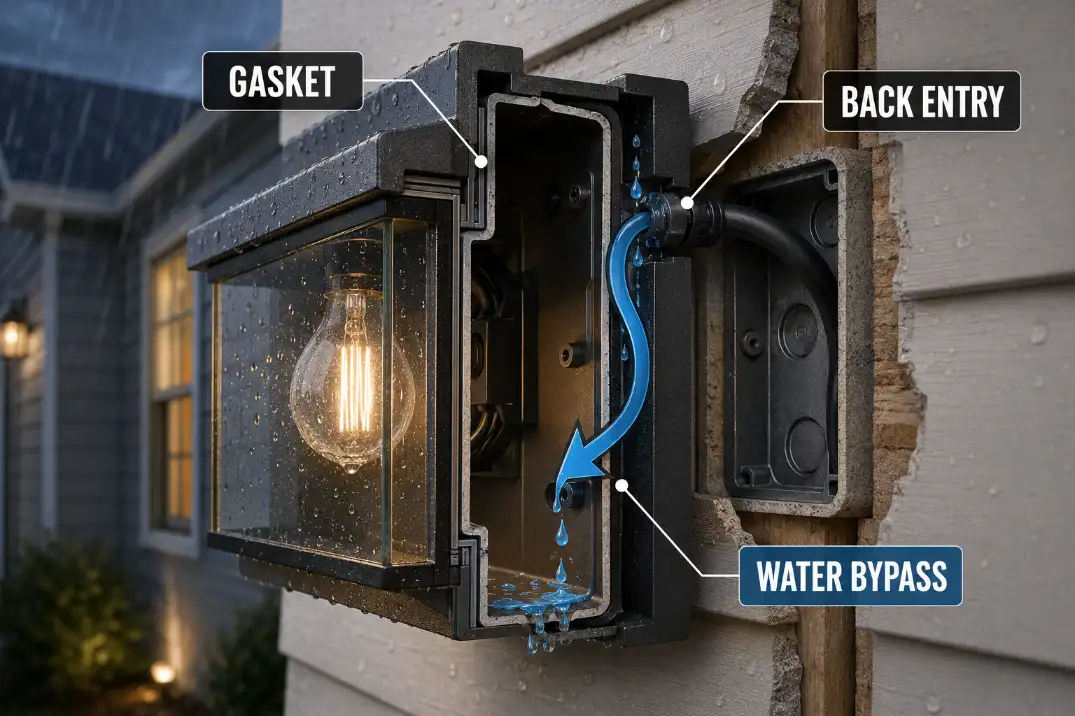
The gasket is often the real weather barrier. It should sit evenly, feel flexible, and compress when the lens or cover closes.
A gasket that has flattened, cracked, hardened, or slipped out of its channel can let water in even if the fixture was originally rated for outdoor use.
This is why many failures show up after a few seasons instead of on day one. Heat, UV exposure, cold weather, and repeated bulb changes slowly weaken the seal.
If a fixture repeatedly collects moisture after rain, the issue is closer to Moisture Damage in Outdoor Lighting Explained than to simple surface cleaning.
The Cable Entry and Box Matter
Water does not need to enter through the front lens. It can follow the cable, pass through a loose knockout, seep behind a wall-mounted backplate, or reach the junction box from above.
That is why a fixture can look dry from the front while the connection area behind it is already damp.
A proper outdoor installation protects the wire path and mounting surface, not just the visible shell. Old caulk around the edge of a backplate is not enough if water is already entering from the top, the cable opening, or a poorly fitted box.
Pro Tip: If you remove a fixture and see water staining behind the mounting plate, solve the backplate or cable-entry problem before blaming the front lens.
UL Wet Rating and IP Rating Are Not the Same Check
UL or ETL location listings and IP ratings answer different questions. They can support each other, but one does not replace the other.
Location Listing Tells You Where the Fixture Belongs
A damp-location or wet-location listing tells you whether the fixture is suitable for that type of installed environment. This is the first thing to check when choosing a wall light, porch light, floodlight, or post light.
If the fixture faces direct rain, the decision should not be close. Choose wet-location rated.
IP Rating Tells You About Ingress Resistance
An IP rating describes resistance to solids and liquids entering the enclosure. IP44 may be enough for mild splash protection in some protected areas. IP65 gives stronger dust and water-jet resistance and is often a better fit for exposed outdoor lights. IP67 is stronger still, but it is not automatically necessary for every house fixture.
The practical mistake is treating IP as a cure for poor installation. A higher IP rating does not fix a cracked lens, bad gasket, tilted fixture, loose cable entry, or wet junction box.
What People Usually Misread First
Weatherproofing problems rarely start with the part that looks most dramatic. A cloudy lens, dead bulb, or rusty screw may be visible, but those are often symptoms. The underlying mechanism is repeated moisture contact at a weak point.
Condensation Is Not Always Failure
Outdoor fixtures breathe slightly as temperatures change. Warm air inside the fixture cools, moisture condenses, and a light haze may appear. In many cases, that fog clears after the fixture warms or the weather dries.
The useful threshold is persistence. If fog clears in 2–3 hours, it may be normal. If droplets stay inside for 24–48 hours, or water collects at the bottom of the lens, the fixture is no longer just “breathing.” It is holding water. At that point, Water Inside Outdoor Light Fixtures is the more relevant problem path.
Rain-Triggered Failure Beats Bulb Failure in Priority
If a light works during dry weather and fails after rain, do not start by buying brighter bulbs or changing timer settings.
The rain pattern is the clue. A bulb can fail at any time, but a fixture that flickers, trips, or shuts off after storms is pointing toward moisture, leakage, or a compromised connection.
That pattern is more diagnostic than a simple dead bulb because it repeats around weather, not random usage. The fixture may still look normal from the outside while moisture is reaching the backplate, splice area, or driver.
This is common with exposed floodlights, driveway lights, and wall fixtures where wind pushes water behind the housing.
If the same light behaves normally in dry weather but fails after storms, Why Your Outdoor Light Works Fine Until It Rains is a better diagnostic direction than general bulb troubleshooting.
Caulk Can Waste Time
Caulk feels like the obvious fix because water is involved. It is also one of the easiest fixes to overuse. Sealing the wrong seam can trap water inside the fixture, block a drain path, or hide the real leak at the wire entry.
Caulk makes sense only when it protects the correct exterior joint without closing off needed drainage. It does not make an indoor fixture outdoor-rated, and it does not restore a failed gasket.
Quick Weatherproof Check Before You Trust the Fixture
Use this check before installing a new light or deciding whether an older one still belongs outdoors.
- The fixture is labeled for wet locations if it will face direct rain, snow, sprinkler spray, or hose splash.
- The gasket sits flat and compresses evenly with no cracks, gaps, or hardened edges.
- The cable entry and junction box are protected from water following the wire path.
- The fixture sheds water instead of holding it on a flat top, seam, or upward-facing lens.
- The splice area is clean, dry, and free of green corrosion, white residue, or brittle insulation.
- The light behaves the same after rain as it does during dry weather.
- Any internal fog clears within a few hours instead of remaining for 24–48 hours.
This checklist is not about perfection. It is about ruling out the weak points that actually change reliability.
When Weatherproofing Stops Being a Repair Job
A weatherproof outdoor light is worth maintaining when the issue is limited: a loose cover, dirty gasket seat, slightly misaligned lens, or minor installation gap. It stops making sense when water has reached the electrical parts repeatedly.
Corrosion Changes the Decision
Surface rust on a decorative screw is not the same as corrosion inside the wiring area. Green residue on copper, white powder near terminals, darkened insulation, or repeated flickering after damp weather means the fixture has moved beyond a cosmetic problem.
At that point, cleaning the outside may improve appearance but not reliability. Once corrosion reaches connection points, Corrosion in Outdoor Light Connections becomes a safety and performance issue, not just a maintenance detail.
Repeated Water Means the Rating No Longer Matters
A fixture can be wet-rated on paper and still fail in the field if the gasket is damaged, the mount is tilted, the lens is cracked, or the cable path is wrong.
The useful question is not “Was this sold as outdoor?” The useful question is “Can this exact installed fixture still keep water out under normal exposure?”
If a fixture fills with water after every storm, trips a GFCI, or flickers repeatedly, routine fixes stop making sense. A one-time dry-out may buy time, but it does not restore the weather barrier.
Repair, Replace, or Call an Electrician?
If the fixture is dry inside, properly rated, and only has a loose cover or dirty gasket surface, a careful reset may be enough.
Clean the gasket channel, reseat the lens, tighten the cover evenly, and confirm that water can drain away. Then check it again after the next rain.
Replacement makes more sense when the fixture is the wrong rating for the location, the lens is cracked, the gasket is no longer flexible, or the fixture has failed after multiple storms.
A fixture that has lasted 5–10 years outdoors may simply have reached the point where seals, plastics, and metal finishes are no longer reliable.
Use Repair or Replace Outdoor Lights when the fixture is still physically intact but unreliable, especially if you are weighing seal repair against a full replacement.
Electrical help becomes the priority when water has reached wiring, the GFCI trips repeatedly, the breaker trips, insulation looks damaged, or more than one fixture behaves oddly after rain.
Those signs point beyond the weatherproof shell and into the circuit. In that case, Call an Electrician for Outdoor Lighting Problems is the safer next step.
The Better Purchase Rule
For exposed locations, buy for the wettest normal day, not the average day. A covered patio light can often survive with a damp rating.
An uncovered driveway floodlight, fence post light, exposed deck light, or wall fixture hit by sprinklers should be treated as a wet-location installation.
A good outdoor light is not just sealed tightly. It is rated correctly, mounted cleanly, wired safely, allowed to drain, and still able to hold its seal after heat, cold, rain, and seasonal movement.
Questions People Usually Ask
Is weatherproof the same as waterproof?
No. Weatherproof usually means the light is designed to resist normal outdoor exposure for its rating. Waterproof is stronger language, but even high-rated fixtures can fail if they are damaged, installed poorly, or used in the wrong exposure zone.
Can I make an indoor light weatherproof?
Not reliably. Adding caulk, a covered bulb, or a sheltered shade does not change the fixture’s listing, gasket system, wiring design, or corrosion resistance. Use a fixture rated for the actual outdoor location.
Are solar outdoor lights weatherproof?
Some are, but many small solar lights fail because the panel, battery compartment, switch, or lens seal is weaker than the visible housing. A solar light can look sealed and still let water reach the battery area after repeated rain.
How long should a weatherproof outdoor light last?
A well-matched fixture can last several years, and higher-quality fixtures may last much longer. But seals and finishes age.
If a fixture begins collecting water, flickering after rain, or showing internal corrosion, its practical weatherproof life is already ending.
For formal product safety context around listed outdoor luminaires, see UL Solutions Landscape and Outdoor Luminaire Lighting.