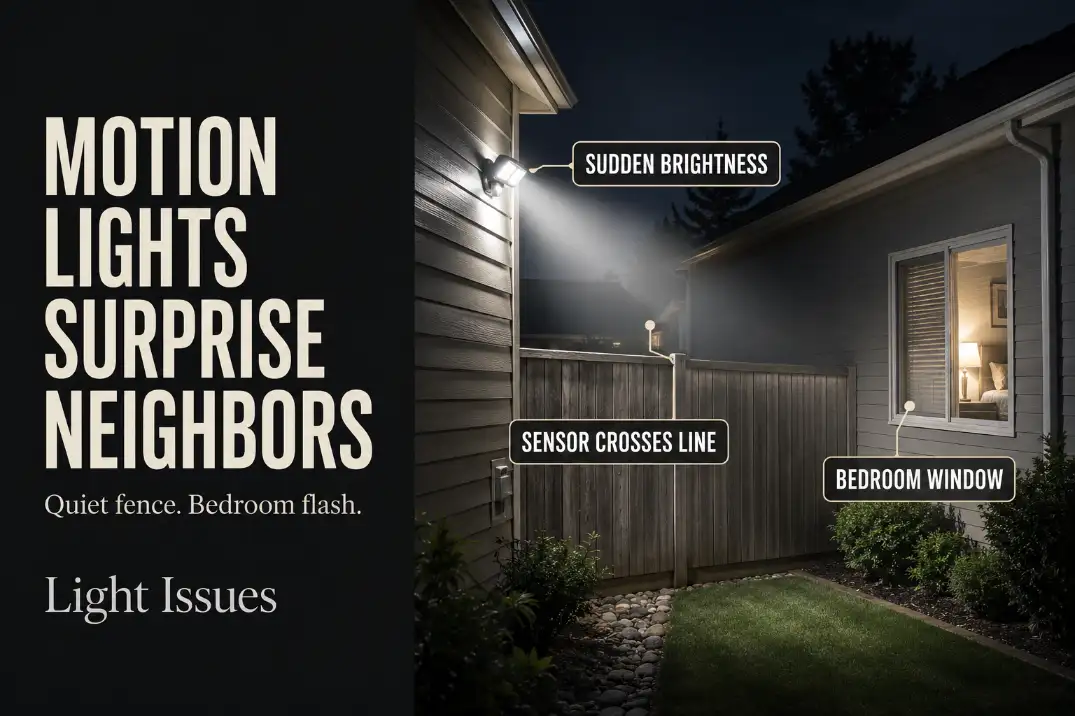
Motion sensor lights usually surprise neighbors because they react to the wrong movement, not because every fixture is wildly overpowered. A passing car 35 feet away, a dog near the fence, a person on the sidewalk, or wind movement at the property edge can trigger a full-brightness burst that feels aimed at someone else’s house.
The first checks are simple: what triggers the sensor, where the brightest part of the beam lands, and how long the light stays on. If the fixture flashes into a bedroom window 3–5 times per night without anyone entering your usable yard, that is no longer normal security behavior.
A 20- to 30-second downward burst near a gate is very different from a 90-second blast across a shared side yard. This is not the same as steady all-night glare. The problem is not just light level; it is the sudden change from a quiet dark room to an unexpected flash.
Sudden Brightness
The shock comes from instant contrast
Neighbors do not experience the fixture the same way you do. From your side, the light may make the driveway, gate, or back step feel safer. From their side, it may look like a dark window suddenly flashed white.
That contrast matters. Human eyes adjust to darkness after several minutes. When a motion light jumps instantly to full output, even a moderate fixture can feel harsh if the lens is visible or the beam catches glass. A 1,200-lumen motion light aimed low may be acceptable. A lower-output fixture aimed toward a bedroom can feel worse.
The lens view is often worse than the ground pattern
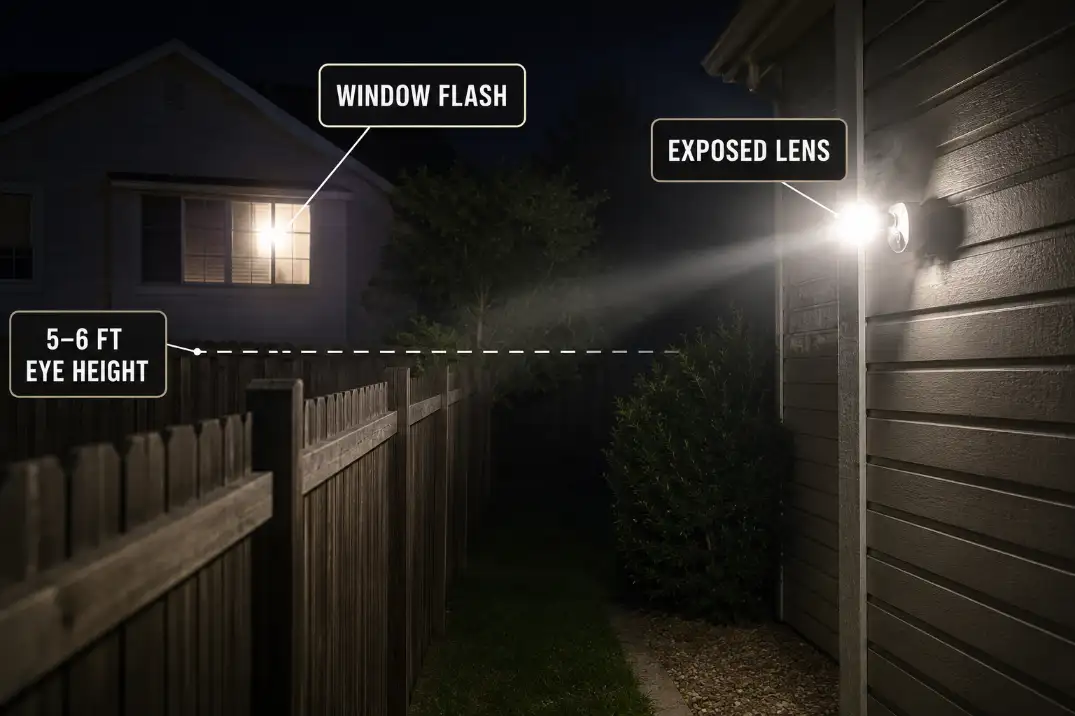
Many homeowners judge the light by looking at the ground under it. That misses the real complaint. A neighbor may not care that your patio has a bright patch. They care that the exposed lens or upper beam is visible from their window.
A useful first test is to stand near the shared fence at about 5–6 feet high and look back toward the fixture. If the lens itself is uncomfortable to look at, the fixture can surprise a neighbor even when the ground coverage looks controlled.
The same visible-lens problem also shows up in broader neighbor complaints about Outdoor Lights That Annoy Neighbors, where the fixture seems normal from the owner’s side but harsh from another angle.
Street Movement
The sensor fan may be watching outside your yard
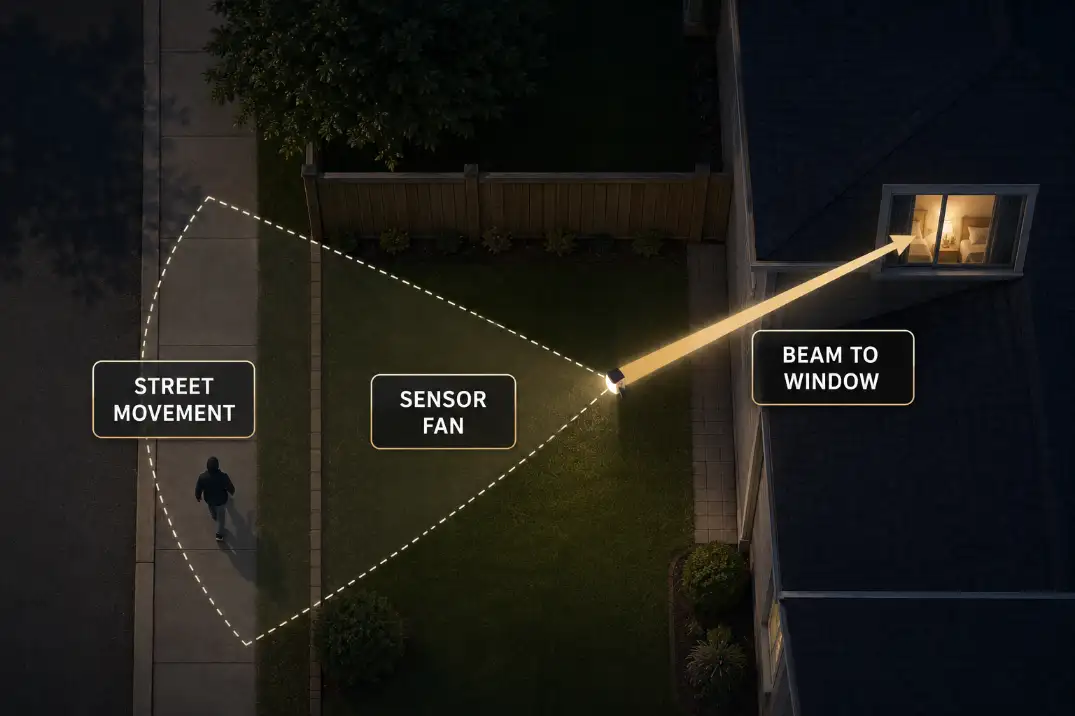
The most important part of a motion light is not always the lamp head. It is the invisible sensor fan. If that fan reaches past the driveway, sidewalk, street edge, or shared fence, the light starts reacting to movement that does not belong to the task.
This is where many fixes go sideways. A dimmer bulb can reduce harshness, but it does not stop the sensor from reacting to passing cars or pedestrians.
If the light turns on every time someone walks past the front sidewalk, the brightness is only the symptom. The underlying problem is sensor permission.
On narrow lots, this can overlap with the same boundary problem explained in Backyard Lights That Cross the Property Line: the fixture may be mounted on your house, but the active light behavior is happening beyond the area you meant to control.
False triggers are the clue
A clean motion light turns on when someone uses a real approach path: driveway, gate, steps, side door, trash-bin route, or back entry. A failing setup reacts to background movement.
Use a 5-minute night walk. Move along the sidewalk, shared fence, driveway edge, and the normal neighbor-side sightline. Do not only wave your hand near the sensor.
If the light activates from outside the area you actually want protected, the sensor range is too wide, aimed too far outward, or mounted where it cannot separate public movement from private movement.
For a motion-specific diagnosis, Outdoor Motion Sensor Light Too Sensitive is the closer repair path when cars, branches, pets, or sidewalk movement keep triggering the fixture.
Bedroom Windows
Glass turns a small mistake into a bigger one
A motion light can be neighbor-friendly in one direction and disruptive in another. The worst target is usually a bedroom window, especially on the side of a house where lots are close together.
The beam does not need to fully flood the room. A quick flash across blinds, curtains, or upper glass can be enough to wake someone. That is why “it only stays on for a few seconds” is not a complete defense. A 15-second flash into a bedroom is still a flash into a bedroom.
The useful distinction is this: the symptom is brightness, but the mechanism is beam placement. If the brightest part of the beam lands on ground, steps, or a gate, the light may be doing its job. If it lands on glass, upper siding, or fence-top height, it is leaving the job zone.
Upstairs angles get underestimated
Second-floor windows create a problem that is easy to miss from the patio. A fixture mounted 8–10 feet high and aimed “somewhat downward” may still expose its lens to an upstairs bedroom or send a diagonal wash across the upper part of a window.
This is common in side yards where houses sit 10–20 feet apart. From ground level, the beam may look acceptable. From a bedroom-height angle, the same light may feel direct.
When the complaint is specifically about glass or sleep disruption, the more focused fix logic belongs in How to Stop Outdoor Lights From Shining Into Neighbor’s Windows, because the repair is usually aim, shielding, or fixture position rather than simple dimming.
Sensor Range
Maximum range is not better on a narrow lot
People often buy motion lights as if more range means better security. That is true only when the space needs it. A 70-foot detection range can make sense for a long driveway. It is a liability on a 14-foot side yard facing another house.
For most home entries, gates, and short side-yard paths, the useful detection zone is closer to 10–30 feet. Past that, the sensor often starts watching movement you cannot control. A strong security light should detect meaningful movement near the access point, not every warm object moving near the property.
Aim the sensor before blaming the bulb
If the sensor body points toward the street, sidewalk, neighbor-side fence, or open air beyond the driveway, the fixture will behave like a public-area detector. The lamp head may then blast your private space and someone else’s window at the same time.
The better sequence is sensor first, lamp second. Narrow the detection zone, rotate the sensor away from public movement, then adjust the lamp head so the brightest area lands low. The aiming principles in Aim Outdoor Security Lights are especially important when the fixture sits near a shared fence or bedroom-facing wall.
When adjustment stops making sense
There is a point where repeated tweaking becomes wasted time. If the lowest sensitivity setting still catches street movement, or the fixture cannot aim downward without exposing the lens, the product design is working against you.
That is the replacement boundary. A fixture with no usable sensitivity control, no timer control, no shielding, and wide exposed heads will be hard to make neighbor-friendly. Another bulb change may soften the flash, but it will not fix the trigger path.
Shorter Triggers
Duration changes how intrusive the light feels
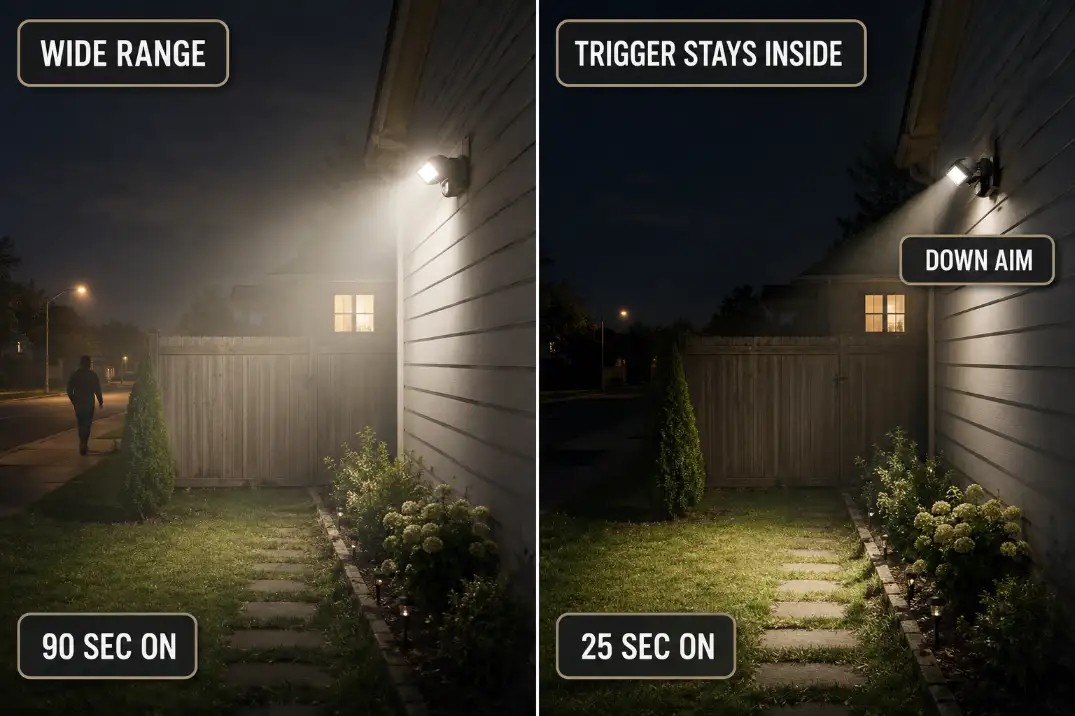
Time-on settings often cause more neighbor irritation than people expect. A motion light that stays on for 2–3 minutes after every harmless trigger feels like a repeated event. A controlled 20- to 45-second activation feels more like a brief response.
Shorter timing is especially useful for side yards, gates, trash areas, and short walk paths. Longer timing makes sense only when someone genuinely needs time to unlock a door, unload a vehicle, or cross a long driveway.
| Setting choice | Healthier condition | Failing condition |
|---|---|---|
| Trigger source | Movement inside the task area | Street, sidewalk, branches, or neighbor-side motion |
| Detection range | About 10–30 ft for short zones | Maximum range left unchecked |
| Light duration | 20–45 seconds | 60–180 seconds |
| Beam target | Ground, steps, gate, driveway | Bedroom window, upper wall, fence-top spill |
| Neighbor experience | Brief low response | Sudden repeated flash |
Shorter time is not a substitute for better aim
A shorter trigger helps only after the beam is controlled. If the light flashes directly into a bedroom window, reducing the timer from 90 seconds to 20 seconds improves the problem but does not solve it.
Fix direction first. Then shorten duration. Then soften the output if needed. That order matters because duration controls how long the problem lasts, while aim controls whether the problem reaches the neighbor at all.
Softer Security
Softer does not mean less safe
Neighbor-friendly security lighting is not weak lighting. It is controlled lighting. A good setup reveals the step, lock, gate, driveway edge, or approach path without turning the neighbor’s window into part of the scene.
This is where homeowners often overestimate raw brightness and underestimate beam discipline. More light can make a yard feel less readable if it creates glare, hard shadows, and dark pockets behind bright areas. A lower, shielded, warmer, better-aimed light can be more useful than a high-output flood that fires in every direction.
Warm light also helps the fixture feel less harsh. Around 2700K–3000K is usually a better residential range than cool white light near bedroom windows, especially when the fixture is already motion-triggered.
Choose replacement only after the control test
Replacement makes sense when the existing light cannot keep the trigger and beam inside the job zone. Before buying anything, try this sequence:
- Walk the property edge for 5 minutes after dark.
- Count false activations from street, sidewalk, fence, or branch movement.
- Rotate the sensor away from public or neighbor-side motion.
- Aim the lamp head below window height.
- Set the duration near 20–45 seconds.
- Recheck from 5–6 feet eye height at the shared boundary.
If the fixture still blasts sideways after those steps, choose a more controlled design instead of chasing small adjustments. The better buying path is a shielded, adjustable fixture category like Best Neighbor-Friendly Outdoor Lights, not simply the brightest motion floodlight available.
Quick Diagnostic Checklist
Check behavior before replacing parts
- The light activates from street, sidewalk, or neighbor-side movement.
- The exposed lens is visible from the shared fence or bedroom direction.
- The beam reaches glass, upper siding, or fence-top height.
- The fixture stays on longer than 45 seconds for a short side-yard task.
- The sensor is set to maximum range on a narrow lot.
- The complaint is about sudden flashes, not steady all-night glow.
- Bulb changes reduce harshness but do not reduce activation frequency.
Key Takeaway
Motion sensor lights surprise neighbors when the sensor watches beyond the job zone and the beam reaches glass, upper walls, or fence-line views.
The best fix is tighter detection, lower aim, shorter duration, and warmer output before replacement.
Replace the fixture only when it cannot shield the lens, narrow the trigger area, or keep the brightest part of the beam low.
A good motion light should feel almost boring from the neighbor’s side: it turns on only for the protected path, stays on briefly, and lights the ground more than the glass.
For broader official guidance on efficient outdoor lighting controls and fixture design, see the U.S. Department of Energy lighting design guidance.