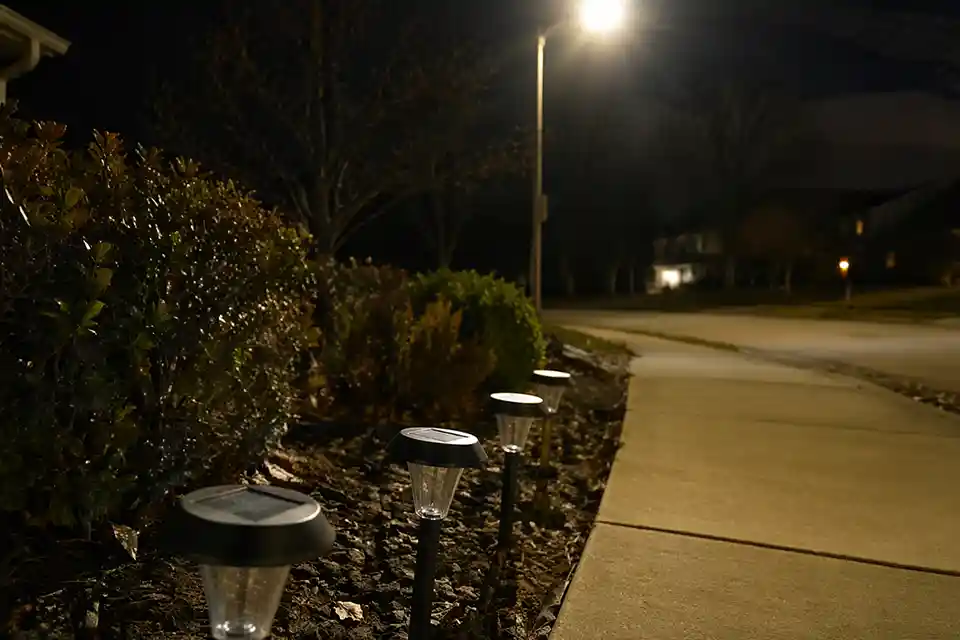
Solar lights near a bright streetlight usually are not broken. In this specific setup, the more likely problem is that the dusk sensor never sees a dark enough condition to switch into night mode.
That changes what you should test first. Before replacing batteries, cover the sensor fully for 30 to 60 seconds after dark, move one fixture 10 to 15 feet away for one night, and compare how it behaves after a day with 6 to 8 hours of direct sun.
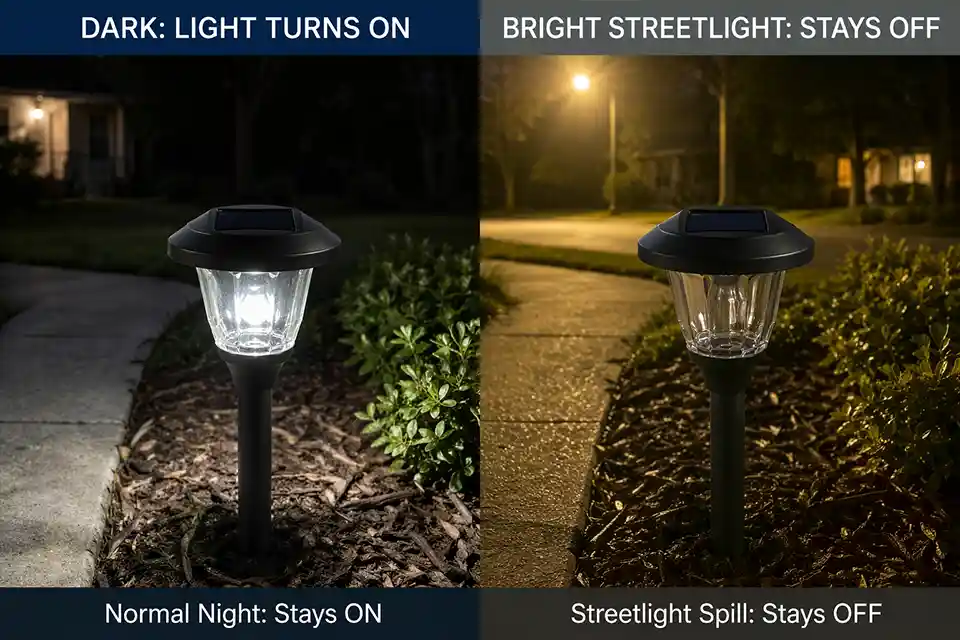
If it turns on in a darker spot but stays off in its original location, the issue is usually artificial light interference, not failed charging.
That distinction is where people waste the most time. A weak battery usually lets the light come on, then fade or die within 1 to 2 hours.
A nearby streetlight, security light, or strong reflected glare can stop activation altogether. The symptom is “it never really starts,” not “it starts and cannot last.”
Why this happens
The sensor reacts to brightness, not time
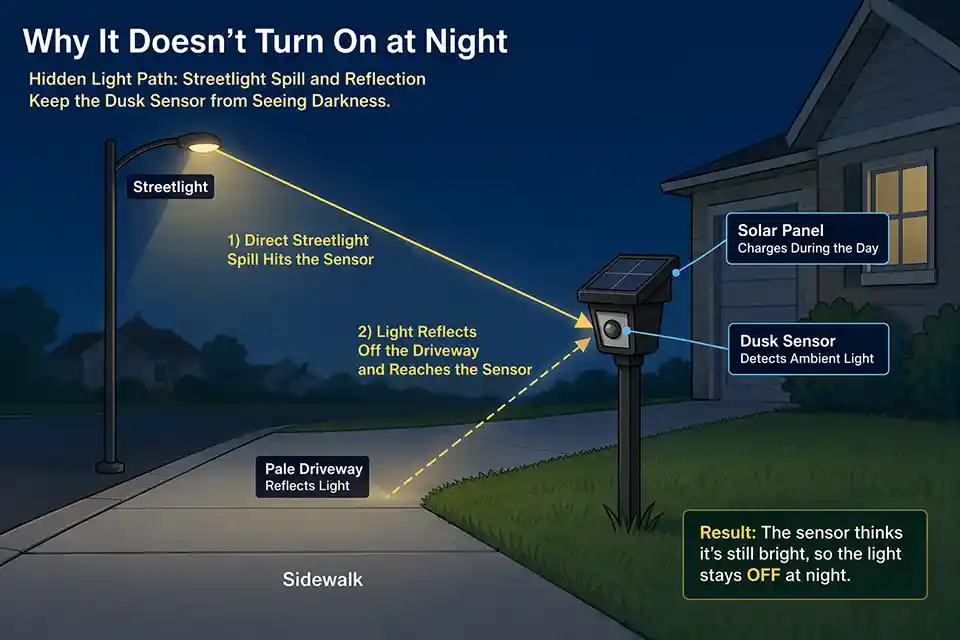
Most solar path and stake lights do not know what time sunset happens. They react to the light level around the sensor. If enough artificial light reaches that sensor after dark, the fixture can stay in daytime mode all night.
Direct spill is only half the story
The mistake people make is focusing only on the streetlight itself. The real issue is the light path. Pale concrete, a white garage door, light-colored siding, or vinyl fencing within about 2 to 6 feet can bounce enough light back toward the fixture head to interfere with the sensor.
Why this looks like a charging problem
The complaint sounds the same at first: “my solar lights do not turn on at night.” But the pattern is different. Charging trouble usually shows up as short runtime or weak brightness after the light activates. Sensor interference shows up as failure to enter night mode in the first place. That is why Sensor Failures in Solar Lighting is often the better match for this scenario than starting with a battery swap.
Quick diagnostic checklist
- Cover the sensor completely for 30 to 60 seconds after dark.
- Move one light 10 to 15 feet away from the streetlight for one full night.
- Give that test light 6 to 8 hours of direct sun before judging the result.
- If it turns on but lasts less than 1 to 2 hours, suspect charge or battery weakness more than streetlight interference.
- If only the first 1 to 3 lights near the curb fail, the site is usually the clue.
- Check for reflective surfaces within about 2 to 6 feet of the fixture.
Streetlight interference or something else?
It stays off near the streetlight, but works in darkness
This is the clearest interference pattern. If the light switches on when you block the sensor or move it to a darker part of the yard, the environment is the problem. Stop treating it like a dead unit until you prove otherwise.
It turns on normally, but dies fast
That points in a different direction. If the light activates at dusk and fades within 30 to 90 minutes, weak charging, poor panel exposure, or battery age is a better lead. In that case, Sun Exposure Issues Affecting Solar Lights is the more relevant next step.
It changes with season or layout
If the lights work when shrubs or summer growth block nearby glare, then fail after leaf drop or site cleanup, the fixture may not have changed at all. The light environment changed. That is one reason Seasonal Problems With Solar Lights can explain behavior that looks random at first.
What people usually misread first
“The battery must be bad”
Usually too early. In this exact scenario, battery blame is the most common wasted move. A bad battery usually causes poor runtime, not a clean pattern where one location fails and another works.
“The streetlight is too far away to matter”
Distance matters, but not as much as line of sight and bounce. A farther light with a clean reflection path can cause more trouble than a closer one that is partially blocked.
“Cleaning the panel should solve it”
Cleaning is good maintenance. It can help if runtime is short because the charge is weak. It usually does not fix a fixture that never enters night mode in the first place.
The fixes that actually change the outcome
Reposition one fixture before touching the whole row
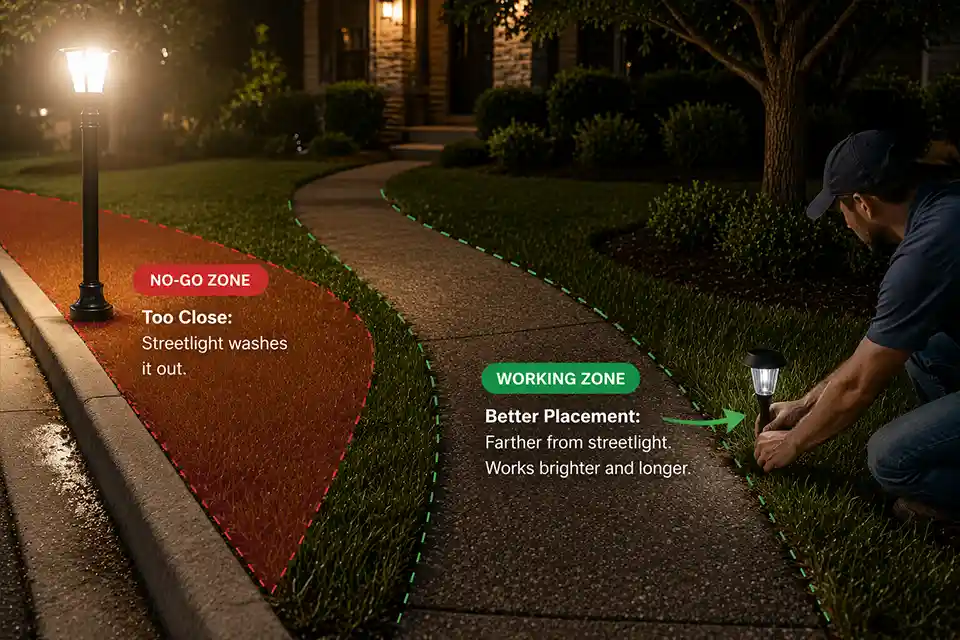
This is the highest-value move. Shift one light 10 to 15 feet farther from the curb or behind something that interrupts the light path, then leave it there for one full night. If that test unit behaves normally, the site has already answered the question for you.
Change sensor exposure, not just panel exposure
This is the part many guides undersell. More sun on the panel is not the only goal. Less artificial light on the sensor is often the bigger win. Some fixtures only need a quarter turn so the sensor side faces away from the streetlight.
Use a small shield only if it solves one problem without creating another
A narrow baffle can help if it blocks the sensor’s view of the streetlight without shading the panel during the day. The fix stops making sense when the shield improves nighttime activation but cuts daytime charging enough to shorten runtime. That tradeoff shows up in other placement mistakes too, especially the kind seen in Solar Path Lights Losing Charge Under Roof Overhangs.
Pro Tip: Test after midnight as well as right after dusk. Some sites are brightest in the early evening, and a later check can reveal whether the fixture is failing all night or only during the strongest spill-light window.
When the standard fix stops making sense
You are fighting the site, not the light
If you have tried 2 or 3 alternate positions, confirmed the light works only when covered or moved well away from the streetlight, and still cannot get reliable operation where you actually need it, stop treating this like a small maintenance issue.
The highest-risk layouts look similar
Open front yards, corner lots, wide pale driveways, low landscaping, and fixtures placed close to the curb are the most likely to struggle. If the first few fixtures fail and the deeper ones work, that pattern is usually environmental, not random.
When to stop tweaking and change solution type
If the area stays bright all night and the fixture needs shielding tricks just to behave, the product type may be mismatched to the location. At that point, Best Solutions for Solar Lights Not Turning On at Night is the better next step than another round of minor adjustments.
Comparison guide
| Symptom pattern | More likely cause | Best next move |
|---|---|---|
| Stays off near streetlight but turns on when covered in 30–60 seconds | Ambient light interference | Reposition, rotate, or shield sensor exposure |
| Turns on normally but dies in under 1–2 hours | Weak charge or aging battery | Check sun exposure, panel condition, battery health |
| Only the first 1–3 fixtures in a row fail | Site-specific spill light or reflection | Map the light path near curb, driveway, or wall |
| Works in a dark test spot but not in original location | Placement problem | Stop replacing parts first |
| Stays inconsistent everywhere | Internal fault, corrosion, or moisture | Inspect contacts and housing |
Sudden lighting failure can be frustrating, but this breakdown of why outdoor solar lights stop working makes troubleshooting easier.
Questions people usually ask
Can a streetlight really stop a solar light from turning on all night?
Yes. If the sensor never sees a dark enough condition, the light may stay in daytime mode even when the panel and battery are otherwise fine.
Why do only the lights closest to the street stay off?
Because the light environment is uneven. The nearest fixtures usually get the strongest direct spill and reflected light, while the deeper fixtures finally see enough darkness to activate.
Will covering the sensor permanently solve it?
Usually not. It is a good test, and a very small shield can sometimes help, but a permanent cover often makes the light turn on too early or behave inconsistently.
For broader official guidance on outdoor lighting controls, see the U.S. Department of Energy.