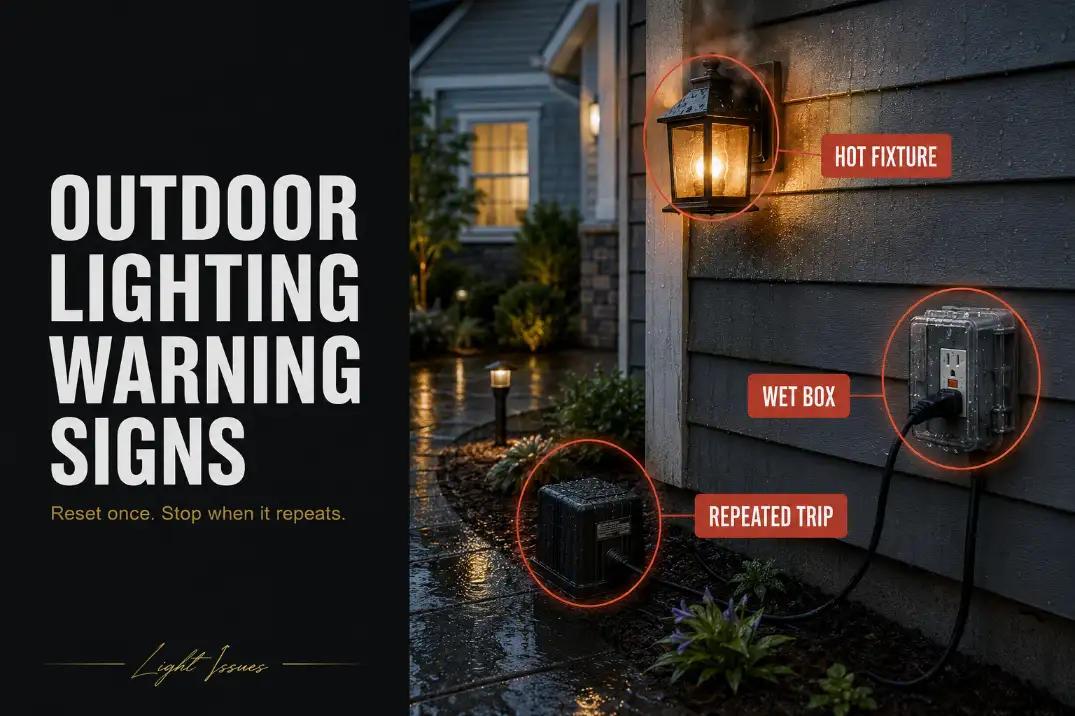
Outdoor lighting problems need an electrician when the failure moves beyond a bulb, timer, photocell, or loose low-voltage fixture.
The strongest warning signs are repeated breaker or GFCI trips, heat, burning smell, buzzing, water inside an electrical box, damaged cable, or a whole lighting zone that fails even though the power source is working.
A single dead 12-volt path light is usually a local problem. A 120-volt wall light, post light, floodlight, outlet, or junction box that trips twice is a safety boundary.
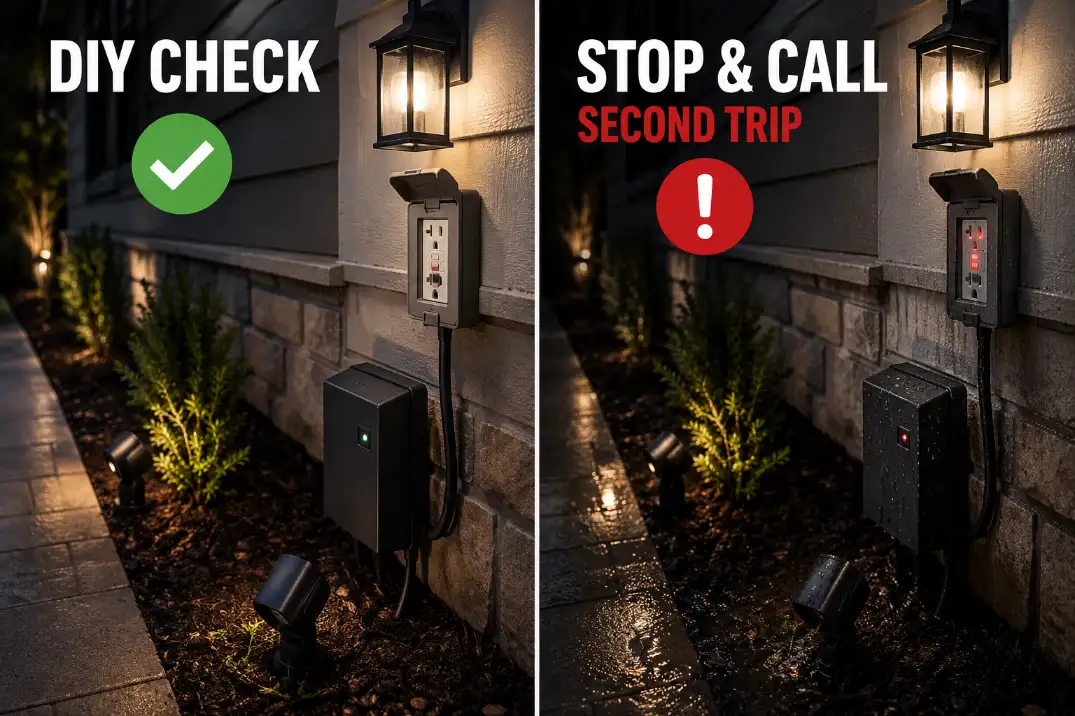
The safest rule is simple: check the easy things once, but do not keep proving the failure. If an outdoor GFCI trips again within minutes, after the next rain, or within 24–48 hours of drying out, treat it as a fault signal.
The visible symptom may be “lights not working,” but the mechanism may be current leakage, wet wiring, a failing driver, or damaged cable.
Is This a DIY Check, a Scheduled Repair, or a Stop-Now Problem?
Check these first if there are no warning signs
Some outdoor lighting problems are still reasonable homeowner checks. Replace a known-bad bulb, confirm the switch is on, check the timer, clean a dirty photocell, reset a GFCI once, and make sure a low-voltage transformer is plugged in and set to the right mode.
For low-voltage landscape lighting, one dark fixture usually starts with the lamp, socket, connector, or fixture. That is different from a whole section going out.
A single failed light is local; six lights going dark after the same point usually means the power path has failed upstream.
Schedule help when the pattern repeats
A problem becomes professional-level when it repeats under the same condition. If lights fail after rain, after irrigation runs, after 30–60 minutes of operation, or only when one zone turns on, the timing is diagnostic. Repeating patterns usually point to moisture, heat, load, cable damage, or a weak connection.
Do not overestimate a bulb replacement here. A new bulb can make a bad connection look fixed for one night, then the same failure returns.
Stop now when heat, smell, or tripping appears
Call an electrician immediately if you notice burning odor, buzzing, arcing, melted plastic, a hot fixture box, a breaker that trips again, or a GFCI that will not stay reset. A fixture that becomes uncomfortable to touch after 10–15 minutes is not just “running warm.” That is a reason to turn off the affected circuit and stop troubleshooting.
If there is smoke, active sparking, or a strong burning smell that does not stop after power is turned off, treat it as an emergency rather than a normal service call.
A GFCI that trips repeatedly outdoors should be treated as a safety device reporting leakage, not as an outlet that simply needs another reset.
If this is the exact pattern you are seeing, Outdoor Lights Tripping GFCI Outlets explains why repeated trips matter more than the fact that the lights briefly come back on.
The Outdoor Lighting Warning Signs That Matter Most
Repeated breaker or GFCI trips
Repeated tripping is the cleanest decision point. One reset may help you separate a temporary nuisance from a real problem. Two trips are a pattern.
If the trip happens only when outdoor lights turn on, the circuit is giving you useful information. The fault may be in a wet fixture, damaged cable, overloaded transformer, bad splice, failing driver, or line-voltage box. Resetting again does not make the system safer. It only repeats the stress.
Heat, burning smell, buzzing, or melted parts
Outdoor lights should not smell burnt, buzz loudly, arc, or soften nearby plastic. Heat is especially important around wall lights, post lights, floodlights, outlet covers, transformers, and old switch boxes. These parts can hide damage behind a clean-looking fixture face.
This is where a routine fix stops making sense. Replacing the bulb or tightening a visible screw does not solve a failing connection inside the box. Heat and odor suggest the connection or component is under electrical stress.
Water inside a box, not just fog on a lens
A little fog inside a lens can be minor. Water sitting inside a fixture, dripping from a junction box, pooling around terminals, or entering through a cable opening is different. Outdoor electrical parts are built to resist weather, not to hold water against wiring.
This is common after heavy rain, sprinkler spray, coastal moisture, or freeze-thaw movement in northern states. The light may work after a dry day and fail again after the next storm.
That recovery pattern is not reassuring; it often proves the moisture path is still open. For the fixture-level difference, Water Inside Outdoor Light Fixtures is a useful next read.
Should You Call an Electrician or a Landscape Lighting Technician?
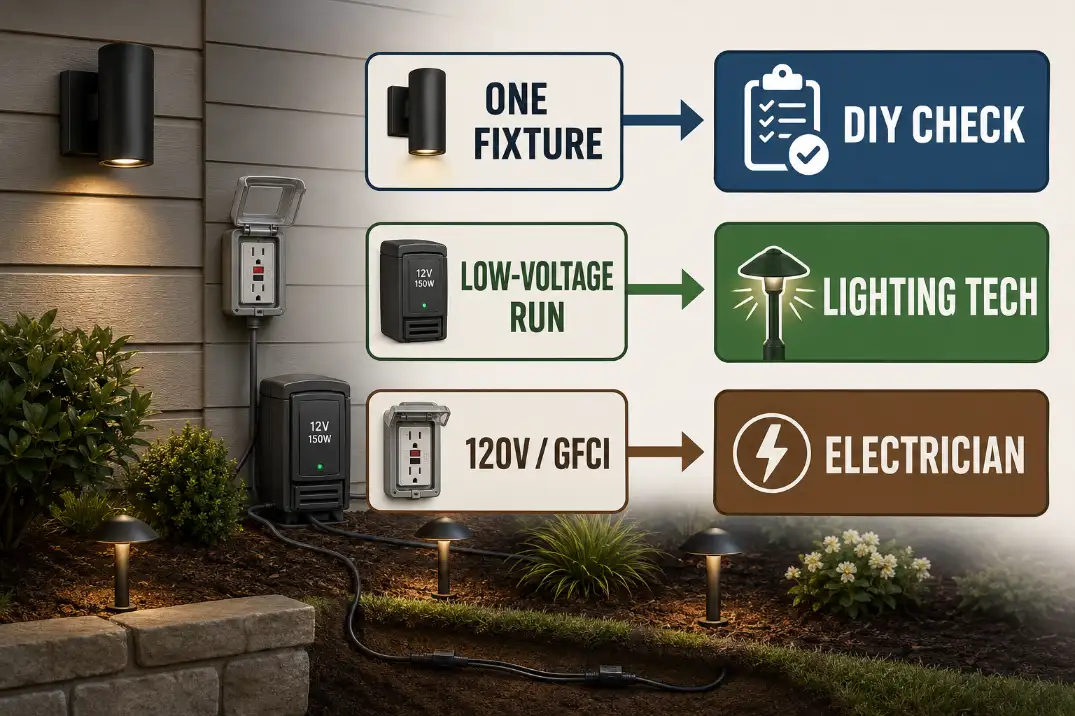
Call a licensed electrician for the 120-volt side
The electrician boundary begins when the problem touches the house-voltage side of the system. That includes breakers, GFCI outlets, wall fixture boxes, post light wiring, floodlight circuits, conduit, junction boxes, line-voltage buried cable, and the outlet feeding a landscape lighting transformer.
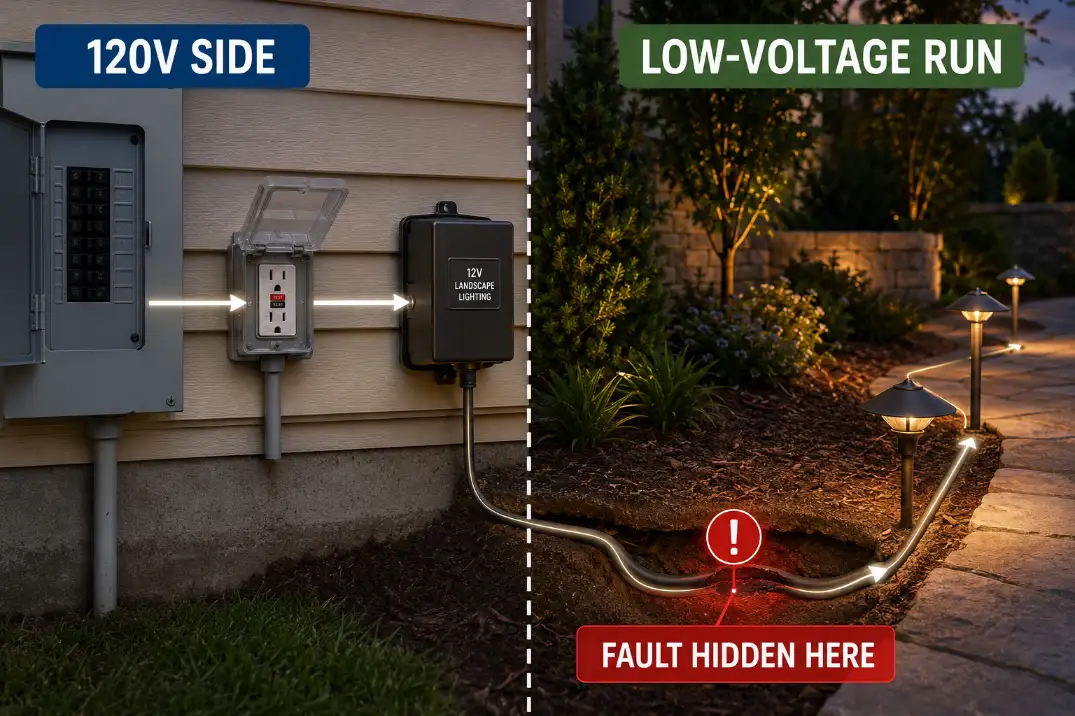
This is the part homeowners commonly underestimate. A low-voltage lighting system may be 12 volts after the transformer, but the transformer still receives 120-volt power before it steps the voltage down.
If the outlet feeding the transformer is dead, wet, hot, buzzing, or tripping, that is electrician territory.
A lighting technician may handle low-voltage layout faults
A landscape lighting technician may be the right call when the system is clearly low voltage and the issue is fixture placement, connector quality, transformer sizing, voltage drop balancing, or replacing damaged low-voltage fixtures.
The distinction is not about pride or convenience. It is about where the fault lives. Fixture aiming and low-voltage run balancing are different from opening a house-voltage box.
When unsure, treat the supply side as electrician work
If you cannot tell whether the failed part is 12 volts or 120 volts, do not guess. This is especially true for post lights, hardwired wall fixtures, older floodlights, garage-entry lights, and landscape transformers connected to exterior outlets.
A simple way to think about it: fixture layout is lighting work; power protection is electrical work.
How the Failure Pattern Tells You What Is Really Wrong
One light out is not the same as one zone out
A single dark path light, step light, or accent light usually points to a local issue. The lamp may have failed, the fixture may be wet, or the connector may have loosened.
A whole side of the yard going dark is different. That points upstream: transformer output, cable run, splice, damaged buried wire, or a fault after the last working fixture.
If the first few lights are bright and the last few are dim, voltage drop or a weak run may be involved. If everything after one point is dead, the likely problem is a break or connection failure.
For that broader system pattern, Low Voltage Landscape Lighting Problems gives a better diagnostic path than replacing fixtures one at a time.
Dim, flickering, or pulsing LED fixtures may be driver-related
With LED outdoor lights, the visible LEDs are not always the failed part. The driver controls the power the LEDs receive. When that driver weakens, the light may flicker, pulse, start dim, shut off after warming up, or fail only under certain weather conditions.
This is why replacing a fixture face or lamp can disappoint. If several fixtures on the same circuit flicker together, the problem may be upstream.
If one integrated LED fixture behaves badly while others stay stable, the driver or fixture assembly may be failing. Outdoor LED Driver Failure explains this failure pattern in more detail.
Corrosion can look minor until load exposes it
Outdoor connections fail slowly. A corroded splice may pass enough current on a dry, mild night and then fail when moisture, temperature change, or load increases. Green or white residue, blackened copper, brittle insulation, or flickering when a wire is touched are not cosmetic details.
Do not treat corrosion as something to wrap with tape and bury again. If water has reached the conductor, the connection needs a rated outdoor repair, not a temporary cover-up. For outdoor connection symptoms, see Corrosion in Outdoor Light Connections.
What Not to Do When Outdoor Lights Keep Failing
Do not keep resetting the same protective device
Repeated resets are one of the easiest ways to turn useful diagnostic information into risk. If the GFCI or breaker trips again, leave it off and investigate the cause. The device is not being stubborn; it may be preventing shock, overheating, or further damage.
Do not bypass protection or use indoor parts outdoors
Never bypass a GFCI, remove a grounding feature, replace outdoor covers with indoor covers, or use indoor extension cords as a permanent outdoor lighting solution. Outdoor outlets and boxes need weather-appropriate protection, especially where plugs remain connected during rain.
Also be cautious with missing in-use covers, cracked fixture gaskets, upward-facing cable entries, and transformers sitting low in mulch or sprinkler spray. These are not just installation details. They change how easily water reaches electrical parts.
Do not bury a questionable splice
A buried splice that is only taped, twisted, or loosely capped is likely to fail again. In a dry garage, a weak connection may show up as flicker. In a wet garden bed, it can become a recurring moisture fault.
The wasted fix is making the splice look tidy without making it weather-rated. If the failure returns after the next rain or irrigation cycle, the repair did not solve the mechanism.
Quick Decision Table
| Situation | Decision Level | Best next step | Why it matters |
|---|---|---|---|
| One low-voltage fixture is out | DIY check first | Check lamp, socket, or local connector | Usually a local failure |
| Whole lighting zone is dark | Scheduled diagnosis | Have the run, splice, or transformer checked | Points upstream |
| GFCI trips twice | Stop and call | Stop resetting and call an electrician | Repeated leakage or fault pattern |
| Fixture smells burnt, buzzes, or gets hot | Urgent stop-now problem | Turn off circuit and call now | Heat or arcing risk |
| Lights fail after rain for 24–48 hours | Scheduled diagnosis | Treat as moisture intrusion | Dry recovery does not prove safety |
| Transformer shuts down after 30–60 minutes | Scheduled diagnosis | Check load and call if repeated | Heat, overload, or downstream fault |
When the Transformer Is Part of the Problem
Repeated shutdown is not a normal reset cycle
A low-voltage transformer that shuts down once may be reacting to overload, heat, or a short. A transformer that shuts down repeatedly is not asking for another reset. It is telling you the system is outside its normal operating range.
Many residential landscape lighting systems behave better when the transformer is not loaded right to its printed maximum. A transformer running near its limit has less room for added resistance, long wire runs, heat, wet connectors, or future fixtures.
For a deeper transformer-specific diagnosis, Transformer Problems in Low Voltage Lighting Systems is the better place to continue.
Bigger is not always the safer fix
Upgrading to a larger transformer can be the wrong move if the existing transformer is shutting down because of a short, wet splice, or damaged cable. More capacity does not repair the fault. It can hide the warning sign until something else fails.
Pro Tip: If a transformer fails only after the system has been on for 30–60 minutes, think heat and load before you blame the timer.
What to Do Before the Electrician Arrives
Make the failure traceable
Do not keep testing the circuit by resetting it repeatedly. Instead, write down when the problem happens. Useful details include whether it fails immediately, after 10 minutes, after 1 hour, after rain, after irrigation, or only when one switch or lighting zone is used.
Take photos of the fixture, GFCI outlet, transformer label, breaker label, visible cable route, wet areas, corrosion, and the point where working lights stop and dead lights begin. Those details help separate a fixture problem from a power-path problem.
Turn off the affected circuit when warning signs appear
If you smell burning, see melted plastic, hear buzzing, find water in a box, or get repeated trips, turn off the affected switch or breaker and leave it off. That is not overreacting. It preserves the failure pattern without repeatedly energizing a suspect circuit.
The goal is not to prove that the lights can fail again. The goal is to prevent a repairable fault from becoming a shock or fire risk.
Questions People Usually Ask
Should I call an electrician if only one outdoor light is not working?
Not always. One failed low-voltage fixture can be a lamp, connector, socket, or fixture issue. Call when the replacement fails again, the fixture is wet or hot, the circuit trips, or the light is a hardwired 120-volt wall, post, or floodlight fixture you would need to open.
Is it safe to reset an outdoor GFCI?
Reset it once if there is no burning smell, standing water, visible damage, or exposed wiring. If it trips again immediately or repeats after rain, stop resetting it and call an electrician.
Do low-voltage landscape lights always need an electrician?
No. Simple low-voltage fixture checks, aiming, lamp replacement, and some connector work may be handled without an electrician if you know the system is low voltage. The 120-volt supply side, GFCI outlet, breaker, wall box, and repeated transformer shutdowns are different.
When is replacement smarter than repair?
Replacement is smarter when the fixture is cracked, waterlogged, corroded inside, heat-damaged, or repeatedly failing after short-term fixes. Repair makes less sense when the housing no longer protects the wiring from weather.
Final Takeaway
Call an electrician when the outdoor lighting problem stops behaving like a fixture issue and starts behaving like a power, moisture, heat, or protection-device issue.
A dead bulb is a symptom. A repeated trip, wet box, hot fixture, damaged cable, or failing transformer is the mechanism that changes the decision.
For broader official outdoor electrical safety guidance, see the Electrical Safety Foundation International.