Landscape Transformer Gets Hot and Keeps Resetting
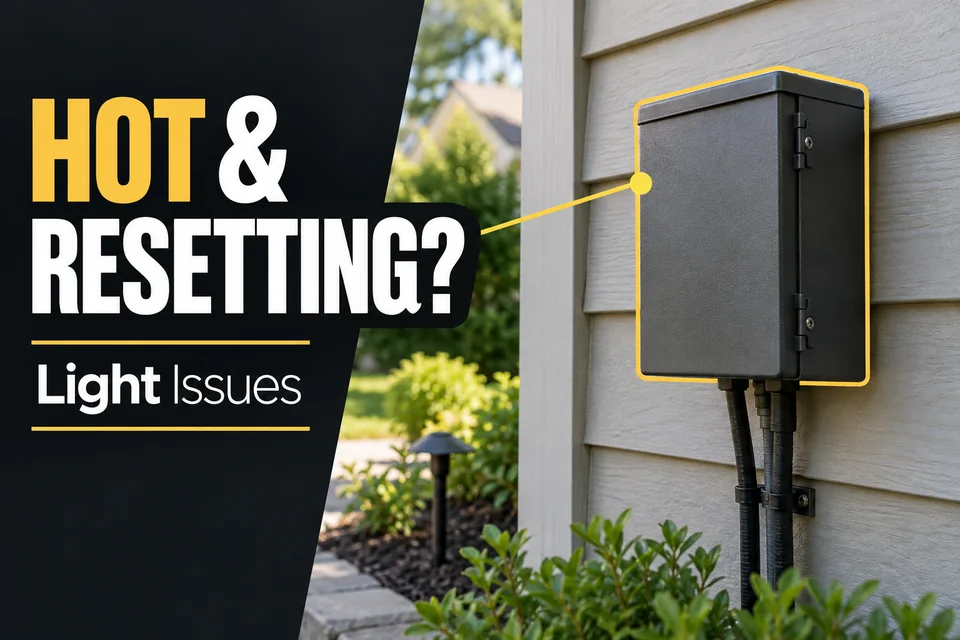
Closed landscape-lighting transformer mounted on an exterior wall with its housing highlighted.

Your landscape lights come on, the transformer warms up, and the entire system shuts down. Later, the lights return without anyone changing the controls. That recovery can mean a protective device has reset while the condition that triggered it remains. The useful decision is whether to correct connected load or installation conditions, investigate a particular … Read more
Landscape Transformer Hums Much Louder Than It Used To

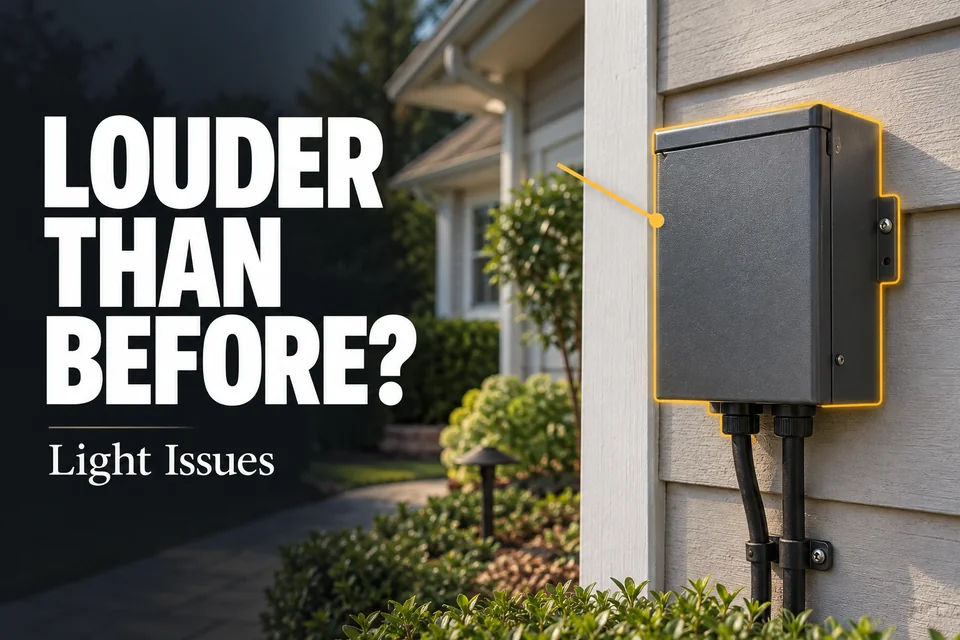
Closed landscape-lighting transformer mounted on an exterior wall, with its housing highlighted.

The landscape transformer used to disappear into the background. Now you hear it from the patio, beside the garage, or through the wall—even though the lights still come on. The first decision is whether the louder hum follows an identifiable change or remains unexplained. Added lights, replacement lamps, or a loosened mounting point give you … Read more

Smart Outdoor Lighting Zones for Timers and Sensors

Home exterior divided into separate entry, security, patio, path, and quiet lighting zones.

Outdoor lights are often grouped by proximity: every fixture at the front of the house becomes one group, while everything behind the house becomes another. That looks tidy in an app, but it rarely reflects how the property works after dark. A door landing may need a low, steady baseline. A side gate may need … Read more

Smart Patio Lights That Feel Random

Smart patio lights showing mismatched colors, brightness levels, and zone states caused by overlapping saved scenes.

The dining lights return in warm white, the step lights stay blue, and the seating zone comes on at yesterday’s dim setting. Nothing is obviously broken, but the patio no longer produces the same result twice. That behavior is rarely random. A saved scene, partial zone command, color mode, or manual adjustment usually explains each … Read more

Smart Outdoor Lighting Automations That Conflict

Conflicting smart lighting automations controlling the outdoor lights of a home.

A smart outdoor light turns on correctly at dusk. Motion raises its brightness, but when the motion period ends, the fixture switches off even though the evening schedule should still be active. You restore it manually, and a later scene changes it again. That sequence looks unreliable, but it can mean the light is executing … Read more

Repair or Replace Outdoor Lights? How to Decide

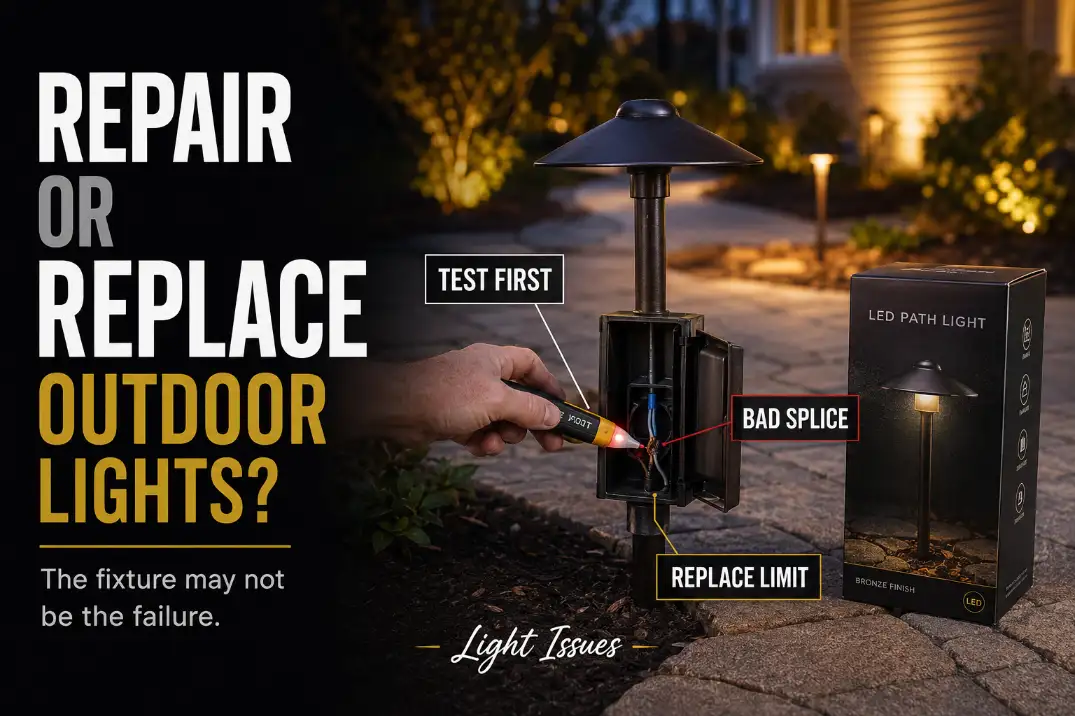
Outdoor light repair or replacement decision scene showing a failing fixture, voltage tester, bad splice, and boxed replacement light.

A stopped outdoor light is not automatically a bad fixture. The repair-or-replace decision depends on where the failure sits: upstream in the power source, beside the fixture at a splice or socket, or inside the fixture body itself. Several lights failing together usually point to a system fault. One wet, cracked, overheated, or repeatedly failing … Read more

Daisy Chain vs Hub Landscape Lighting

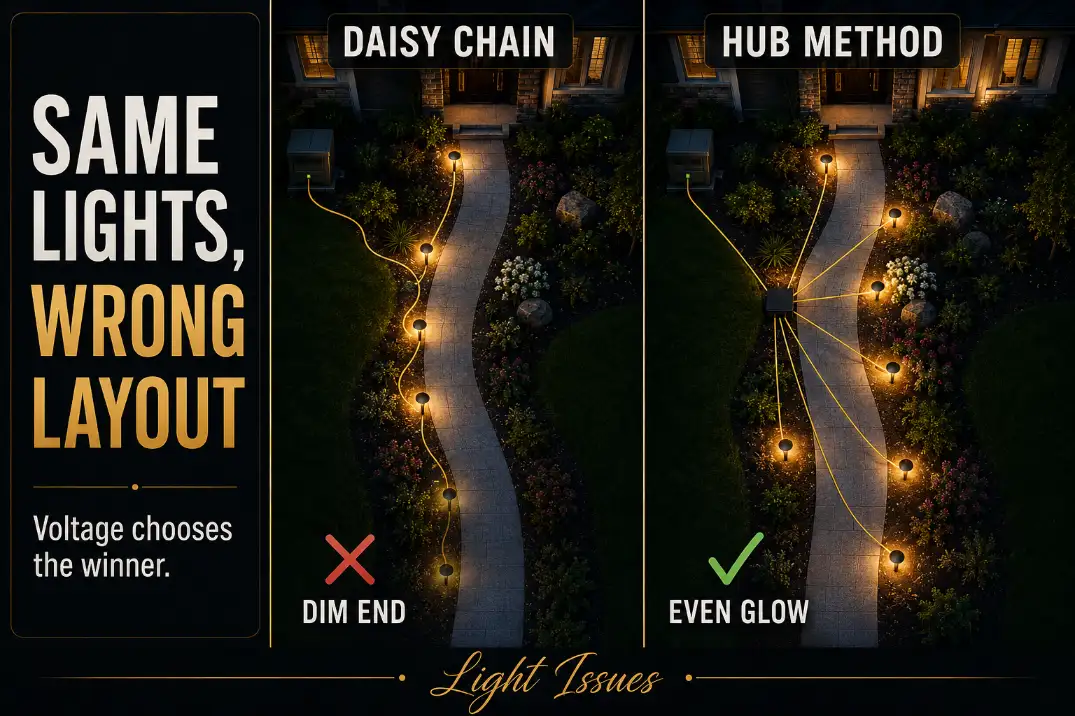
Daisy chain versus hub landscape lighting layout showing the same path lights dimming at the end of one cable run but staying balanced from a hub.

Low-voltage landscape lighting usually shows wiring problems as uneven brightness before it shows a complete failure. The last path lights look weaker, one side of the yard never matches the other, or a few fixtures flicker after 20–60 minutes of runtime. That does not automatically mean the transformer is too small or the fixtures are … Read more

How Many Landscape Lights Can You Put on One Cable Run?

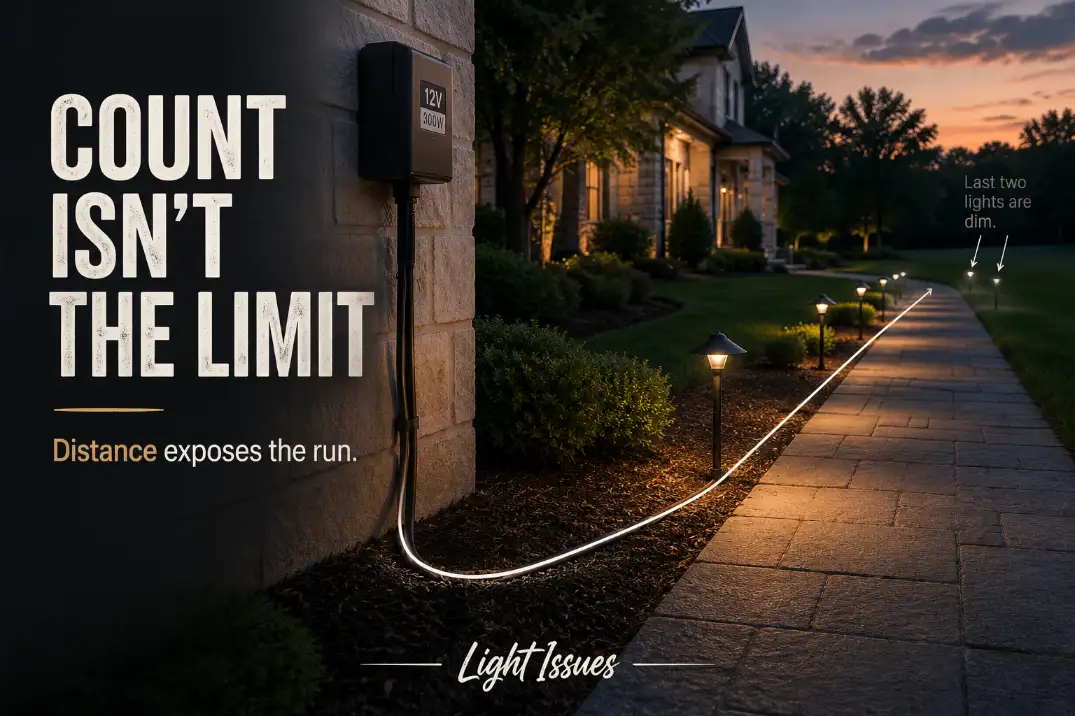
Low-voltage landscape lighting cable run with bright first path lights and weak far-end lights showing that distance limits fixture count.

A low-voltage landscape lighting cable run does not have one universal fixture limit. The run starts failing when the last fixture no longer receives usable voltage. As a practical planning range, many short LED path-light runs can handle about 8–12 low-watt fixtures, while a long 100–150 ft run may be safer with 4–8 fixtures, depending … Read more